Bulgaria.
Bulgaria is a historically Orthodox nation whose autocephalous Bulgarian Orthodox Church — Patriarchate of Bulgaria — was the first Slavic patriarchate, founded after the 9th-century baptism of Tsar Boris I.
Orthodoxy in
Bulgaria.
A living tradition — its history, its faithful, its sacred places.
Bulgaria is one of the oldest Orthodox lands in the Slavic world. The country was formally Christianised in the 860s, when Khan Boris I accepted baptism from Byzantine clergy and established Eastern Christianity as the religion of his state. A mission from the Patriarch of Constantinople Photios arrived at the Bulgarian capital Pliska in the late autumn of 864 and baptised the ruler, his family and the leading nobles, giving Boris the Christian name Michael.
Origins and the first Bulgarian Patriarchate
After the disciples of Saints Cyril and Methodius were received in Bulgaria, the country became the chief centre of Slavonic letters and Orthodox worship in Slavic lands. In 927 Bulgaria obtained its own patriarchate — the first autocephalous Slavic Orthodox Church, preceding the autocephaly of the Serbian Church by nearly three centuries and of the Russian Church by more than six. The patriarchate functioned through the First and Second Bulgarian Empires, with seats at Preslav, Ohrid, and finally Tarnovo, before being abolished after the Ottoman conquest.
From Ottoman rule to the modern Church
Under Ottoman rule Bulgarian Orthodox Christians were placed under the Ecumenical Patriarchate of Constantinople. National church life was restored in 1870 with the establishment of the Bulgarian Exarchate, though a schism with Constantinople followed. The schism was lifted in 1945, when the Ecumenical Patriarch recognised the autocephaly of the Bulgarian Church. In 1953 the Holy Synod restored the patriarchal dignity, elevating the Metropolitan of Sofia to Patriarch, and Constantinople formally recognised this status in 1961.
Twentieth century and present day
Under communist rule (1944–1989) the Church suffered heavy restrictions and state surveillance, and in the 1990s was shaken by an internal schism that was canonically resolved in the early 2000s. Since then the Bulgarian Orthodox Church has reorganised itself as the spiritual mother of the nation.
Primate: His Holiness Daniil, Metropolitan of Sofia and Patriarch of All Bulgaria, elected on 30 June 2024 by the Patriarchal Electoral Church Council following the repose of Patriarch Neofit.
Structure: 13 dioceses inside Bulgaria and two abroad (in the United States and Western/Central Europe), divided into some 58 church counties and about 2,600 parishes.
Orthodox population: According to the 2021 census, approximately 4.1 million Bulgarians identify as Eastern Orthodox Christians, the overwhelming majority belonging to the Bulgarian Orthodox Church.
Great lavras such as Rila Monastery, Bachkovo, and Troyan remain living centres of prayer and pilgrimage, while the Patriarchal Cathedral of St Alexander Nevsky in Sofia stands as the spiritual heart of the nation. Orthodox Christianity remains closely tied to Bulgarian cultural, linguistic, and historical identity.
Saints of
Bulgaria.
3 venerated souls with ties to this land — fathers and mothers of the faith who are remembered here still.
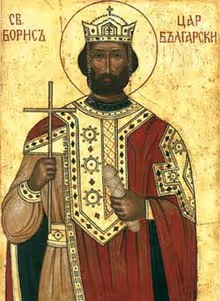

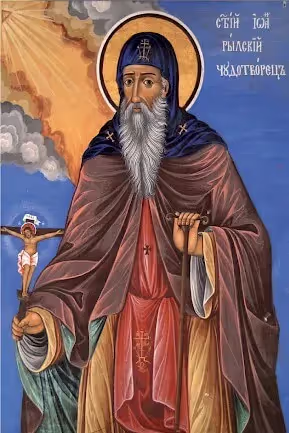
Famous Orthodox churches and monasteries in Bulgaria
The sacred architecture of Orthodox Bulgaria — cathedrals, parishes, and the mountain monasteries that keep the lamps burning.
- Patriarchal Cathedral of St Alexander Nevsky (Sofia) — The cathedral of the Patriarch of Bulgaria and the largest Orthodox church on the Balkan Peninsula. Its cornerstone was laid in 1882, and it was built in honour of the Russian soldiers who fell in the Russo-Turkish War of 1877–78, which liberated Bulgaria from Ottoman rule. It is among the ten largest Eastern Orthodox church buildings in the world.
- Rila Monastery of St John of Rila — Founded in the 10th century by the hermit St John of Rila, patron saint of Bulgaria, and long the heart of Bulgarian spiritual and cultural life. It is inscribed on the UNESCO World Heritage List and remains the largest and most revered monastery in the country.
- Bachkovo Monastery of the Dormition of the Theotokos — Founded in 1083 by the Georgian-Byzantine statesman Gregory Pakourianos near Plovdiv, it is the second-largest monastery in Bulgaria and renowned for its medieval frescoes and its unique blend of Georgian, Byzantine, and Bulgarian Orthodox heritage.
- Boyana Church (Saints Nicholas and Panteleimon), Sofia — A small medieval church famous for its 1259 frescoes, among the finest surviving works of Eastern Orthodox art before the Palaiologan revival. It has been inscribed on the UNESCO World Heritage List since 1979.
- Troyan Monastery of the Dormition of the Most Holy Theotokos — The third-largest monastery in Bulgaria, founded no later than the end of the 16th century in the Balkan Mountains. It is famed for its wonder-working icon of the Most Holy Theotokos "Troeruchitsa" (the Three-Handed).
Orthodoxy
kept here.
The shape of the faith as it is lived and prayed across Bulgaria today.
Orthodoxy in Bulgaria is embodied in the Bulgarian Orthodox Church – Patriarchate of Bulgaria, one of the nine historical patriarchates of the Eastern Orthodox communion and the first autocephalous Slavic Church. The primatial see is Sofia, and the current primate is His Holiness Patriarch Daniil, elected in 2024. The liturgical language is Church Slavonic, the same sacred tongue whose foundations were laid in Bulgaria itself by the disciples of Saints Cyril and Methodius, though modern Bulgarian is also used in homilies and certain prayers.
The Church comprises 13 dioceses within Bulgaria and two diocesan jurisdictions abroad, covering Bulgarian Orthodox communities in Western and Central Europe and in the Americas. Approximately 2,600 parishes are served by around 1,500 priests, alongside a small but significant monastic presence at houses such as Rila, Bachkovo, and Troyan.
Bulgaria is constitutionally a secular state, but Eastern Orthodox Christianity is recognised by law as the country's traditional religion, reflecting its deep historical role in preserving Bulgarian identity under Ottoman rule and during the National Revival. Major feasts — Pascha, the Nativity of Christ, the Dormition of the Theotokos, the feasts of St John of Rila (patron of the nation), and Saints Cyril and Methodius (24 May) — are woven into national life.
The Bulgarian Orthodox Church is in full canonical communion with all the other Eastern Orthodox autocephalous churches. It should not be confused with the Oriental Orthodox churches (such as the Armenian Apostolic or Coptic), which are not in communion with the Ecumenical Patriarchate and have only a small immigrant presence in the country.
Asked
of this land.
Frequently asked questions about Orthodoxy in Bulgaria
When did Bulgaria become Orthodox?
Bulgaria was Christianised in the 860s. In 864, Khan Boris I was baptised at Pliska by clergy sent from the Patriarch of Constantinople Photios, and Eastern Christianity became the religion of the Bulgarian state.
Is the Bulgarian Orthodox Church autocephalous?
Yes. A Bulgarian patriarchate was first established in 927, making it the first autocephalous Slavic Orthodox Church. After centuries of Ottoman rule and a 19th-century schism with Constantinople, autocephaly was re-recognised by the Ecumenical Patriarchate in 1945, and the patriarchal dignity was restored in 1953.
Who is the current Patriarch of Bulgaria?
His Holiness Daniil, Metropolitan of Sofia and Patriarch of All Bulgaria, elected on 30 June 2024 by the Patriarchal Electoral Church Council. He succeeded Patriarch Neofit, who reposed in March 2024.
How many Orthodox Christians live in Bulgaria?
According to the 2021 national census, about 4.1 million people in Bulgaria identify as Eastern Orthodox Christians, making Orthodoxy by far the largest religion in the country. The great majority belong to the Bulgarian Orthodox Church.
What language is used in the Divine Liturgy?
The traditional liturgical language is Church Slavonic, with portions also served in modern Bulgarian. Bulgaria is the historical cradle of Slavonic Orthodox worship, which developed from the mission of Saints Cyril and Methodius and their disciples.
How is the Church organised?
The Bulgarian Orthodox Church has 13 dioceses within Bulgaria and two abroad (serving diaspora communities in Western/Central Europe and North America), divided into 58 church counties and approximately 2,600 parishes.