Romania.
Romania is an overwhelmingly Orthodox nation, home to the autocephalous Romanian Orthodox Church (Biserica Ortodoxă Română), one of the largest Orthodox Churches in the world and the only autocephalous Church to use a Romance language for its liturgy.
Orthodoxy in
Romania.
A living tradition — its history, its faithful, its sacred places.
Eastern Orthodoxy in Romania
Romania is one of the heartlands of Eastern Orthodox Christianity. The Romanian Orthodox Church (Biserica Ortodoxă Română) is an autocephalous patriarchate in full communion with the other canonical Orthodox Churches and is the largest autocephalous Eastern Orthodox body in the Balkans. According to tradition, Christianity reached the lands of ancient Dacia through the preaching of the Apostle Andrew, who is venerated today as the protector of Romania.
From Metropolis to Patriarchate
For centuries, the Romanian principalities of Wallachia, Moldavia and Transylvania lived under the spiritual care of the Ecumenical Patriarchate of Constantinople. Following the union of Wallachia and Moldavia, the Romanian Church unilaterally declared its autocephaly in 1865, and this status was formally recognised by the Ecumenical Patriarchate in 1885 with the issuance of a Tomos. In 1925, after the Great Union of 1918 brought Transylvania, Bessarabia and Bukovina into the Romanian state, the Church was raised to the rank of patriarchate, and its primate has since borne the title of Patriarch of All Romania.
The Communist Era and Revival
During the communist period (1947–1989) the Church suffered heavily: thousands of monks and nuns were expelled from monasteries, clergy were imprisoned, and the related Romanian Greek Catholic Church was forcibly absorbed into Orthodoxy. After the 1989 revolution, monastic life and parish activity revived dramatically. Hundreds of new churches have been built, theological faculties and seminaries have reopened, and philanthropic, catechetical and media work have flourished under the current primate, Patriarch Daniel.
Jurisdiction and Structure
The Patriarchate’s canonical territory covers Romania and the Republic of Moldova (through the Metropolis of Bessarabia), with additional dioceses serving Romanians in Ukraine, Serbia, Hungary, Western and Central Europe, the Americas and Oceania. The Holy Synod, presided over by the Patriarch, is the supreme authority. The Church is organised into six metropolitan provinces within the country and several abroad, with the Metropolis of Wallachia centred in Bucharest as its heart.
Orthodoxy Today
Orthodoxy remains central to Romanian national identity. Major feasts such as Pascha, the Dormition, the Nativity, and the feast of Saint Andrew the Apostle (30 November) are observed as public and cultural events. Popular devotion to relics — including those of Saint Parascheva of Iași, Saint Demetrius the New of Bucharest, Saint Nektarios, and Saint John the New of Suceava — draws enormous pilgrimages each year. The opening of the new National Cathedral of Romania in Bucharest, with its altar consecrated in 2018 and its interior mosaic consecrated in 2025, marks a major milestone in the modern life of the Romanian Church.
For the faithful, Romanian Orthodoxy preserves a distinctive blend of Byzantine, Slavonic and Latin heritage — expressed in its vivid painted monasteries, its rich hesychast tradition associated with figures such as Saint Paisius Velichkovsky of Neamț, and its vernacular liturgy chanted in Romanian.
Saints of
Romania.
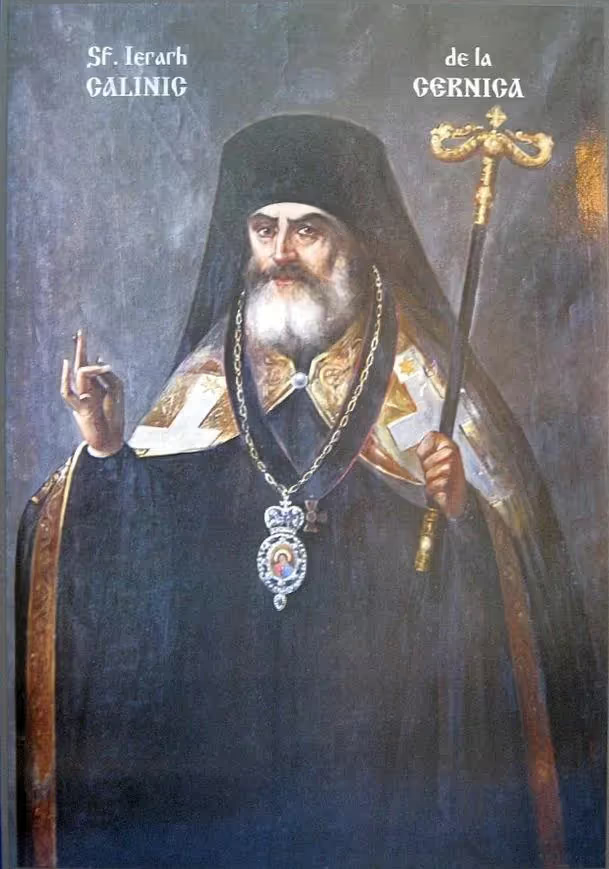
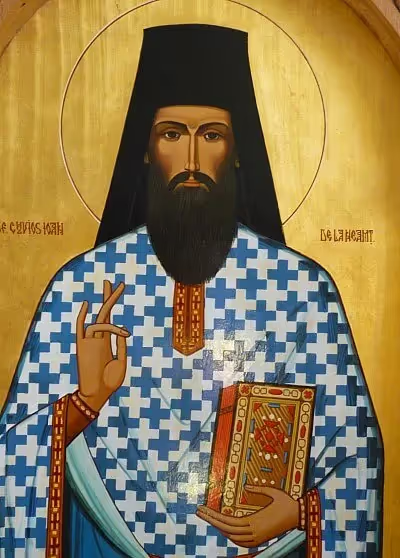
2 venerated souls with ties to this land — fathers and mothers of the faith who are remembered here still.
Famous Orthodox churches and monasteries in Romania
The sacred architecture of Orthodox Romania — cathedrals, parishes, and the mountain monasteries that keep the lamps burning.
- Patriarchal Cathedral of Saints Constantine and Helena (Bucharest) — The historic seat of the Patriarch of Romania, built between 1655 and 1659 under Prince Constantin Șerban in the Brâncovenesc style. It has served as metropolitan cathedral since 1668 and as patriarchal cathedral since 1925.
- National Cathedral of Romania (Bucharest) — The new patriarchal cathedral, dedicated to the Ascension of the Lord and to Saint Andrew the Apostle, protector of Romania. Its altar was consecrated in 2018 by Ecumenical Patriarch Bartholomew and Patriarch Daniel, and its interior mosaic was consecrated in 2025.
- Voroneț Monastery (Suceava County) — Dedicated to Saint George and built in 1488 by Saint Stephen the Great to commemorate his victory at the Battle of Vaslui. Famous for its exterior frescoes and the deep azure known as "Voroneț Blue," it is often called the "Sistine Chapel of the East."
- Putna Monastery (Suceava County) — Founded between 1466 and 1469 by Saint Stephen the Great, who is buried within its walls. One of the most important pilgrimage and cultural centres of the Romanian Orthodox Church.
- Neamț Monastery (Neamț County) — One of the oldest and most venerable monasteries in Moldavia, and the great centre of Romanian manuscript culture. It is intimately linked with Saint Paisius (Velichkovsky), the 18th-century father of modern Orthodox hesychasm, who served there as abbot until his repose in 1794.
- Sucevița Monastery (Suceava County) — A late-16th-century fortified painted monastery of Bukovina, part of the UNESCO-listed group of painted churches of northern Moldavia, renowned for its fresco cycle of the "Ladder of Divine Ascent."
Orthodoxy
kept here.
The shape of the faith as it is lived and prayed across Romania today.
The Romanian Orthodox Church is an autocephalous patriarchate of the Eastern Orthodox communion. Its autocephaly was declared by the Romanian state in 1865 and recognised by the Ecumenical Patriarchate of Constantinople in 1885; it was elevated to a patriarchate in 1925. It is the only autocephalous Orthodox Church in the world to use a Romance language — Romanian — as its principal liturgical language.
Orthodoxy is by far the dominant faith in Romania. In the 2021 national census, approximately 14.03 million Romanians (about 73.4% of the total population) declared themselves members of the Romanian Orthodox Church, making it one of the largest Orthodox populations in the world. Several million additional faithful live in Moldova, Ukraine, the European Union, North America and elsewhere under the jurisdiction of the Patriarchate.
Relations between Church and state are regulated by law: the Romanian constitution guarantees religious freedom, but Orthodoxy enjoys a recognised place as the majority faith and its clergy receive partial state support. Religious education is offered in public schools, and major ecclesiastical feasts are widely observed. The Church maintains an extensive monastic network — including the celebrated painted monasteries of Bukovina — and a vibrant tradition of hesychastic spirituality associated especially with the Neamț–Sihăstria lineage.
Abroad, the Romanian Patriarchate organises its diaspora through metropolias and dioceses in Western and Central Europe, the Americas, and Australia–Oceania, serving the large post-1989 Romanian emigration while cooperating with sister Orthodox jurisdictions locally.
Asked
of this land.
Frequently asked questions about Orthodoxy in Romania
Is Romania an Orthodox country?
Yes. The overwhelming majority of Romanians belong to the Romanian Orthodox Church. In the 2021 census, about 73.4% of the population (some 14 million people) identified as Orthodox Christians, making Orthodoxy by far the largest religious community in the country.
Is the Romanian Orthodox Church canonical and autocephalous?
Yes. The Romanian Orthodox Church is a fully canonical, autocephalous Eastern Orthodox Church in communion with the Ecumenical Patriarchate of Constantinople and the other Orthodox patriarchates. Its autocephaly was recognised by Constantinople in 1885, and it was elevated to the rank of patriarchate in 1925.
What language is used in Romanian Orthodox services?
The Divine Liturgy and other services are celebrated in Romanian. The Romanian Orthodox Church is the only autocephalous Orthodox Church to use a Romance language as its principal liturgical language, although Church Slavonic and Greek were historically used in earlier centuries.
Who is the head of the Romanian Orthodox Church?
The head of the Church is the Patriarch of All Romania, who presides over the Holy Synod and resides in Bucharest. Since 2007, the primate has been His Beatitude Patriarch Daniel (Ciobotea).
What is the National Cathedral in Bucharest?
The National Cathedral of Romania (also called the People’s Salvation Cathedral, Catedrala Mântuirii Neamului) is a monumental new patriarchal cathedral in Bucharest. It is dedicated to the Ascension of the Lord and to Saint Andrew the Apostle, protector of Romania; its altar was consecrated in 2018 and its mosaic interior in 2025.
What about the Republic of Moldova?
The Romanian Patriarchate's jurisdiction extends to Moldova through the Metropolis of Bessarabia, which exists alongside the Moldovan Orthodox Church under the Patriarchate of Moscow. Both are canonical Orthodox structures, and the situation reflects Moldova's layered historical ties.