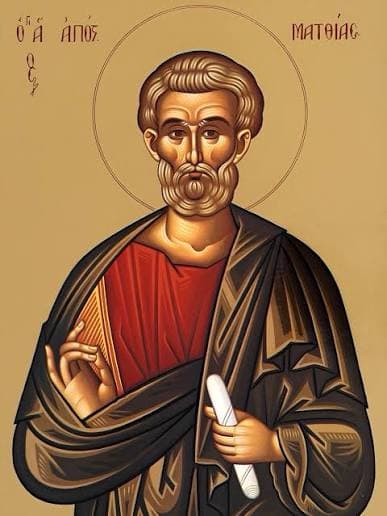
Saint Apostle Matthias.
Also known as Matthias the Apostle, Saint Matthias of the Twelve, Holy Apostle Matthias, Matthias of Jerusalem, Matthias who replaced Judas
After the Ascension of the Savior, Saint Matthias was chosen by lot to replace Judas Iscariot as one of the Twelve Apostles, and after the Descent of the Holy Spirit, he preached the Gospel at Jerusalem and in Judea together with the other Apostles.
Tone 3
O holy Apostle Matthias,
Pray to the merciful God,
That He may grant to our souls
Remission of our transgressions!
The Twelfth
Apostle Chosen by Lot
Apostle Matthias holds a unique place among the Twelve: he was chosen not by Jesus during His earthly ministry, but by the early Church through prayer and the casting of lots after the Ascension, to replace the traitor Judas Iscariot. Though he remains one of the most overlooked apostles in Scripture, Orthodox Tradition preserves a rich account of his missionary labors across Judea, Cappadocia, and Ethiopia, his miraculous signs and wonders, and his faithful martyrdom for Christ.
Early years
The Holy Apostle Matthias was born at Bethlehem of the Tribe of Judah, and from his early childhood he studied the Law of God under the guidance of Saint Simeon the God-Receiver. Unlike the other apostles, Matthias receives no mention in the Gospels themselves, yet when the Lord Jesus Christ revealed Himself to the world, Saint Matthias believed in Him as the Messiah, followed constantly after Him and was numbered among the Seventy Apostles, whom the Lord sent them two by two before His face. He had been with Jesus from his baptism by John until Jesus's Ascension.
In the Church
After the Ascension of the Savior, Saint Matthias was chosen by lot to replace Judas Iscariot as one of the Twelve Apostles. This unique calling underscores the Church's faith that lots were cast; Matthias was chosen, and soon after his election, Matthias received the Holy Spirit with the other disciples at Pentecost. After the Descent of the Holy Spirit, the Apostle Matthias preached the Gospel at Jerusalem and in Judea together with the other Apostles. From Jerusalem he went with the Apostles Peter and Andrew to Syrian Antioch, and was in the Cappadocian city of Tianum and Sinope, where he was locked into prison and miraculously freed by Saint Andrew the First-Called, and afterwards journeyed to Amasea, a city on the shore of the sea, and during a three year journey of the Apostle Andrew, Saint Matthias was with him at Edessa and Sebaste.
Later years
According to Church Tradition, he was preaching at Pontine Ethiopia (presently Western Georgia) and Macedonia, and he was frequently subjected to deadly peril, but the Lord preserved him to preach the Gospel. Once, pagans forced the saint to drink a poison potion, and he drank it, and not only did he himself remain unharmed, but he also healed other prisoners who had been blinded by the potion, and when Saint Matthias left the prison, the pagans searched for him in vain, for he had become invisible to them. Another time, when the pagans had become enraged intending to kill the Apostle, the earth opened up and engulfed them.
The Apostle Matthias returned to Judea and did not cease to enlighten his countrymen with the light of Christ's teachings, and he worked great miracles in the Name of the Lord Jesus and he converted a great many to faith in Christ. The Jewish High Priest Ananias ordered that the Apostle Matthias be arrested and brought for judgment before the Sanhedrin at Jerusalem, where using the prophecies of the Old Testament, the Apostle Matthias demonstrated that Jesus Christ is the True God, the promised Messiah, the Son of God, Consubstantial and Coeternal with God the Father. After these words the Apostle Matthias was sentenced to death by the Sanhedrin and stoned, and when Saint Matthias was already dead, the Jews, to hide their malefaction, cut off his head as an enemy of Caesar. According to several historians, the Apostle Matthias was crucified, and indicate that he instead died at Colchis; the Apostle Matthias received the martyr's crown of glory in the year 63.
Legacy and veneration
St. Helena brought the relics of St. Matthias to Rome, and a portion of them was at Trier. According to Greek sources, the remains of the apostle are buried in the castle of Gonio-Apsaros, Georgia. Local tradition in Georgia states that Matthias was stoned to death and buried at the ruins of the Roman fortress of Gonio (Apsaros) in Adjara.
The Apostle Matthias is depicted in iconography with a battle sword placed over a book, symbolizing his struggles to preach the Gospel. His veneration throughout the Eastern Orthodox Church acknowledges him as a faithful witness to the Resurrection and a zealous missionary who paid the ultimate price of martyrdom. While preaching the Gospel message, Matthias emphasized the importance of self-control, and said that in order to experience the peace and joy that God intends, people must subordinate their physical desires to their spiritual desires.
How the saint's
memory is kept.
- When is the feast day of Apostle Matthias in the Eastern Orthodox Church?
- The feast day of Apostle Matthias is commemorated on August 9 in the Eastern Orthodox calendar.
- How was Apostle Matthias chosen as one of the Twelve?
- After the Ascension, the apostles cast lots between Matthias and Joseph Barsabbas to replace Judas Iscariot. The lot fell upon Matthias, and he was numbered with the Twelve Apostles.
- Where did Apostle Matthias preach the Gospel?
- Apostle Matthias preached in Judea and Jerusalem with the other apostles, and according to Church Tradition, also in Cappadocia, Syria, Pontine Ethiopia (Western Georgia), and Macedonia.
- What are the accounts of Apostle Matthias's martyrdom?
- According to Eastern Orthodox Tradition, Matthias was arrested in Jerusalem before the Sanhedrin, and was stoned to death, with his head cut off by the Jews. Some traditions indicate he was crucified or martyred at Colchis. He received his martyr's crown in the year 63 AD.
- What miracles are attributed to Apostle Matthias?
- Tradition records that Matthias remained unharmed when forced to drink poison, and healed other prisoners blinded by poison. He also became invisible to persecutors and the earth opened to swallow those trying to kill him.
- What is the significance of Apostle Matthias in the early Church?
- Matthias holds unique significance as the only apostle chosen after the Ascension of Christ through prayer and casting of lots, demonstrating the Church's apostolic authority and faith in God's guidance for leadership decisions.
Tone 4
O wonder-worker and Apostle Matthias,
Your words have gone out into all the world,
Enlightening men as the sun,
And giving grace to the Church
Bringing faith to heathen lands!
O Holy Apostle Matthias, intercede with the merciful God to grant our souls forgiveness of transgressions.
Through the intercession of blessed Matthias whom God numbered among the company of His apostles, grant, O Lord, that we may ever experience the tenderness of Thy love. Through our Lord Jesus Christ, Thy Son, who livest and reignest with Thee in the unity of the Holy Spirit, God, for ever and ever. Amen.
Carry the tradition with you.
Hand-finished icons, books, and calendars to carry the Orthodox day into your home.
Read a life like this
every morning.
Meet the daily saints through Orthodox Daily Companion on iPhone and iPad, or through the Lives of the Saints web app in any modern browser.
Orthodox Daily Companion
The native Apple app, with a Home Screen widget, prayer reminders, and a private on-device journal.
Download on the App StoreLives of the Saints Web App
The browser experience for desktop, tablet, or phone, with a seven-day trial of the complete devotional library.
Open the web appGet a life like this one on every new tab - free, no account, from the same catalogue.
References and further reading
- en.wikipedia.orghttps://en.wikipedia.org/wiki/Matthias_the_Apostle
- oca.orghttps://www.oca.org/saints/lives/2025/08/09/102243-apostle-matthias-of-the-seventy
- orthodoxwiki.orghttps://orthodoxwiki.org/Apostle_Matthias
- britannica.comhttps://www.britannica.com/biography/Saint-Matthias
- acrod.orghttps://www.acrod.org/orthodox-christianity/articles/saints/matthias
- stmargaretmary.orghttps://stmargaretmary.org/st-matthias-the-apostle/
- en.wikipedia.orghttps://en.wikipedia.org/wiki/Matthew_the_Apostle
- orthodoxwiki.orghttps://orthodoxwiki.org/Apostle_Matthew
- livingspace.sacredspace.iehttps://livingspace.sacredspace.ie/f0514s/
- orthodoxtimes.comhttps://orthodoxtimes.com/memory-of-st-apostle-matthias-2/
- medium.comhttps://medium.com/@klausmagnus/saints-bio-saint-matthias-5e8442b352a5
- oca.orghttps://www.oca.org/saints/lives?q=MATTHIAS
- anglicancompass.comhttps://anglicancompass.com/the-liturgical-home-st-matthias-the-apostle-who-replaced-judas/
- ewtn.comhttps://www.ewtn.com/catholicism/saints/matthias-698
- young-catholics.comhttps://young-catholics.com/8469/st-matthias-apostle/
- neamericandiocese.orghttps://www.neamericandiocese.org/feasts/feasts_details/62
- newadvent.orghttps://www.newadvent.org/cathen/10066a.htm
- vaticanstate.vahttps://www.vaticanstate.va/en/state-and-government/general-informations/saint-of-the-day/1877-may-14-saint-matthias-apostle.html
- tradcatholica.comhttps://tradcatholica.com/saint-matthias-apostle/
- christiantoday.comhttps://www.christiantoday.com/news/who-was-matthias-and-why-is-he-called-the-thirteenth-apostle
More from the tradition.
Read the Journal
Essays on feasts, fasting, and the rhythm of the Church year.
ExploreOrthodox countries
How the faith is lived and kept across the Christian world.
ExploreThe 2027 Calendar
A saint, a reading, and the day's fasting guideline for every day of 2027.
ExploreMobile & web apps
Carry the daily rhythm on iPhone and iPad or continue in the web app.
Explore