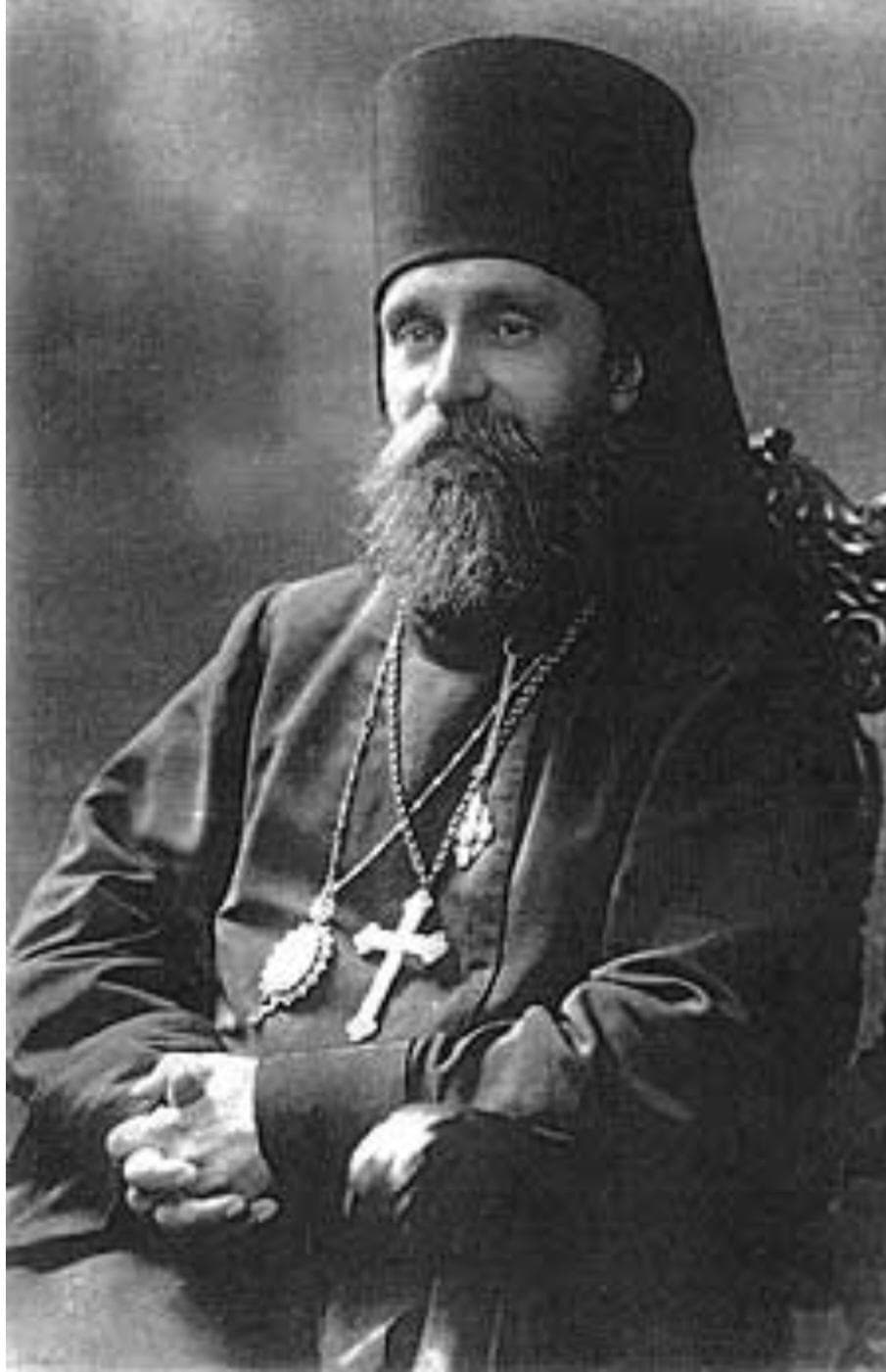
Saint Hieromartyr Platon
of Tallinn.
Also known as Platon Kulbusch, Platon Kulbush, Paul Kulbusch, Bishop Platon of Reval, Platon (Kulbusch)
First Estonian Orthodox bishop, consecrated on December 31, 1917; executed by Bolsheviks at the Tartu Credit Center on January 14, 1919, together with Priests Michael Bleive and Nicholas Bezhanitsky. Glorified as a hieromartyr of the Russian Orthodox Church.
Tone 4 (Podoben: "O citizen of the desert...")
Let all the faithful honor Platon, the illustrious Hierarch,
the august prize-winner, and divinely-honored leader of Estonia, with hymns and spiritual songs;
for he bestows gifts upon the faithful who cry to him:
"Glory to Him Who gave you strength.
Glory to Him Who crowned you.
Glory to Him Who, through you, grants healing to all."
A Pastor's
Witness in Times of Trial
Paul Kulbusch was born into a family of Estonian Orthodox clergy and distinguished himself as a scholar, missionary, and bridge-builder between the Anglican and Orthodox churches. Elected as the first Orthodox bishop of Estonia in 1917 at a moment of profound political upheaval, he served his flock with unwavering devotion for less than two years before falling victim to Bolshevik persecution. His martyrdom in Tartu on January 14, 1919, sealed his witness to Christ and secured his veneration as a righteous hierarch and confessor of the faith.
Early years
Paul Kulbusch was born on July 13, 1869 in Pootsi, Pärnu County, Estonia, where his father was the cantor of the local Orthodox parish. He studied at the Arusaare Orthodox parish school, and then at the Theological School and Seminary at Riga. Every year the two best graduates were granted places to study, free of charge, at the Theological Academy in Saint Petersburg, and one of those chosen to receive such a scholarship was Bishop Platon. He graduated from the Academy in 1894.
During his years of theological study and early ministry, Kulbusch became deeply involved in pastoral work among Estonian Orthodox. While studying at the academy in 1890-94, Kulbusch actively engaged in missionary work among the Orthodox Estonians, preaching in the parish of St Michael the Archangel in the Malaia Kolomna district of St Petersburg to workers who lived nearby. However, Metropolitan Palladii (Raevskii) chose the industrious Kulbusch, who then married Nadezhda Losskaia, the daughter of the influential secretary of the Riga consistory and the sister of a fellow student at the Riga seminary.
In the Church
Archpriest Paul Kulbusch worked in Saint Petersburg for 23 years (1894-1917), and he founded there the Brotherhood of the Martyr Isidore. From 1912 he was an active member in the St Petersburg society which tried to bring closer the Anglican and Orthodox churches, and as such he was often despatched to England by the Synod. He had in fact already been offered an Episcopal see in Russia but had refused, because he felt that his vocation was, first of all, to serve his own people - the Estonian Orthodox.
In July 1917 the delegates of the Orthodox parishes in Estonia traveled to Saint Petersburg in order to approach Archpriest Paul Kulbusch and to ask for his consent to be consecrated as Bishop of Estonia. Benjamin, Metropolitan of Saint Petersburg, and Artemi, Bishop of Luuga, performed his consecration as Bishop in the Alexander Cathedral in Tallinn on December 31, 1917. Bishop Platon celebrated his first Pontifical Liturgy on the night of the New Year, January 1, 1918, at the Cathedral of the Transfiguration.
Platon had become the de-facto bishop of Riga, administering Latvian, Estonian (including Seto), and Russian parishes from his residence in Tartu. On 12 November 1918, the day of the German surrender, Platon composed an appeal to Orthodox Estonians in which he called them to help to create a democratic and prosperous Estonian homeland. He believed that the Orthodox Church had to rebuild itself as a people's church.
Later years
At the time of the Bolshevik invasion, Platon was in Tartu (Dorpat), having fallen ill with pneumonia. The Bolsheviks took Tartu on 24 December, and on 2 January Platon was arrested and imprisoned in a cellar. On 3 January, two other Orthodox priests (Nikolai Bezhanitskii and Mikhail Bleive) and the Lutheran pastor Traugott Hahn were arrested.
In the prison Bishop Platon was forced to clean the toilet of the prisoners with his bare hands. This was on Sunday January 12. On the same evening the Bishop felt sure that he would be put to death. He told his fellow prisoners that, if this happened, they should transmit his last blessing to all his Orthodox flock and parishes: he urged them to flee if possible from the Communist terror, but at the first opportunity to return.
On January 14, 1919, at about 10 o'clock in the morning a commissar with two Red Guards summoned Bishop Platon to come out. During a previous examination at night the commissar had insisted that the Bishop should cease to preach the Gospel. Bishop Platon had been stabbed seven times in the chest, and four bullet wounds were found on his body: two bullets had pierced his chest, one bullet had pierced his left shoulder, and one bullet had passed through his right eye. There were also signs of beatings on his body, including a punch to his right temple.
The Estonian Government ordered that the body of Bishop Platon should be transported to the capital city of Tallinn where a state funeral took place. On the way from the railway station to the Cathedral of the Transfiguration, where the Bishop had celebrated his first and his last Pontifical Liturgy, soldiers stood as a guard of honor on both sides of the streets. Three orchestras followed the funeral procession.
Legacy and veneration
Saint Platon's relics rest in the Cathedral of the Transfiguration in Tallinn. On January 18, 1931 a sarcophagus was unveiled over the tomb of Bishop Platon in the Cathedral of the Transfiguration. It is in the baroque style of the seventeenth century, and is made of Estonian marble. On the sarcophagus the Bishop's vestment is molded in cast bronze, together with his pastoral staff, his miter, and a crown of seven thorns, symbolizing the seven wounds that he received from the bayonet.
Bishop Platon (Kulbusch), the first Estonian to become an Orthodox prelate, became a figure of symbolic importance in Estonia and beyond. Bishop Platon, Archpriests Nicholas Bezhanitsky and Michael Bleive were glorified as martyrs by the Russian Orthodox Church Outside of Russia in 1982, and by the Patriarchate of Constantinople in 2000.
The martyrdom of Bishop Platon and his companion priests continues to be commemorated as a witness to the Church's endurance through persecution. A Church Service in honor of Saint Platon was composed by Metropolitan Joel of Edessa. The Church also commemorates all the New Martyrs of Estonia: Priests, Deacons and laymen.
How the saint's
memory is kept.
- When was Hieromartyr Platon of Tallinn executed?
- January 14, 1919, at the Tartu Credit Center in Estonia, by Bolshevik forces during the Red Terror.
- What was Platon's secular name?
- Paul Kulbusch (also spelled Kulbush, Kuhlbusch, or Kuldbush).
- When was he consecrated as a bishop?
- December 31, 1917, in the Alexander Cathedral in Tallinn, making him the first Orthodox bishop of Estonia.
- Who were executed alongside Hieromartyr Platon?
- Archpriests Michael Bleive and Nicholas Bezhanitsky, two other Orthodox priests.
- Where are the relics of Saint Platon today?
- In the Cathedral of the Transfiguration in Tallinn, Estonia, where they are entombed in a baroque sarcophagus of Estonian marble.
- When was Platon glorified as a saint?
- By the Russian Orthodox Church Outside of Russia in 1982, and by the Patriarchate of Constantinople in 2000.
- What is Platon's feast day in the Eastern Orthodox Church?
- January 14, the date of his martyrdom, commemorated together with the New Martyrs of Estonia.
- How many parishes did Bishop Platon visit in his brief episcopate?
- Over 70 parishes in less than a year in 1918, despite difficult travel conditions under German occupation.
Tone 4 (Podoben: "You have appeared today...")
Today Estonia celebrates the Hierarch Platon,
and with him, the devout and courageous New Martyrs
who glorified Christ as the Lover of mankind.
O holy Hieromartyr Platon, first Bishop of Estonia and advocate of our people! Thou who didst willingly lay down thy life for Christ and His Church, and didst endure cruel torture at the hands of the godless Bolsheviks, intercede for us before the throne of the Almighty. Deliver us from the snares of those who oppose the truth, grant peace to the afflicted, and bestow upon all the faithful the grace to confess Christ boldly and steadfastly until the end. Glory be to Him Who gave thee strength; glory be to Him Who crowned thee with the crown of martyrdom. Amen.
Carry the tradition with you.
Hand-finished icons, books, and calendars to carry the Orthodox day into your home.
Read a life like this
every morning.
Meet the daily saints through Orthodox Daily Companion on iPhone and iPad, or through the Lives of the Saints web app in any modern browser.
Orthodox Daily Companion
The native Apple app, with a Home Screen widget, prayer reminders, and a private on-device journal.
Download on the App StoreLives of the Saints Web App
The browser experience for desktop, tablet, or phone, with a seven-day trial of the complete devotional library.
Open the web appGet a life like this one on every new tab - free, no account, from the same catalogue.
References and further reading
- johnsanidopoulos.comhttps://www.johnsanidopoulos.com/2017/01/life-and-martyrdom-of-hieromartyr.html
- oca.orghttps://www.oca.org/saints/lives/2022/01/14/100244-hieromartyr-platon-the-first-bishop-of-estonia-and-all-the-new-m
- en.wikipedia.orghttps://en.wikipedia.org/wiki/Platon_(Kulbusch)
- balticorthodoxy.comhttps://www.balticorthodoxy.com/platon-kulbusch
- oca.orghttps://www.oca.org/saints/troparia/2022/01/14/100244-hieromartyr-platon-the-first-bishop-of-estonia-and-all-the-new-m
- en.wikipedia.orghttps://en.wikipedia.org/wiki/Tartu_Credit_Center_Massacre
- balticorthodoxy.comhttps://www.balticorthodoxy.com/founding-the-estonian-orthodox-church
- estonica.orghttp://www.estonica.org/en/Platon,_Bishop_of_Estonia/
- johnsanidopoulos.comhttps://www.johnsanidopoulos.com/2017/01/life-and-martyrdom-of-hieromartyr.html?m=1
- orthodox.nethttps://www.orthodox.net/russiannm/plato-bishop-and-hieromartyr-of-revel-tallinn-and-those-with-him.html
- andreipsarev.substack.comhttps://andreipsarev.substack.com/p/st-platon-of-estonia-a-bishop-formed
- en.wikipedia.orghttps://en.wikipedia.org/wiki/Platon_of_Banja_Luka
- docplayer.orghttps://docplayer.org/36981794-Residenten-und-repraesentanten-der-stadt-reval-tallinn.html
- oca.orghttps://www.oca.org/saints/lives/2013/01/14/100244-hieromartyr-platon-the-first-bishop-of-estonia-and-all-the-new-m
- muse.jhu.eduhttps://muse.jhu.edu/article/849821/summary
- ra.eehttps://www.ra.ee/tuna/en/amandus-adamson-as-the-perpetuator-of-the-memory-of-bishop-platon/
- linkedin.comhttps://www.linkedin.com/pulse/liberation-tartu-14-january-1919-eric-sibul
- icds.eehttps://icds.ee/en/historian-andrey-zubov-concluding-the-tartu-peace-treaty-with-the-bolsheviks-was-a-moral-mistake-for-estonia/
- grokipedia.comhttps://grokipedia.com/page/Treaty_of_Tartu_(Finland%E2%80%93Russia)
- encyclopedia.1914-1918-online.nethttps://encyclopedia.1914-1918-online.net/article/revolutions-east-central-europe/
More from the tradition.
Read the Journal
Essays on feasts, fasting, and the rhythm of the Church year.
ExploreOrthodox countries
How the faith is lived and kept across the Christian world.
ExploreThe 2027 Calendar
A saint, a reading, and the day's fasting guideline for every day of 2027.
ExploreMobile & web apps
Carry the daily rhythm on iPhone and iPad or continue in the web app.
Explore