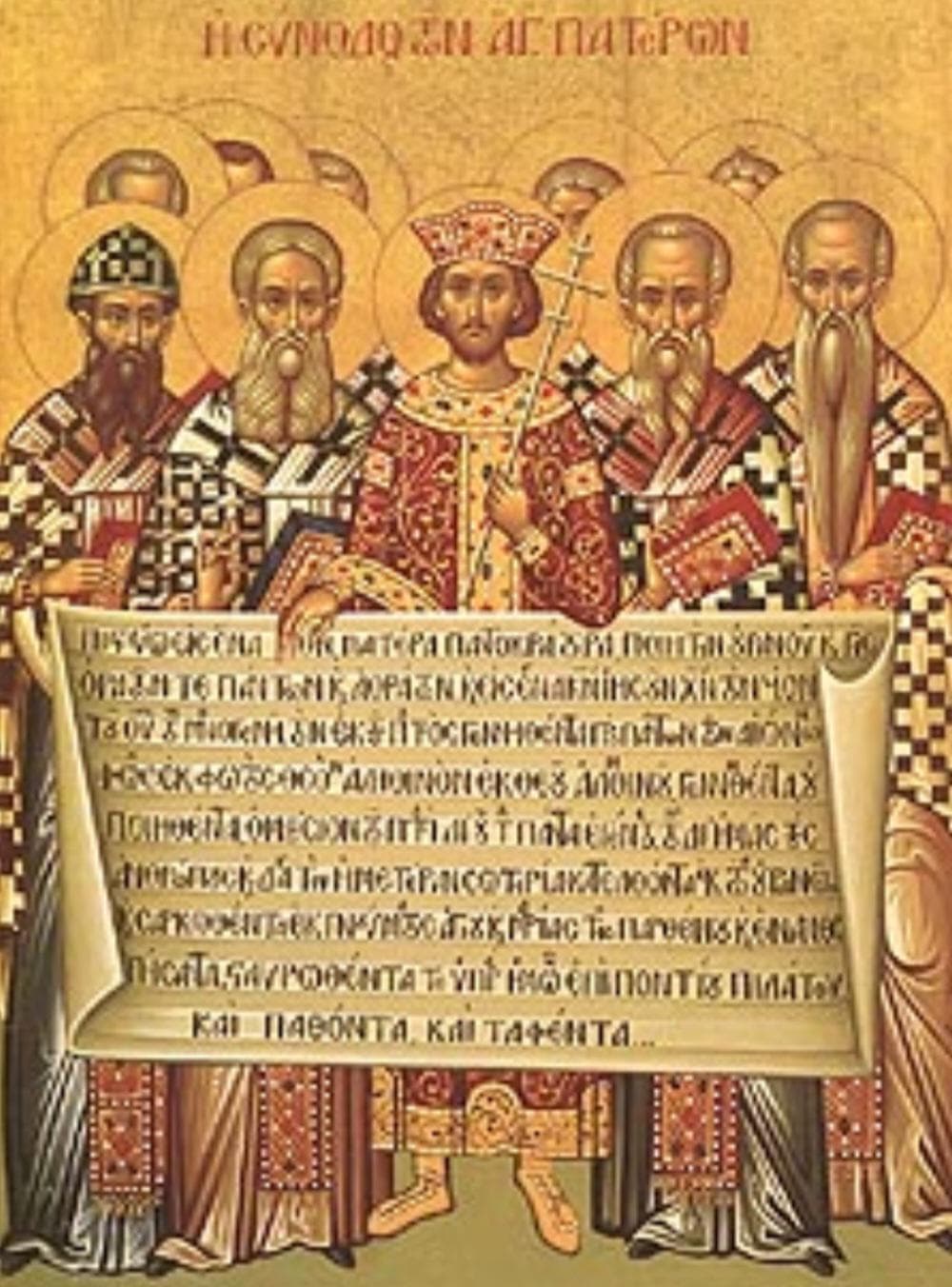
Saint Holy Fathers
of the Second Ecumenical Council.
Also known as Holy 150 Fathers of the Council of Constantinople, Fathers of the First Council of Constantinople, Fathers of Constantinople I, 150 Holy Fathers of 381, Second Ecumenical Council
The 150 bishops who convened in Constantinople in 381, condemning Macedonianism and defining the doctrine of the Holy Trinity through the Niceno-Constantinopolitan Creed.
Tone 8
You are most glorious, O Christ our God! / You have established the Holy Fathers as lights on the earth! / Through them you have guided us to the true faith! / O greatly Compassionate One, glory to You!
The 150
Fathers at Constantinople
The Second Ecumenical Council was convened in the year 381 and consolidated the victory of Orthodoxy attained in the year 325 at the First Ecumenical Council. These holy fathers were gathered by Emperor Theodosius the Great to defend the faith against new heresies that had emerged since Nicaea. The Council dealt primarily with the Macedonian Controversy. It also added the remaining articles to the Creed and issued some canons.
Early years
The holy fathers who gathered at Constantinople in 381 were bishops from across the Eastern Empire, called together by the pious Emperor Theodosius the Great. Among them were some of the greatest ecclesiastical figures of the fourth century. Saint Gregory the Theologian, Saint Gregory of Nyssa - the other of the three great Cappadocian Fathers, along with his older brother, Saint Basil the Great - and Saint Meletios, Bishop of Antioch, were leaders at the Second Ecumenical Council. Each brought deep learning and Orthodox conviction forged in the struggles against Arianism and other heresies that had plagued the Church during the preceding decades.
In the Church
The Second Ecumenical Council was convened in the year 381 and consolidated the victory of Orthodoxy attained in the year 325 at the First Ecumenical Council. During the difficult years which passed after the acceptance of the Nicene Symbol of Faith (Creed), the Arian heresy developed new offshoots. Under the guise of struggle against the Sabellian heresy, which taught about a blending of the Hypostatic Persons of the Father and the Son [as mere aspects or modalities within the Trinity], Macedonius began to employ the word "homoiousios" "of similar essence" [in contrast to the Orthodox teaching of "homoousios", "of the same essence"] regarding the essence of the Son and that of the Father.
The council was called by the Emperor Theodosius the Great, primarily to clarify the Church's teaching on the Holy Spirit. Macedonius, bishop of Constantinople, had falsely taught that the Spirit is a creature rather than a Divine Person "Who together with the Father and the Son is worshiped and glorified." Partly to correct this error, the council revised and expanded the text of the Nicene Creed into the form that we know today.
In the Ninth Article of the Nicea-Constantinople Symbol of Faith proclaimed by the holy Fathers of the First and Second Ecumenical Councils, we confess our faith in "One, Holy, Catholic, and Apostolic Church." "Clad in the garment of truth," the doctrine of the Fathers, based upon the preaching of the Apostles, has established one faith for the Church.
Later years
After the document was read aloud, the Holy Fathers rejected the false teaching of Macedonius, and unanimously affirmed the Apostolic teaching that the Holy Spirit is not a creature, but is rather the Life-Creating Lord, Who proceeds from the Father, and is worshipped and glorified with the Father and the Son. In order to combat other heresies, of the Eunomians, Arians and Semi-Arians, the Holy Fathers reaffirmed the Nicene Symbol of Faith.
The 381 revision of the creed at Constantinople (i.e., the Niceno-Constantinopolitan Creed), which is often simply referred to as the "Nicene Creed", speaks of the Holy Spirit as worshipped and glorified with the Father and the Son. In the end it achieved its special status when the council of Chalcedon, at its second session and in its definition of the faith, linked the form of the creed read out at Constantinople with the Nicene form, as being a completely reliable witness of the authentic faith.
Legacy and veneration
The Holy Fathers of the Second Ecumenical Council are commemorated on May 22 and also on the 9th Sunday after Pentecost, with the Sunday of the Fathers of the First Six Councils. The 150 Holy Fathers of the Second Ecumenical Council left their mark on the theology of the Church concerning the Holy Spirit, "repudiating the teaching of Macedonius, as one who wished to divide the inseparable Unity, so that there might be no perfect mystery of our hope."
They definitively formulated and affirmed the Nicean-Constantinople Symbol of Faith, confessed in the Creed even now by all the Orthodox Church. Such Councils, guided by the grace of the Holy Spirit, and accepted by the Church, are infallible. The Orthodox Church's conciliar definitions of dogma have the highest authority, and such definitions always begin with the Apostolic formula: "It seemed good to the Holy Spirit and to us..." (Acts 15: 28).
How the saint's
memory is kept.
- When did the Second Ecumenical Council take place?
- The Council sat in session from May to July 381 A.D. and was attended by 150 Bishops of the Eastern Churches.
- What were the main heresies condemned by the Second Ecumenical Council?
- The council unequivocally condemned various heresies, including Arianism, Eunomianism, Apollinarianism, and Macedonianism, among others.
- What is the Niceno-Constantinopolitan Creed?
- The "Niceno-Constantinopolitan Creed" received this name because it was adopted at the Second Ecumenical Council held in Constantinople in 381 as a modification of the original Nicene Creed of 325.
- What did the Council teach about the Holy Spirit?
- The Holy Fathers rejected the false teaching of Macedonius, and unanimously affirmed the Apostolic teaching that the Holy Spirit is not a creature, but is rather the Life-Creating Lord, Who proceeds from the Father, and is worshipped and glorified with the Father and the Son.
- Who convened the Second Ecumenical Council?
- Emperor Theodosius the Great came to the imperial throne of the eastern part of the Roman Empire in 379. A strong supporter of the Nicene Faith, he wanted to help the Church finally put an end to the various forms of Arianism which had cropped up since the Council of Nicea. In 381 he called a Church council in Constantinople which would come to be known as the Second Ecumenical Council.
- On what feast day are the Holy Fathers of the Second Ecumenical Council commemorated?
- The Holy Fathers of the Second Ecumenical Council are commemorated on May 22 and also on the 9th Sunday after Pentecost, with the Sunday of the Fathers of the First Six Councils.
Tone 8
The Apostles' preaching and the Fathers' doctrines / Have established one faith for the Church. / Adorned with the robe of truth, woven from heavenly theology, / It defines and glorifies the great mystery of Orthodoxy!
Holy Fathers of the Second Ecumenical Council, ye 150 bishops gathered at Constantinople in the year 381, intercede for us before Christ our God! Through your Orthodox teaching concerning the Holy Spirit and the Holy Trinity, ye have guided all the faithful to salvation. Pray for us that we may remain steadfast in the true faith which ye have delivered to us, and by which the Church is preserved until this day. Amen.
Carry the tradition with you.
Hand-finished icons, books, and calendars to carry the Orthodox day into your home.
Read a life like this
every morning.
Meet the daily saints through Orthodox Daily Companion on iPhone and iPad, or through the Lives of the Saints web app in any modern browser.
Orthodox Daily Companion
The native Apple app, with a Home Screen widget, prayer reminders, and a private on-device journal.
Download on the App StoreLives of the Saints Web App
The browser experience for desktop, tablet, or phone, with a seven-day trial of the complete devotional library.
Open the web appGet a life like this one on every new tab - free, no account, from the same catalogue.
References and further reading
- goarch.orghttps://www.goarch.org/theology-articles/-/asset_publisher/zg5D5ENaCTK9/content/the-second-ecumenical-council/pop_up?_101_INSTANCE_zg5D5ENaCTK9_viewMode=print&_101_INSTANCE_zg5D5ENaCTK9_languageId=fi_FI
- goarch.orghttps://www.goarch.org/-/the-second-ecumenical-council
- saintjohnchurch.orghttps://www.saintjohnchurch.org/second-ecumenical-council/
- oca.orghttps://www.oca.org/saints/lives/2010/05/22/101462-commemoration-of-the-holy-fathers-of-the-second-ecumenical-counc
- newworldencyclopedia.orghttps://www.newworldencyclopedia.org/entry/First_Council_of_Constantinople
- en.wikipedia.orghttps://en.wikipedia.org/wiki/First_Council_of_Constantinople
- britannica.comhttps://www.britannica.com/event/First-Council-of-Constantinople-381
- orthodoxwiki.orghttps://orthodoxwiki.org/Second_Ecumenical_Council
- en.wikipedia.orghttps://en.wikipedia.org/wiki/Nicene_Creed
- theopedia.comhttps://theopedia.com/nicene-creed
- catholic.comhttps://www.catholic.com/encyclopedia/nicene-and-niceno-constantinopolitan-creed
- igoarchusa.orthodoxws.comhttps://igoarchusa.orthodoxws.com/thenineecumenicalcouncils
- oca.orghttps://www.oca.org/saints/all-lives/2008/07/13
- orthocal.infohttps://orthocal.info/readings/gregorian/2024/5/22/
- holytrinityorthodox.comhttps://www.holytrinityorthodox.com/calendar/los/May/22-02.htm
- trueorthodox.euhttps://trueorthodox.eu/the-second-ecumenical-council-commemorated-on-may-22/
- oca.orghttps://www.oca.org/saints/troparia/2025/07/13/50-fathers-of-the-first-six-councils
- orthodoxwiki.orghttps://orthodoxwiki.org/Sunday_of_the_Fathers_of_the_First_Six_Councils
- sb.rfpa.orghttps://sb.rfpa.org/the-council-of-constantinople-ad-381-the-meeting/
- roca.orghttps://roca.org/oa/volume-ii/issue-15/381-the-second-ecumenical-council-1981/
More from the tradition.
Read the Journal
Essays on feasts, fasting, and the rhythm of the Church year.
ExploreOrthodox countries
How the faith is lived and kept across the Christian world.
ExploreThe 2027 Calendar
A saint, a reading, and the day's fasting guideline for every day of 2027.
ExploreMobile & web apps
Carry the daily rhythm on iPhone and iPad or continue in the web app.
Explore