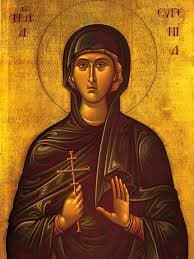
Saint Eugenia the Martyr
of Rome.
Also known as Holy Martyr Eugenia of Alexandria, Saint Eugenia of Rome, Nun-Martyr Eugenia, Saint Eugenia the Virgin Martyr
A Roman noblewoman of the 2nd–3rd century who disguised herself as a monk, acquired the gift of healing, and was martyred in Rome after being falsely accused and revealing her true identity to her father, the Prefect of Egypt.
Tone 3
Inspired by the Divine Spirit, you sang the praises of God, / receiving the light of divine knowledge, O Eugenia, Christ's beautiful virgin. / You shone forth in the choirs of monastics, / and in your contest you triumphed over the Enemy. / O glorious Martyr, entreat Christ God to grant us great mercy.
A Roman
Virgin Martyr of Nobility and Humility
Saint Eugenia was born into one of Rome's most distinguished families but chose radical poverty and hidden service over wealth and marriage. Having encountered the Epistles of Saint Paul, she abandoned her family's pagan prosperity to pursue monastic life in complete anonymity. Her story - one of false accusation, divine vindication, and faithful witness unto death - exemplifies the Orthodox virtue of self-renunciation and the triumph of Christ's love over worldly status.
Early years
Holy Martyr Eugenia was a Roman by birth; she lived at Alexandria, where her father Philip was sent by the emperor Commodus (180-192) to be Prefect of Egypt. As the privileged daughter of this powerful administrator, she enjoyed every advantage of the Roman aristocracy. Eugenia received a fine upbringing and was noted for her beauty and good disposition; many illustrious youths sought her hand, but she did not wish to marry anyone, for she was determined to preserve her virginity.
Providentially, she became acquainted with the Epistles of the Apostle Paul; she yearned with all her soul to become a Christian, but kept this a secret from her parents. This encounter with apostolic truth stirred her spirit toward God and away from the empty allure of pagan society.
In the Church
At that time, Christians were banished from Alexandria by the command of the emperor; wishing to learn more about Christian teachings, she asked permission to visit one of the family estates outside the city, supposedly to enjoy the countryside; she left in the company of her two servants Protus and Hyacinthus, dressed in men's clothes. This act of renunciation - donning masculine garb to enter a monastic community otherwise closed to women - demonstrated her absolute commitment to the ascetic life.
She and her companions were baptized at a monastery by Bishop Elias, who learned about Eugenia in a vision; he blessed her to pursue asceticism at the monastery disguised as the monk Eugene. By her ascetic labors, Saint Eugenia acquired the gift of healing. Her sanctity became evident to all who knew her as the monk Eugene, and many sought her counsel and miracles.
Later years
Once, a rich young woman named Melanthia turned to her for help; seeing "Eugene," this woman burned with an impure passion, and when she was spurned, she falsely accused the saint of attempted rape; Saint Eugenia came to trial before the Prefect of Egypt (her father), and she was forced to reveal her secret. In a moment of divine providence, her father presided over her trial and witnessed the truth of her innocence and identity. Her parents and brothers rejoiced to find the one for whom they had long grieved; after a while they all accepted holy Baptism.
Philip, after being denounced by pagans, was dismissed from his post; the Alexandrian Christians chose him as their bishop; the new Prefect, fearing the wrath of the people, did not dare to execute Philip openly, but sent assassins to kill him; they inflicted wounds upon Saint Philip while he was praying, from which he died three days later. Following her father's martyrdom, Saint Eugenia traveled to Rome and continued with monastic life, bringing many young women to Christ.
In Rome, she was arrested and condemned to death by Gallienus (who reigned alongside Valerian in 253-260 and then alone in 260–268), who was angry with her for converting his niece Basilla to Christianity. They threw the holy martyr into the Tiber with a stone about her neck, but the stone became untied and she remained unharmed; she also remained unscathed in the fire; then they cast her into a pit, where she remained for ten days; during this time the Savior Himself appeared to her and said that she would enter into the heavenly Kingdom on the day He was born; when this radiant Feast came, the executioner put her to death with a sword.
Legacy and veneration
Eugenia was ultimately beheaded on what tradition records as Christmas Day, making her feast one of the strangest coincidences in the liturgical calendar: the birth of Christ and the martyrdom of Eugenia on the same day; she is unique among the nine women of this article because she belongs to both the Eastern and Western traditions with equal strength - on the Orthodox calendar on December 24, on the Roman calendar on December 25.
Her cult had spread and she appeared in 5th century mosaics at the Basilica of Sant'Apollinare Nuovo in Ravenna and 6th century ones at the Eufrasiana in Parenzo, along with being mentioned and celebrated by Avitus of Vienne and Venantius Fortunatus; her life also appeared in the Golden Legend in the 13th century. She became a model for countless women throughout Orthodox history who sought to reconcile their ascetic vocations with family expectations and ecclesial obedience.
How the saint's
memory is kept.
- When is the feast day of Saint Eugenia in the Eastern Orthodox Church?
- December 24 (the day before Christmas in the Gregorian calendar), marking her martyrdom by beheading, which she was told would occur on the day of Christ's Nativity.
- Who was Saint Eugenia and why did she disguise herself as a monk?
- Saint Eugenia was a Roman noblewoman of the 2nd–3rd century, daughter of Philip, Prefect of Egypt. She disguised herself as a monk to enter a men's monastery and pursue ascetic life in secret, away from the pressure of arranged marriage and pagan society.
- What is the miracle associated with Saint Eugenia's healing gift?
- Through her ascetic labors, Saint Eugenia received from God the grace of healing the sick. She healed a wealthy woman named Melanthia, though that same woman later falsely accused her of attempted rape out of rejected passion.
- How was Saint Eugenia's true identity revealed?
- When Melanthia falsely accused the monk Eugene of assault before the Prefect of Egypt, Eugenia was forced to reveal her secret and her true identity as a woman. The presiding judge was her own father Philip, who rejoiced at discovering his long-lost daughter.
- Did Saint Eugenia's family convert to Christianity?
- Yes. After Eugenia revealed her identity to her father Philip, he and the entire family converted to Christianity. Philip became bishop of Alexandria but was later martyred for his faith.
- Where are the relics of Saint Eugenia today?
- The relics of Saint Eugenia rest in the Church of the Twelve Holy Apostles (Santi Apostoli) in Rome, in a porphyry urn in the Bessarion Chapel, having been transferred there from the Catacomb of Apronian on the Via Latina in the 9th century.
Podoben: "O citizen of the desert..."
Fleeing from the passing glory of this world, you longed for Christ, / preserving the nobility of your soul unharmed, / O godly-wise Martyr, all-praised Eugenia.
O holy Martyr Eugenia, noble virgin of Christ and wonderworker of healing, thou didst flee the vanities of the world and its fleeting glories to embrace the narrow way of monastic struggle. Thou didst endure false accusation with meekness, thereby revealing thy innocence and leading thy father to the faith. Receiving the grace of miracles, thou didst convert many souls to Christ. When torturers sought to destroy thy body, the Lord preserved thee miraculously, that on the very day of His Nativity thou mightest offer thyself a living sacrifice. O glorious Martyr, entreat Christ our God for us sinners, that we too may despise the temporal world, persevere in faith when unjustly accused, and finally receive the crown of martyrdom or the peace of virginal rest. Amen.
Carry the tradition with you.
Hand-finished icons, books, and calendars to carry the Orthodox day into your home.

Read a life like this
every morning.
Meet the daily saints through Orthodox Daily Companion on iPhone and iPad, or through the Lives of the Saints web app in any modern browser.
Orthodox Daily Companion
The native Apple app, with a Home Screen widget, prayer reminders, and a private on-device journal.
Download on the App StoreLives of the Saints Web App
The browser experience for desktop, tablet, or phone, with a seven-day trial of the complete devotional library.
Open the web appGet a life like this one on every new tab - free, no account, from the same catalogue.
References and further reading
- oca.orghttps://www.oca.org/saints/lives/2026/12/24/103631-nun-martyr-eugenia-of-rome
- ww1.antiochian.orghttp://ww1.antiochian.org/node/17207
- goarch.orghttps://www.goarch.org/chapel/saints?contentid=351
- en.wikipedia.orghttps://en.wikipedia.org/wiki/Eugenia_of_Rome
- orthodoxtimes.comhttps://orthodoxtimes.com/memory-of-eugenia-the-righteous-nun-martyr-of-rome-and-those-with-her-24-december/
- basilica.rohttps://basilica.ro/en/orthodox-calendar-december-24/
- oca.orghttps://www.oca.org/saints/troparia/1950/12/24/103631-nun-martyr-eugenia-of-rome
- romanchurches.fandom.comhttps://romanchurches.fandom.com/wiki/Santi_Apostoli
- romereports.comhttps://www.romereports.com/en/2018/07/01/two-apostles-and-four-martyrs-lie-within-the-walls-of-roman-church/
- romanchurches.fandom.comhttps://romanchurches.fandom.com/wiki/Catacomba_di_Aproniano
- queersaints.wordpress.comhttps://queersaints.wordpress.com/2011/12/24/eugenia-eugenios-of-alexandria-24th-december/
- queersaints.wordpress.comhttps://queersaints.wordpress.com/2-the-early-christians-saints-and-martyrs-for-the-church/martyrs-for-the-church/st-eugenia-eugenios-of-alexandria-dec-24th-and-protas-hyacinthus-her-eunuch-slaves/
- byzantinela.comhttps://byzantinela.com/dec-24-2022/
- orthodoxtimes.comhttps://orthodoxtimes.com/memory-of-the-holy-blessed-virgin-martyr-eugenia-3/
- queering-the-church.blogspot.comhttp://queering-the-church.blogspot.com/2009/11/eugenia-eugenios-of-alexandria-24th.html
- grokipedia.comhttps://grokipedia.com/page/Eugenia_of_Rome
- oca.orghttps://www.oca.org/saints/lives/2025/12/24/103631-nun-martyr-eugenia-of-rome
- orthodoxtimes.comhttps://orthodoxtimes.com/memory-of-eugenia-the-righteous-nun-martyr-of-rome-and-those-with-her/
- theeasternchurch.comhttps://www.theeasternchurch.com/saints/women-saints-who-disguised-themselves-as-monks
- euphrosynoscafe.comhttp://euphrosynoscafe.com/forum/viewtopic.php?t=219&start=301
More from the tradition.
Read the Journal
Essays on feasts, fasting, and the rhythm of the Church year.
ExploreOrthodox countries
How the faith is lived and kept across the Christian world.
ExploreThe 2027 Calendar
A saint, a reading, and the day's fasting guideline for every day of 2027.
ExploreMobile & web apps
Carry the daily rhythm on iPhone and iPad or continue in the web app.
Explore