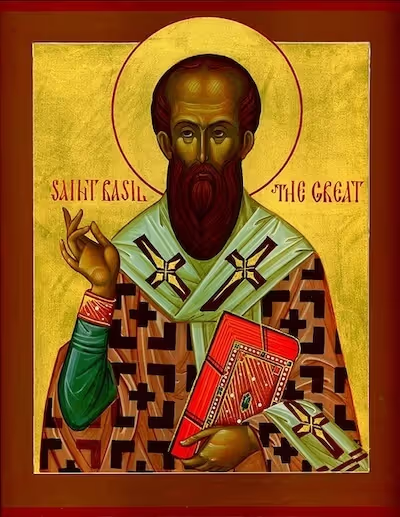
Saint Basil the Great.
About Saint
Basil the Great
St. Basil the Great, also known as Basil of Caesarea, was a prominent Christian bishop and theologian of the 4th century. He is widely recognized as one of the Cappadocian Fathers, alongside Gregory of Nazianzus and Gregory of Nyssa. His contributions to Christian monasticism, liturgy, and doctrine have left a lasting impact on both Eastern and Western Christianity. St. Basil is venerated as a saint in the Orthodox Church, Catholic Church, and Anglican Communion, and he is considered one of the great defenders of the Nicene faith.
Early years
Basil was born around 330 AD in Caesarea, Cappadocia (modern-day Turkey) into a wealthy and pious Christian family. He received an excellent education, studying rhetoric and philosophy in Caesarea, Constantinople, and Athens, where he met and formed a lifelong friendship with Gregory of Nazianzus. Despite his early interest in secular learning, Basil experienced a profound conversion that led him to dedicate his life to Christ. He was deeply influenced by his sister, St. Macrina, who encouraged him to embrace a life of asceticism and service to the Church.
In the Church
After his baptism, St. Basil devoted himself to the monastic life, founding several monasteries in Pontus. His "Long Rules" and "Short Rules" became foundational texts for communal monasticism. In 370 AD, Basil was consecrated as the Bishop of Caesarea, where he quickly became a leading figure in the fight against Arianism, a heresy that denied the divinity of Christ. His theological writings, particularly on the Holy Trinity, played a crucial role in defending the Nicene Creed. St. Basil was also known for his care for the poor, founding a large complex known as the Basiliad, which provided food, shelter, and medical care to the needy.
Later years
St. Basil's later years were marked by illness and intense struggles with heretical factions. Despite these challenges, he remained steadfast in his commitment to orthodoxy and the pastoral care of his flock. He passed away on January 1, 379 AD, leaving behind a legacy of profound theological insight, liturgical reform, and charitable works. His influence on Christian monasticism and liturgy is particularly notable, with the Liturgy of St. Basil still celebrated in the Eastern Orthodox Church. St. Basil was quickly recognized as a saint, and his feast day is celebrated on January 1.
Legacy and veneration
St. Basil the Great's legacy endures through his theological writings, particularly his treatises on the Holy Trinity and the Holy Spirit, which continue to be foundational texts in Christian theology. He is also remembered for his contributions to monasticism, with his rules influencing both Eastern and Western monastic traditions. St. Basil's care for the poor and his establishment of the Basiliad set a precedent for Christian social welfare initiatives. His life and works have made him one of the most revered saints in both Eastern and Western Christianity, earning him the title "Great" for his profound impact on the Church.
Carry the tradition with you.
.avif&w=3840&q=75)
More saints of Turkey.
Read a saint like this
every morning.
The Orthodox Calendar app gives you the daily saints' lives, scripture, and prayers — in one quiet place. Free for seven days.