Moldova.
Moldova is an overwhelmingly Orthodox Christian country where two canonical Eastern Orthodox jurisdictions coexist: the Metropolis of Chișinău and All Moldova (under Moscow) and the Metropolis of Bessarabia (under Bucharest).
Orthodoxy in
Moldova.
A living tradition — its history, its faithful, its sacred places.
Eastern Orthodox Christianity is the historic and overwhelmingly dominant faith of the Republic of Moldova. The lands between the Prut and Dniester rivers — historically part of the medieval Principality of Moldavia and the region of Bessarabia — have been Orthodox since the Middle Ages, and the Church continues to shape Moldovan identity, culture, and calendar to this day.
Historical background
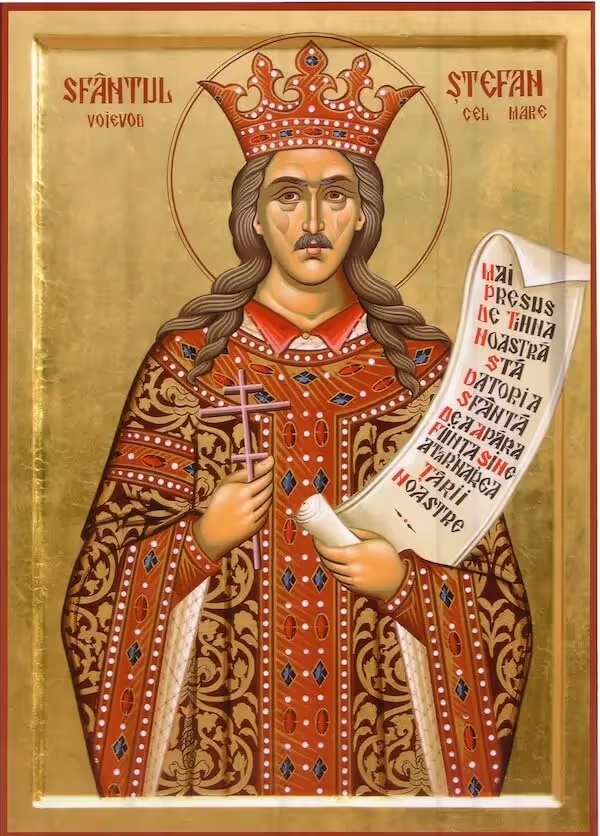
Orthodoxy in what is now Moldova traces back to the medieval Metropolis of Moldavia. On July 26, 1401, the Ecumenical Patriarchate of Constantinople recognized the Metropolis of Moldavia, giving canonical form to a church that had been emerging in the Moldavian principality for decades. Monastic life flourished from the early fifteenth century, especially under Alexander the Good (Alexandru cel Bun) and later Stephen the Great (Ștefan cel Mare), whose foundations remain national treasures.
After Russia annexed Bessarabia in 1812, the region's church life was reorganized under the Russian Orthodox Church, and the Archdiocese of Chișinău and Hotin was established in 1813. With the union of Bessarabia and Romania in 1918, the territory was incorporated into the Romanian Orthodox Church, and the Metropolis of Bessarabia was created in 1918 as the Archbishopric of Chișinău and elevated to a metropolis in 1927. Soviet occupation in 1940 and again after 1944 returned the region to Moscow's jurisdiction and brought severe persecution, monastery closures, and confiscations.
Jurisdictional situation today
The Eastern Orthodox Church in Moldova is represented by two canonical jurisdictions:
The Metropolis of Chișinău and All Moldova (the "Moldovan Orthodox Church"), a self-governing body of the Russian Orthodox Church that was granted autonomy by the Church of Russia in October 1992. It comprises the large majority of parishes and is led by Metropolitan Vladimir (Cantarean).
The Metropolis of Bessarabia, an autonomous metropolitanate of the Romanian Orthodox Church, reactivated in September 1992. Moldovan authorities declined to register it until 2002, when recognition followed a ruling of the European Court of Human Rights.
Contemporary developments
Both jurisdictions are fully canonical within world Orthodoxy, but their coexistence reflects the country's broader cultural tension between Romanian and Russian orientations. Since 2022, following the Russian invasion of Ukraine, numerous parishes and more than sixty priests have transferred from the Moscow-linked Metropolis of Chișinău to the Romanian-affiliated Metropolis of Bessarabia.
According to the 2024 Population and Housing Census, 95.2% of Moldova's residents identify as Eastern Orthodox Christian, making it one of the most Orthodox countries in the world by share of population. Church feasts — the Nativity of Christ, Theophany, Pascha, the Dormition of the Theotokos, and the commemoration of St. Parascheva — remain central to national life. Romanian is the dominant liturgical language in most parishes, with Church Slavonic and Russian also used, especially in parishes of the Metropolis of Chișinău and among Russian, Ukrainian, and Gagauz faithful.
Saints of
Moldova.
1 venerated soul with ties to this land — fathers and mothers of the faith who are remembered here still.
Famous Orthodox churches and monasteries in Moldova
The sacred architecture of Orthodox Moldova — cathedrals, parishes, and the mountain monasteries that keep the lamps burning.
- Nativity Cathedral, Chișinău — The metropolitan cathedral of the Moldovan Orthodox Church and the principal church of the capital. Built between 1830 and 1836 to a neoclassical design by Abram Melnikov, its bell tower was destroyed in 1962 and rebuilt in 1997.
- Căpriana Monastery (Strășeni District) — One of the oldest monasteries in Moldova, first documented in 1429 when Alexander the Good granted it the status of royal monastery. Its first stone church was dedicated to the Dormition of the Theotokos; later churches honor St. George (1840) and St. Nicholas (1903).
- Curchi Monastery (Orhei District) — Dedicated to the Nativity of the Theotokos, Curchi is a major eighteenth–nineteenth-century monastic ensemble and one of the most important pilgrimage sites in central Moldova.
- Tipova Monastery — An ancient cave monastery carved into the cliffs above the Dniester River, counted among the oldest monastic settlements on Moldovan soil.
- Noul Neamț (Kitskany) Monastery — A male monastery dedicated to the Ascension of the Lord, located at Chițcani near Tiraspol and Bender. It was founded in 1861 by monks from Neamț Monastery in Romania and remains an important spiritual center in the Transnistrian region.
- Hâncu Monastery — A historic convent in the Codri forest, founded in the seventeenth century and a major center of women's monasticism in the country.
Orthodoxy
kept here.
The shape of the faith as it is lived and prayed across Moldova today.
Moldova is among the most Orthodox countries in the world. According to the 2024 census, 95.2% of Moldova's population identifies as Eastern Orthodox Christian, and roughly 80–90% of these faithful belong to the Metropolis of Chișinău and All Moldova, which is subordinate to the Russian Orthodox Church. The remainder worship primarily within the Metropolis of Bessarabia, an autonomous metropolitanate of the Romanian Orthodox Church. Both are in the canonical communion of the Eastern Orthodox (Chalcedonian) world.
Liturgical life is conducted chiefly in Romanian, reflecting the language of the majority population, though Church Slavonic, Russian, and occasionally Gagauz are used in particular parishes. Monastic life has recovered strongly since the end of Soviet rule: more than forty monasteries and sketes operate across the country, many of them restored from near-ruin after decades of closure. Pilgrimage to sites such as Căpriana, Curchi, Hâncu, and the cave monasteries of the Dniester is a significant part of popular piety.
Church–state relations in Moldova are formally those of separation, but the Orthodox Church enjoys deep cultural influence and public presence. The great feasts are observed as public holidays, and parish life is central to village culture. Since 2022, the jurisdictional landscape has shifted noticeably, with a growing number of clergy and parishes moving from the Moscow-linked Metropolis of Chișinău to the Romanian-affiliated Metropolis of Bessarabia — a trend with both ecclesiastical and geopolitical dimensions.
The Moldovan diaspora — in Italy, Romania, Russia, Portugal, and elsewhere — is typically served by parishes of the Romanian Orthodox Church or of the Russian Orthodox Church, depending on the country and community.
Asked
of this land.
Frequently asked questions about Orthodoxy in Moldova
Is Moldova an Orthodox Christian country?
Yes. According to the 2024 Moldovan census, 95.2% of the population identifies as Eastern Orthodox Christian, making Orthodoxy the overwhelmingly dominant faith.
Which Orthodox jurisdictions are present in Moldova?
Two canonical Eastern Orthodox jurisdictions operate in Moldova: the Metropolis of Chișinău and All Moldova, a self-governing body of the Russian Orthodox Church granted autonomy in October 1992; and the Metropolis of Bessarabia, an autonomous metropolitanate of the Romanian Orthodox Church reactivated in September 1992.
Is the Moldovan Orthodox Church autocephalous?
No. The Metropolis of Chișinău and All Moldova is self-governing (autonomous) under the Moscow Patriarchate, not autocephalous. The Metropolis of Bessarabia is autonomous under the Romanian Patriarchate.
What language is used in the Divine Liturgy?
Romanian is the principal liturgical language in most Moldovan parishes. Church Slavonic and Russian are also used, particularly in parishes of the Metropolis of Chișinău and among Russian-speaking, Ukrainian, and Gagauz communities.
Why are there two Orthodox metropolitan churches in one country?
The two jurisdictions reflect Moldova's shifting history between Russian and Romanian rule. After the Soviet Union collapsed, the Romanian Orthodox Church reactivated the historic Metropolis of Bessarabia in 1992, while the Moldovan state initially recognized only the Moscow-linked church. Recognition of the Metropolis of Bessarabia followed a 2001 judgment of the European Court of Human Rights and registration in 2002.
Are there historic Orthodox monasteries in Moldova?
Yes. Moldova has many medieval and early-modern monasteries, including Căpriana (attested 1429), Curchi, Hâncu, Tipova (a rock-cut cave monastery on the Dniester), and Noul Neamț near Tiraspol, founded in 1861 by monks from Neamț Monastery in Romania.