Russia.
Russia is the world's most populous Orthodox nation, home to the Russian Orthodox Church (Moscow Patriarchate), whose history begins with the Baptism of Rus' in 988 and whose patriarchate today serves roughly 90 million faithful.
Orthodoxy in
Russia.
A living tradition — its history, its faithful, its sacred places.
Eastern Orthodox Christianity in Russia
Orthodox Christianity is the historic and majority faith of Russia, shaping over a millennium of Russian culture, art, literature, and statecraft. The Russian Orthodox Church (Moscow Patriarchate) is the canonical local church of the Russian people and one of the largest autocephalous churches in the worldwide Eastern Orthodox communion.
Origins: the Baptism of Rus'
Christianity was introduced into the East Slavic lands of Kievan Rus' by Greek missionaries from Byzantium, and was formally adopted in 988 when Grand Prince Vladimir of Kiev was baptized and had the people of Kiev baptized in the Dnieper. From this event, commemorated annually on 28 July (the feast of St Vladimir, Equal-to-the-Apostles), flows the continuous Orthodox tradition of the Russian lands.
From Kiev to Moscow
Originally a metropolitanate under the Ecumenical Patriarchate of Constantinople, the see of the Russian metropolitan was transferred to Moscow in the 14th century. The Russian Church declared its autocephaly in 1448, electing its own metropolitan without reference to Constantinople. In 1589, the metropolitan of Moscow was elevated to the dignity of Patriarch, a recognition confirmed by the Eastern patriarchs.
Imperial era, persecution, and revival
Under Peter the Great the patriarchate was suppressed (1721) and replaced by a Holy Synod; it was restored in 1917 with the election of Patriarch Tikhon. The Soviet period brought catastrophic persecution: tens of thousands of clergy, monastics and lay faithful were martyred, monasteries were closed, and the Church was reduced to a fraction of its former size. A major revival began in 1988 with the millennium of the Baptism of Rus', accelerating after the fall of the Soviet Union.
The Church today
The Russian Orthodox Church is led by His Holiness Patriarch Kirill of Moscow and All Rus', elected in 2009. Its canonical territory extends beyond the Russian Federation, and it reports a very large global network of parishes, hundreds of dioceses, and hundreds of monasteries and convents, together with numerous theological schools. The liturgy is served primarily in Church Slavonic, with sermons and parts of the services in Russian.
Primate: Patriarch Kirill of Moscow and All Rus'
Capital see: Moscow (Cathedral of Christ the Saviour)
Liturgical language: Church Slavonic
Calendar: Julian (Old Calendar) for feasts and Pascha
Recent events
In 2007 the reunion with the Russian Orthodox Church Outside of Russia (ROCOR) healed a 20th-century division within the Russian tradition. In 2018 the Moscow Patriarchate broke eucharistic communion with the Ecumenical Patriarchate of Constantinople over the granting of autocephaly to the Orthodox Church of Ukraine. Despite these tensions, the Russian Church remains a full member of the Eastern Orthodox (Chalcedonian) communion recognized by the other autocephalous churches.
Saints of
Russia.
4 venerated souls with ties to this land — fathers and mothers of the faith who are remembered here still.
.avif&w=3840&q=75)
.avif&w=3840&q=75)
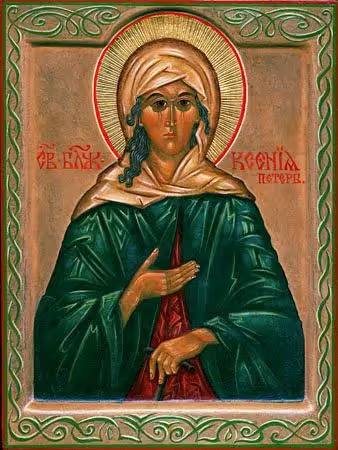
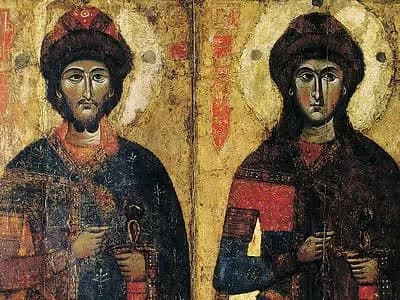
Famous Orthodox churches and monasteries in Russia
The sacred architecture of Orthodox Russia — cathedrals, parishes, and the mountain monasteries that keep the lamps burning.
- Cathedral of Christ the Saviour, Moscow — The patriarchal cathedral of the Russian Orthodox Church, originally built in the 19th century as a monument of thanksgiving for Russia's deliverance from Napoleon, demolished by the Soviet authorities in 1931 and rebuilt in the 1990s. It is the seat of the patriarchal liturgy in Moscow.
- Saint Basil's Cathedral (Cathedral of the Intercession of the Most Holy Theotokos on the Moat), Moscow — Standing on Red Square, commissioned by Tsar Ivan IV in the 16th century and famous for its brightly coloured onion domes; one of the most iconic images of Russia and a UNESCO World Heritage Site.
- Dormition Cathedral of the Moscow Kremlin — The historic coronation church of Russian tsars and the cathedral of the metropolitans and patriarchs of Moscow, completed in 1479 under Ivan III.
- Trinity Lavra of St Sergius, Sergiev Posad — Founded in the 14th century by St Sergius of Radonezh, the greatest monastic centre of Russian Orthodoxy, a UNESCO World Heritage Site and spiritual heart of the Russian Church.
- Saint Isaac's Cathedral, Saint Petersburg — A vast neoclassical cathedral consecrated in 1858, dedicated to St Isaac of Dalmatia, the heavenly patron of Peter the Great; services are celebrated there alongside its museum function.
- Kazan Cathedral, Saint Petersburg — A cathedral on Nevsky Prospekt dedicated to Our Lady of Kazan, one of Russia's most venerated icons; built 1801–1811 by the architect Andrei Voronikhin and returned to the Russian Orthodox Church in 1992.
- Valaam Monastery (Monastery of the Transfiguration of the Saviour) — A stauropegic monastery on Valaam Island in Lake Ladoga, Karelia, an ancient centre of northern Russian monasticism.
- Solovetsky Monastery — Founded in the 1430s on the Solovetsky Islands in the White Sea, a UNESCO World Heritage Site celebrated for its austere northern spirituality and for the witness of its new martyrs during the Soviet period.
Orthodoxy
kept here.
The shape of the faith as it is lived and prayed across Russia today.
Russia is overwhelmingly shaped by the Eastern Orthodox tradition. Surveys by the Levada Center in 2020 estimated that roughly 63% of Russians identify as Orthodox Christians, and Encyclopaedia Britannica places the membership of the Russian Orthodox Church at more than 90 million faithful — making Russia by far the largest Orthodox country in the world.
The Russian Orthodox Church (Moscow Patriarchate) is the dominant and historically rooted jurisdiction. Its services are celebrated in Church Slavonic on the Julian calendar, so Pascha, the Nativity of Christ (7 January civil / 25 December Julian) and the Twelve Great Feasts fall on their traditional dates. Parish life centers on the Divine Liturgy, veneration of icons (Russia's icon tradition — Rublev, Theophanes the Greek, the Moscow and Novgorod schools — is world-renowned), the feasts of Russian saints such as Sergius of Radonezh, Seraphim of Sarov, Xenia of Petersburg and the New Martyrs and Confessors of Russia, and a rich culture of pilgrimage to great monasteries.
Although the Russian Federation is a secular state by its Constitution, the Church has a privileged public role: it is recognized in law as one of Russia's "traditional" religions, cooperates widely with state institutions, and provides military and prison chaplaincy. A minority of Russians belong to Old Believer communities, which separated from the Church in the 17th century over Patriarch Nikon's liturgical reforms; a small Russian Catholic and Protestant population also exists but lies outside the Orthodox communion. Oriental Orthodox Christians (for example, Armenian Apostolic parishes) are present in Russia as a distinct communion and are not part of the Eastern Orthodox Church.
Beyond its borders the Moscow Patriarchate exercises canonical oversight over dioceses in Belarus, Moldova, Central Asia, the Baltic states, Western Europe, East Asia and — through the Russian Orthodox Church Outside Russia — a large diaspora in North America, Australia and elsewhere.
Asked
of this land.
Frequently asked questions about Orthodoxy in Russia
When did Russia become Orthodox?
Russia traces its Christian origins to the year 988, when Grand Prince Vladimir of Kiev was baptized and had the people of Kiev baptized in the Dnieper River, an event known as the Baptism of Rus'. Christianity had already been introduced earlier by Greek missionaries from Byzantium, but 988 marks the formal conversion of the nation.
Is the Russian Orthodox Church autocephalous?
Yes. The Russian Church declared its autocephaly in 1448 by electing its own metropolitan, and in 1589 the metropolitan of Moscow was elevated to the rank of Patriarch, a status confirmed by the ancient Eastern patriarchates.
Who leads the Russian Orthodox Church today?
The primate is His Holiness Kirill, Patriarch of Moscow and All Rus', elected in 2009. He presides over the Holy Synod and the Bishops' Council, which together govern the Church.
What language is used in Russian Orthodox services?
The liturgical language is Church Slavonic, a sacred form of Old Slavic developed from the mission of Saints Cyril and Methodius. Sermons, readings of parish notices and some hymns may be given in modern Russian.
What calendar does the Russian Church follow?
The Russian Orthodox Church follows the Julian calendar for all fixed feasts and for the paschalion. This is why the Nativity of Christ is celebrated on 7 January by the civil (Gregorian) calendar.
How many Orthodox Christians live in Russia?
Estimates vary by methodology, but around 63% of Russians identify as Orthodox according to the Levada Center, and the Russian Orthodox Church's total membership is generally placed at more than 90 million — making Russia the largest Orthodox Christian nation in the world.