
Saint Apostle and Evangelist Luke.
Also known as Saint Luke the Evangelist, Luke the Apostle, The Physician Luke, Luke of Antioch, Luke the Iconographer
Physician, painter, and companion of the Apostle Paul, Luke authored the Third Gospel and Acts of the Apostles. He is venerated as the first iconographer of the Theotokos.
Let us praise the godly Luke:
he is the true preacher of piety,
the orator of ineffable mysteries
and the star of the Church;
for the Word, Who alone knows the hearts of men,
chose him, together with wise Paul,
to be a teacher of the gentiles!
The Beloved
Physician and First Iconographer
Saint Luke, called "the beloved physician" by the Apostle Paul, was a Gentile Christian of exceptional learning and literary skill. From Antioch, he became Paul's faithful companion and the principal historian of the early Church. Beyond his Gospel and Acts, Luke is remembered as the founder of Christian iconography, having painted the first sacred images from life - a tradition that shaped Orthodox devotion for two millennia.
Early years
Saint Luke was a native of Syrian Antioch and a physician, and from his youth he applied himself to seek after wisdom and to study the arts and sciences. He traveled all over the world to quench his thirst for knowledge, and had particular skill as a physician and in painting. Many scholars believe that Luke was a physician who lived in the Hellenistic city of Antioch in Ancient Syria, born of a Greek family, though his exact ethnic background - whether he was a Gentile or a Hellenic Jew - has been debated among scholars.
The Gospel he wrote shows his excellent command of Greek; he also knew Hebrew and Aramaic. This multilingual competence and rhetorical sophistication would later enable him to communicate the Gospel across diverse communities in the Mediterranean world. There is a tradition that Luke was one of the Seventy Disciples that the Lord Jesus Christ sent before Him, two by two, to announce salvation in the towns and villages. Luke was in Jerusalem at the time of the life-giving Passion and, on Easter morning, walked with Cleopas (October 30) towards the village of Emmaus, distraught at the loss of the Master.
In the Church
Luke wrote his Gospel and the Acts of the Apostles at Rome in obedience to Paul, dedicating the Acts to Theophilus, the Governor of Achaia, who was a convert. In his Gospel, Luke adds details which are not found in the first two evangelists: in telling of the Savior's life, he especially stresses His mercy and compassion for sinful humanity that He has come to visit as a Physician (Luke 4:23; 5:31). And in the Acts, after telling of all that happened in the foundation of the Church at Jerusalem, he gives most attention to the work of his master, Saint Paul, who labored more abundantly than all the other Apostles in spreading the glad tidings of salvation.
Luke accompanied Saint Paul on his second missionary journey, and from that time they were inseparable. When Paul's coworkers had forsaken him, only Luke remained to assist him in his ministry (2 Tim. 4:10-11). After two years of imprisonment in Rome, Paul was released and immediately resumed his traveling ministry, followed by his faithful disciple Luke. Luke's presence with Paul during his final imprisonment in Rome is attested in Scripture itself, where Paul writes, "Only Luke is with me" (2 Timothy 4:11).
Later years
After the martyric death of the First-Ranked Apostles Peter and Paul, Saint Luke left Rome to preach in Achaia, Libya, Egypt and the Thebaid. On his return to Greece, Luke became Bishop of Thebes in Boeotia; he ordained priests and deacons, established churches and healed the sick in soul and body by his prayer. Luke was 84 years old when the wicked idolaters tortured him for the sake of Christ and hanged him from an olive tree in the town of Thebes, in Beothia of Greece. Though some sources say Saint Luke died here in peace in his eighties, other sources say he was crucified here to an olive tree and died a martyric death. The tomb works miracles even today. In December 22, 1997 at 1.30pm myrrh appeared on the tomb's marble and since then the interior of the marble sarcophagus is fragrant. The olive tree is still living to the right side of the cemetery in Thebes.
Legacy and veneration
It is the tradition of the Church that Saint Luke was the first iconographer and that he painted an image of the Holy Mother of God in her earthly lifetime. The All Holy Virgin praised this representation and said, "May the grace of Him who was born of me be upon this image." Saint Luke afterwards painted other images of the All Holy Virgin and of the Apostles, giving rise in the Church to the devout and holy tradition of veneration of the icons of Christ and of His Saints. He painted icons of the Most-holy Theotokos - not just one, but three - as well as icons of the Holy Apostles Peter and Paul. For this reason, St. Luke is considered the founder of Christian iconography.
The Eastern Orthodox Church, the Roman Catholic church and other major denominations venerate him as Saint Luke the Evangelist and as a patron saint of artists, physicians, bachelors, notaries, butchers, brewers, and others; his feast day is 18 October. His feast days are celebrated on October 18; on April 22 with Apostles Nathaniel and Clement; on June 20 on which day his relics, among others, were translated to the Church of the Holy Apostles in Constantinople; and on January 4, the synaxis of the Seventy. The veneration of icons throughout Orthodox Christianity stands as Luke's most enduring legacy, as his evangelistic work through art and word continues to bear fruit in the faithful's encounter with the sacred.
How the saint's
memory is kept.
- When is the feast day of Saint Luke?
- The feast day of the Apostle and Evangelist Luke is October 18. He is also commemorated on April 22 with Apostles Nathaniel and Clement, and on June 20, the feast of the translation of his relics to Constantinople. He is also honored on January 4 in the synaxis of the Seventy Apostles.
- What did Saint Luke write?
- Saint Luke authored the Gospel of Luke and the Acts of the Apostles, constituting more than one-quarter of the New Testament. Both works were dedicated to Theophilus, the Governor of Achaia. Luke's Gospel emphasizes Christ's mercy and compassion, while Acts provides the primary historical account of the early Church after the Resurrection.
- Was Saint Luke one of the Twelve Apostles?
- No. Saint Luke was not one of the Twelve Apostles, but rather one of the Seventy Apostles commissioned by Christ. He became a devoted companion of the Apostle Paul during Paul's missionary journeys, and is called "the beloved physician" in Scripture.
- What is the tradition regarding Saint Luke and icons?
- Saint Tradition holds that Luke was the first iconographer, having painted several icons of the Most Holy Theotokos during her earthly lifetime. The Virgin Mary blessed his work, saying "May the grace of Him Who was born of Me be with these icons." Luke also painted icons of the Apostles Peter and Paul, establishing the theological foundation for icon veneration in the Church.
- Where are the relics of Saint Luke today?
- The main body of Saint Luke's relics is housed in the Abbey of Santa Justina (also called Santa Giustina) in Padua, Italy, where they were brought after the Fourth Crusade in 1204. His skull is in the Cathedral of Saint Vico in Prague. A portion of his relics, including a rib, was returned to Thebes, Greece in 2001 and is venerated in the Orthodox cathedral there, where his empty sepulchre continues to manifest his intercession through myrrh that appeared miraculously in 1997.
- What was Saint Luke's profession?
- Saint Luke was a physician by profession, trained in Greek medical arts. The Apostle Paul refers to him as "the beloved physician" in Colossians 4:14. His medical knowledge is evident in his Gospel, which uses precise medical terminology when describing afflictions and healings. He is venerated as the patron saint of physicians, surgeons, and healers.
- How did Saint Luke die?
- According to tradition, Saint Luke was martyred at age eighty-four in Thebes, Boeotia (Greece). While some sources say he died a natural death, the predominant Church tradition reports that he was tortured and either hanged or crucified on an olive tree by pagan authorities who opposed Christianity. The olive tree at the site is said to still be living today.
- Why is Saint Luke important to historians?
- Saint Luke is the primary source for understanding the history of the early Church. His Acts of the Apostles, combined with his Gospel, constitutes the only comprehensive narrative account of Christianity's spread from Jerusalem throughout the Mediterranean world. His historical precision, literary sophistication, and incorporation of eyewitness testimony make him one of the most important writers in Christian history.
Let us praise with sacred songs the holy Apostle Luke,
the recorder of the joyous Gospel of Christ
and the scribe of the Acts of the Apostles,
for his writings are a testimony of the Church of Christ:
He is the physician of human weaknesses and infirmities.
He heals the wounds of our souls,
and constantly intercedes for our salvation!
O Holy Apostle and Evangelist Luke, intercede to our merciful God, that He may grant our souls forgiveness of sins. As a disciple of the Word of God, with Paul you illuminated all the earth and dispelled the gloom in writing Christ's divine Gospel. Entreat the Lord that He may grant salvation and great mercy to all those who honor your holy memory, that we may praise Him as the Giver of all good things and the Lover of mankind.
Carry the tradition with you.
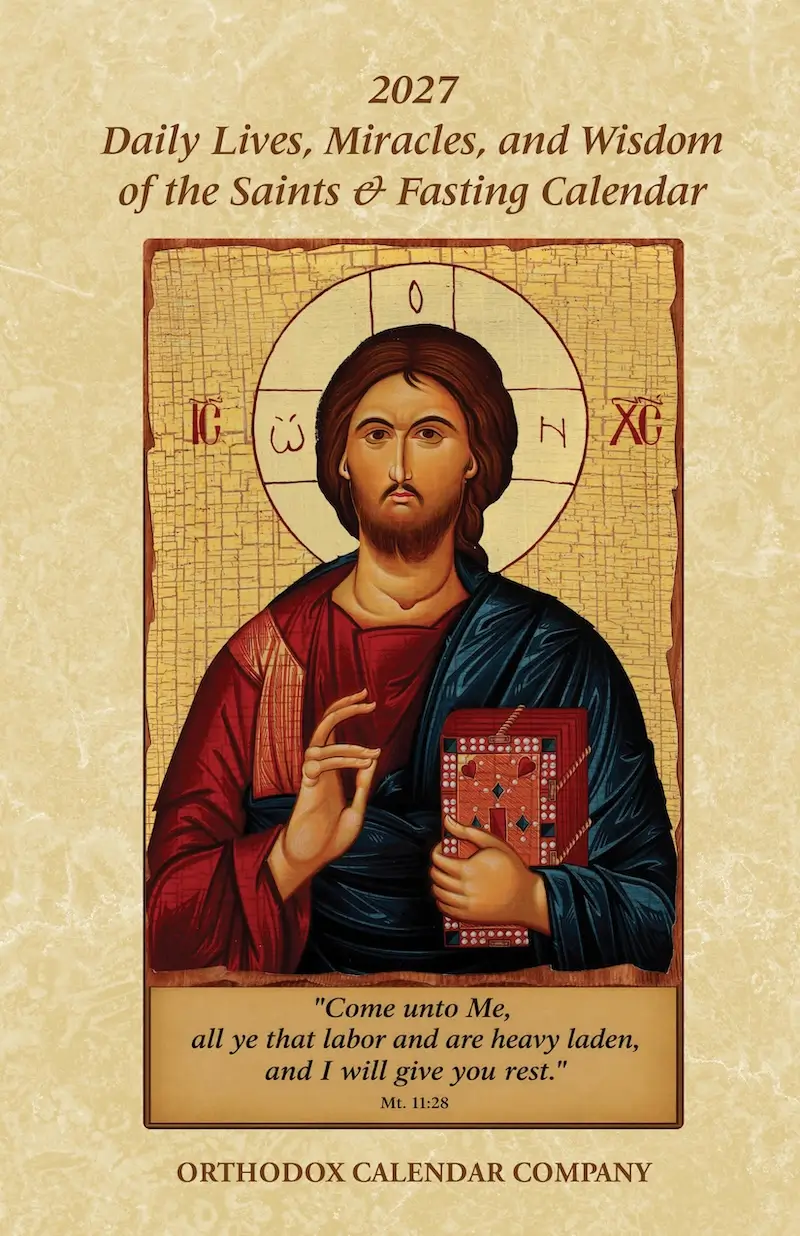
Hand-finished icons, books, and calendars to carry the Orthodox day into your home.
Read a life like this
every morning.
Meet the daily saints through Orthodox Daily Companion on iPhone and iPad, or through the Lives of the Saints web app in any modern browser.
Orthodox Daily Companion
The native Apple app, with a Home Screen widget, prayer reminders, and a private on-device journal.
Download on the App StoreLives of the Saints Web App
The browser experience for desktop, tablet, or phone, with a seven-day trial of the complete devotional library.
Open the web appGet a life like this one on every new tab - free, no account, from the same catalogue.
References and further reading
- oca.orghttps://www.oca.org/saints/lives/2013/10/18/102993-apostle-and-evangelist-luke
- goarch.orghttps://www.goarch.org/-/feast-of-the-holy-apostle-and-evangelist-luke
- orthodoxwiki.orghttps://orthodoxwiki.org/Apostle_Luke
- en.wikipedia.orghttps://en.wikipedia.org/wiki/Luke_the_Evangelist
- britannica.comhttps://www.britannica.com/biography/Saint-Luke
- oca.orghttps://www.oca.org/saints/troparia/2014/10/18/102993-apostle-and-evangelist-luke
- orthodoxchristianethos.comhttps://orthodoxchristianethos.com/2023/10/18/on-the-18th-of-october-the-holy-orthodox-church-commemorates-the-holy-apostle-luke-the-evangelist/
- orthodoxchurchsheffield.comhttps://www.orthodoxchurchsheffield.com/post/akathist-to-the-holy-apostle-and-evangelist-luke-oct-18
- stluke.ushttps://www.stluke.us/stluke
- oca.orghttps://www.oca.org/saints/all-lives/2007/10/18
- myocn.nethttps://myocn.net/st-luke-the-evangelist-celebrated-october-18-some-wise-words-from-a-wise-man/
- oneinchrist.inhttps://oneinchrist.in/st-luke-the-evangelist-october-18-i-apostle-and-evangelist-the-first-iconographer/
- legacyicons.comhttps://legacyicons.com/saint-luke-the-evangelist-koufos-icon-s358/
- obitel-minsk.orghttps://obitel-minsk.org/en/saint-luke-as-an-icon-painter
- legacyicons.comhttps://legacyicons.com/saint-luke-the-evangelist-xxic-icon-s508/
- ecosemiotics.comhttps://ecosemiotics.com/2021/10/31/the-holy-apostle-and-evangelist-luke-and-iconography/
- legacyicons.comhttps://legacyicons.com/apostle-luke-the-iconographer-icon-s174/
- russianicons.wordpress.comhttps://russianicons.wordpress.com/2011/10/27/another-icon-myth-icons-painted-by-st-luke/
- catholicinsight.comhttps://catholicinsight.com/luke-evangelist-and-physician/
- catalog.obitel-minsk.comhttps://catalog.obitel-minsk.com/blog/2021/01/st-luke-the-apostle-as-an-icon-painter-did-he-really-paint-icons
More from the tradition.
Read the Journal
Essays on feasts, fasting, and the rhythm of the Church year.
ExploreOrthodox countries
How the faith is lived and kept across the Christian world.
ExploreThe 2027 Calendar
A saint, a reading, and the day's fasting guideline for every day of 2027.
ExploreMobile & web apps
Carry the daily rhythm on iPhone and iPad or continue in the web app.
Explore