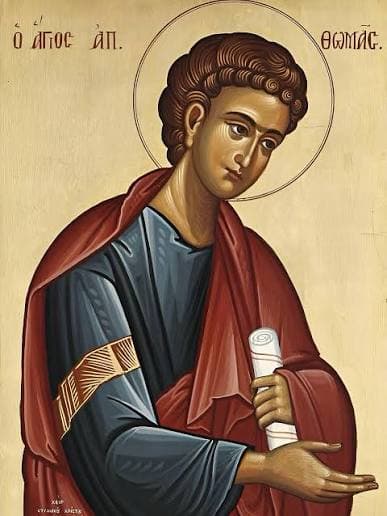
Saint Apostle Thomas.
Also known as Saint Thomas the Apostle, Thomas Didymus, Thomas the Twin, Doubting Thomas
One of the Twelve Apostles renowned for his confession of faith after the Resurrection, Thomas preached the Gospel in Parthia and India and was martyred there, establishing Christian communities along the Malabar Coast.
Tone 2
Thou wast a disciple of Christ and one of the Twelve, and by thy unbelief didst proclaim Christ's Resurrection. By touch thou wast assured of His holy Passion, O glorious Apostle Thomas. Pray to Him to grant us peace and mercy.
The Apostle
to India
Thomas was one of the Twelve Apostles chosen by Christ, best known for his momentary doubt of the Resurrection, which led to his profound confession of faith: "My Lord and my God!" He became an intrepid missionary who traversed the distant lands of Parthia and India, establishing Christian communities and ultimately dying as a martyr, having first brought the light of the Gospel to lands of darkness.
Early years
Thomas, the Holy Apostle, surnamed Didymos (which means "twin"), was born in the Galilean city of Paneada, the child of poor parents. In his youth, he cherished the law of Moses greatly and diligently studied the Sacred Scripture of the Jews. Never interested in the games other children played, he led a godly life, occupying himself constantly with physical labor or the activity of the soul.
When our Lord Jesus Christ, during His sojourn on earth with men, passed through the cities and villages, teaching the people and healing all manner of diseases, Thomas, on hearing His preaching and seeing His miracles, cleaved unto Him with all his heart. Delighting in the sweet words of Jesus Christ and the sight of His All-Holy face, Thomas followed Him and was accounted worthy by the Lord of a place in the Choir of the Twelve Apostles, with whom he followed Christ until the very time of His Saving Passion.
In the Church
When the holy Lazaros reposed (he who was to remain dead for four days in the tomb), it was Thomas who, a good faithful servant of his Master, said in the midst of His Disciples, "Let us also go, that we might die with him" (John 11:16).
Thomas displayed remarkable courage even before the Resurrection, unafraid to accompany his Master into danger. Thomas was with the other Apostles when, on the day of Pentecost, the Holy Spirit came down upon their heads in the form of tongues of fire. He was filled, like the rest, with the power from on High for the proclamation of the world's Salvation; and, when the Apostles went their separate ways, it fell to Thomas to bring the Glad Tidings to the distant lands of the Medes and Parthians (Iran), and as far as India.
Later years
He was grieved to be sent to such barbarous peoples, but the Lord appeared unto him in a vision and strengthened him, commanding him not to fear. He promised to abide with Thomas and showed him the way to those lands in the following manner: Gundafor, the King of India, who desired to erect for himself a royal palace of the most splendid sort, sent Abban, a merchant of his country, to the land of Palestine, to find there a skilled builder who knew well the science of architecture and could build a palace like those in which the emperors of the Romans lived. According to Church tradition, the Lord arranged circumstances compelling Thomas to accompany the merchant to India.
There, Thomas performed several miracles including raising those who had died, as well as healings and exorcisms, all of which resulted in many conversions at the royal court. Among others, Thomas converted two sisters to the Faith - Tertiana and Migdonia - both wives of Indian princes. Because of their faith, both sisters were ill-treated by their husbands, with whom they no longer wanted to live after their baptism. His fervent evangelism provoked the wrath of local pagan authorities.
For having converted the wife and son of the prefect of the Indian city of Meliapur (Melipur), the holy apostle was locked up in prison, suffered torture, and finally, pierced with five spears, he departed to the Lord.
Legacy and veneration
He is believed to have traveled eastward to spread the message of Christianity, eventually reaching India, where he is honored as the founder of the Thomas Christians, particularly in Kerala. To this day in southwest India, along the Malabar Coast, there are people who call themselves Thomas Christians or Christians of St. Thomas and claim Thomas as the founder of their church. Thomas is considered the patron saint of the East Indies.
His holy remains (corpus), after a long interval of time, were removed to the city of Edessa in Syria and there interred. The reputed relics of Saint Thomas remained at Edessa until they were moved to Chios in 1258. Some portion of the relics were later transferred again, and now rest in the Cathedral of Saint Thomas the Apostle in Ortona, Italy.
Saint John Chrysostom teaches that "Thomas, being once weaker in faith than the other apostles, toiled through the grace of God more bravely, more zealously and tirelessly than them all, so that he went preaching over nearly all the earth, not fearing to proclaim the Word of God to savage nations." His legacy endures in the churches and Christian communities he established, and his witness remains a powerful testimony to how God transforms doubt into unshakeable faith and sends forth mighty witnesses.
How the saint's
memory is kept.
- When is the feast day of Apostle Thomas in the Eastern Orthodox Church?
- The primary feast day of Apostle Thomas is October 6 in the Eastern Orthodox calendar. He is also commemorated on June 30 with the Synaxis of the Twelve Apostles, on June 20 with the commemoration of the Translation of the Relics of the Apostles, and on the First Sunday after Easter known as the Sunday of Thomas.
- Why is Thomas called 'Doubting Thomas'?
- Thomas earned this name because when the other apostles told him that the risen Christ had appeared to them, he refused to believe without physical proof. He said, 'Unless I see in His hands the print of the nails, and put my finger into the print of the nails, and thrust my hand into His side, I will not believe.' Eight days later, Christ appeared again and invited Thomas to touch His wounds, after which Thomas made the greatest confession of faith: 'My Lord and my God!'
- What is Thomas known for in terms of mission and evangelism?
- Apostle Thomas is renowned as the Apostle to India. He preached the Gospel in Parthia, Persia, and along the Malabar Coast of India, establishing seven churches and founding the Thomas Christian communities that persist today in Kerala. His missionary zeal led him to convert many people, including members of royal families, before his martyrdom.
- Where did Apostle Thomas die and how was he martyred?
- Thomas died in Mylapore, near modern-day Chennai, India, in 72 AD. According to Church tradition, he was martyred by being pierced with five spears on a hill while at prayer, after he had converted the wife and son of the prefect of Meliapur, thereby provoking the anger of local pagan authorities and priests.
- Where are the relics of Apostle Thomas today?
- Parts of Thomas's relics are dispersed in various locations. Some relics remain in India, others are on Mount Athos, in Hungary, and notably at the Cathedral of Saint Thomas the Apostle in Ortona, Italy, where they have been held since 1258. His skull is believed to be at the Monastery of Saint John the Theologian on the island of Patmos.
- What does the Orthodox Church teach about Thomas's doubt?
- The Eastern Orthodox Church does not regard Thomas as a mere doubter but as someone whose faith was strengthened through divine grace. His momentary doubt became an opportunity for Christ to demonstrate the reality of His bodily Resurrection. Through his touching of Christ's wounds, Thomas became the first to explicitly confess Jesus's divinity, making his faith a profound gift to the entire Church. Saint John Chrysostom teaches that Thomas labored more bravely and zealously than all the other apostles in proclaiming the Gospel.
- What is the significance of the Arabian Icon of the Mother of God in relation to Thomas?
- The Eastern Orthodox Church associates Apostle Thomas with the Arabian (Arapet) Icon of the Mother of God, commemorated on September 6. According to tradition, Thomas was granted to witness the Dormition (falling asleep) of the Mother of God, and she gave him her girdle (cincture) as a sign, which became associated with this icon and is commemorated on August 31.
- What occupations or skills are associated with Apostle Thomas?
- Thomas is recorded as a fisherman by trade before becoming an apostle. According to the apocryphal Acts of Thomas, he was skilled as a carpenter or builder, which led to him being sold as a slave to build a palace for an Indian king. Because of his association with building and construction, Thomas is venerated as the patron saint of architects, builders, carpenters, geometricians, and masons.
Tone 4
CHRIST'S Apostle, who was filled with God's Divine grace, he who was His genuine and faithful servant in all truth, all-lauded Thomas exclaimed aloud in deep repentance: Thou art both my God and Lord.
O Holy Apostle Thomas, intercede with the merciful God that He grant unto our souls forgiveness of offences.
Carry the tradition with you.
Hand-finished icons, books, and calendars to carry the Orthodox day into your home.
Read a life like this
every morning.
Meet the daily saints through Orthodox Daily Companion on iPhone and iPad, or through the Lives of the Saints web app in any modern browser.
Orthodox Daily Companion
The native Apple app, with a Home Screen widget, prayer reminders, and a private on-device journal.
Download on the App StoreLives of the Saints Web App
The browser experience for desktop, tablet, or phone, with a seven-day trial of the complete devotional library.
Open the web appGet a life like this one on every new tab - free, no account, from the same catalogue.
References and further reading
- orthodoxwiki.orghttps://orthodoxwiki.org/Apostle_Thomas
- goarch.orghttps://www.goarch.org/-/feast-of-the-holy-apostle-thomas
- oca.orghttps://www.oca.org/saints/lives/2009/10/06/102885-holy-glorious-apostle-thomas
- britannica.comhttps://www.britannica.com/biography/Saint-Thomas
- saintkosmas.orghttps://saintkosmas.org/chrysostom-press-october-6-saint-thomas-the-apostle
- stgeorge.orghttps://stgeorge.org/2021/10/wednesday-oct-6-feast-of-st-thomas-the-apostle
- ww1.antiochian.orghttps://ww1.antiochian.org/node/23885
- en.wikipedia.orghttps://en.wikipedia.org/wiki/Thomas_the_Apostle
- ebsco.comhttps://www.ebsco.com/research-starters/history/feast-st-thomas-apostle
- orthodoxchristianethos.comhttps://orthodoxchristianethos.com/2022/10/06/6th-of-october-the-feast-of-the-holy-and-glorious-apostle-thomas
- iconreader.wordpress.comhttps://iconreader.wordpress.com/2010/08/17/how-to-recognize-the-holy-apostles-in-icons
- russianicon.comhttps://russianicon.com/apostle-icons-saint-thomas-the-apostle
- trinityiconographers.orghttps://www.trinityiconographers.org/five-specific-icons/st-thomas-the-apostle
- athoniteusa.comhttps://www.athoniteusa.com/products/the-assurance-of-apostle-thomas
- stgeorge.orghttps://stgeorge.org/2021/10/wednesday-oct-6-feast-of-st-thomas-the-apostle/
- getgreece.comhttps://www.getgreece.com/greek-saints/st-thomas-the-apostle
- orthodoxchristianethos.comhttps://orthodoxchristianethos.com/2022/10/06/6th-of-october-the-feast-of-the-holy-and-glorious-apostle-thomas/
- goarch.orghttps://www.goarch.org/thomas-sunday-learn
- ocoy.orghttps://ocoy.org/original-christianity/apostle-of-india/
- orovillecatholic.orghttps://orovillecatholic.org/saint-thomas-the-apostle/
More from the tradition.
Read the Journal
Essays on feasts, fasting, and the rhythm of the Church year.
ExploreOrthodox countries
How the faith is lived and kept across the Christian world.
ExploreThe 2027 Calendar
A saint, a reading, and the day's fasting guideline for every day of 2027.
ExploreMobile & web apps
Carry the daily rhythm on iPhone and iPad or continue in the web app.
Explore