Every new tab,
one saint.
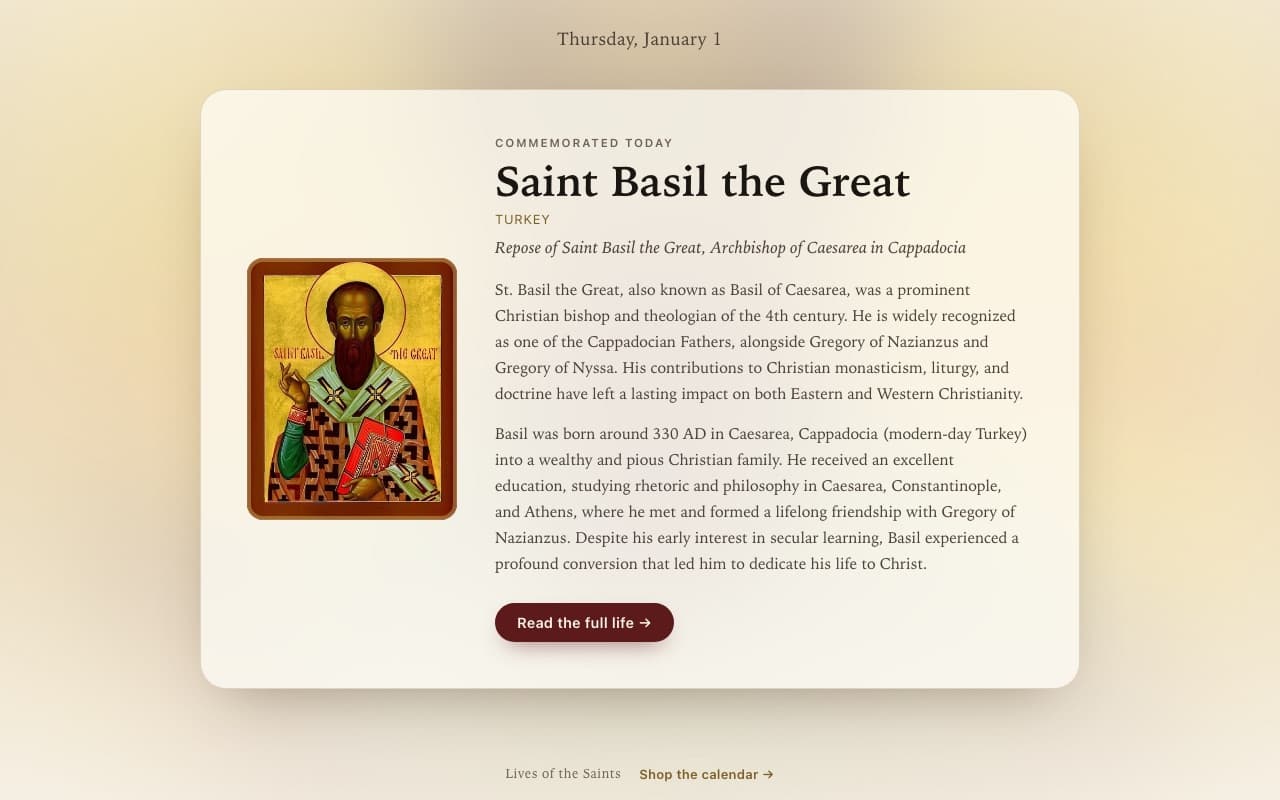
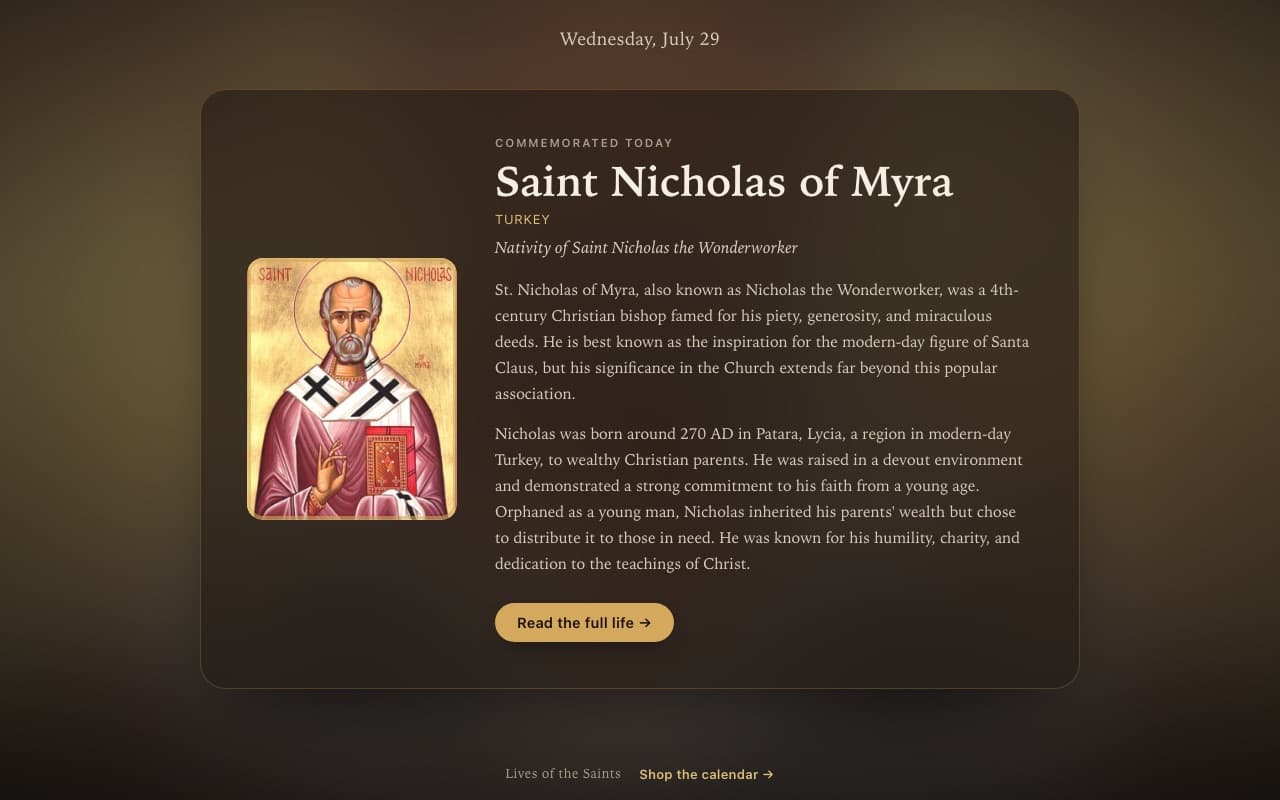
Saint of the Day turns the blank new tab into a single life from the Orthodox calendar - their icon, where they lived and when, and the opening of their story. When you want the rest, one click brings you here. No feed, no notifications, nothing to dismiss.
The tab you open
a hundred times a day.
One life, told properly -
not a headline.
The saint, and where they stood
Their icon, their name, and the place and era they belong to - enough to know who you are looking at before you read a word.
A couple of paragraphs
The opening of their life, drawn from the same text this site tells at length. Enough to read in the moment, before the tab turns into a task.
The rest, one click away
“Read the full life” opens their page here - the whole account, hymnography, feast day, and the country they are kept in.
A feast is named a feast.
Everything else says so.
On days the calendar commemorates a saint, you see that saint, marked Commemorated today, with the feast title where there is one.
The catalogue does not yet cover all 365 days. On the days it doesn’t, you see another life instead, clearly marked From the lives of the saints - never dressed up as a feast it isn’t.
Which life appears is a fixed function of the date: every install sees the same saint on the same day, the catalogue is spread evenly across the year, and it reads the same year over year. Dates follow the New (Revised Julian) Calendar, taken from your own device’s local day.
It asks nothing of you
but the tab you were opening anyway.
No account
Nothing to sign up for, nothing to log into. Install it and open a tab.
No tracking, no ads
No analytics, no identifiers, no advertising. The one request it makes carries nothing but the date.
One permission
Storage - used only to keep the day's entry on your own machine. It reads nothing it did not write itself.
Works offline
It paints instantly from that cache, then refreshes in the background, so a dead connection still shows the last day it fetched.
Follows your theme
Light or dark, matched to your system setting. No preference to configure.
Free
From the family that has printed the Lives of the Saints calendar since 1995. If you want to support it, buy a calendar.
The whole thing is a thin client over our public calendar API - the same endpoint anyone can call. What it does is written out in full in our privacy policy.
Three steps,
about twenty seconds.
Add it from your store
One click - the Chrome Web Store listing, or Microsoft Edge Add-ons if you are on Edge. It installs with no host permissions, so there is no scary access warning to read past.
Confirm the new tab
The browser asks whether to let it change your new tab page - that is the whole point of it, so keep the change.
Open a tab
That's it. A saint is waiting. Changed your mind? chrome://extensions (or edge://extensions) → Remove, and your old new tab is back.
Before you install,
the honest answers.
Yes - free to install and free to keep, with no account, no trial, and nothing to upgrade to. It is published by the same family that has printed the Lives of the Saints calendar since 1995; if you would like to support the work, buy a calendar.
Yes. Microsoft Edge has its own listing on Edge Add-ons, so there is nothing to accept about installing from another store. Brave, Arc, and Opera take the Chrome Web Store build as they are. Safari and Firefox use different extension formats and are not supported.
When the calendar commemorates a saint on that date, yes - you see that saint, marked “Commemorated today”, with the feast title where there is one. The catalogue does not yet carry a commemoration for all 365 days, so on the remaining days you see another life instead, clearly marked “From the lives of the saints” rather than dressed up as a feast it isn't.
The New (Revised Julian) Calendar, using your device's local date, so the day is right regardless of where the server's clock happens to be.
None. There is no account, no analytics, and no ads. It asks for one permission - storage - used only to keep the current day's entry on your own machine so the tab paints instantly and still works offline. The single request it makes to our site carries nothing but the date.
Open chrome://extensions (edge://extensions on Edge), find Saint of the Day, and click Remove. Your new tab goes back to whatever it was before, immediately.
More from the tradition.
Every life in full
The saints the extension draws from - martyrs, ascetics, and wonderworkers of the Church.
ExploreThe daily apps
Readings, the Daily Office, fasting, and the Fathers - on iPhone and iPad or in a browser.
ExploreThe printed calendar
A saint for every day of the year - 384 pages, bound and shipped. Thirty-one editions.
ExploreThe public API
The same calendar the extension reads, free for your own app or agent.
ExploreLet the next tab
open on a saint.
Free, quiet, and over in twenty seconds. Then one life a day, for as long as you keep it.