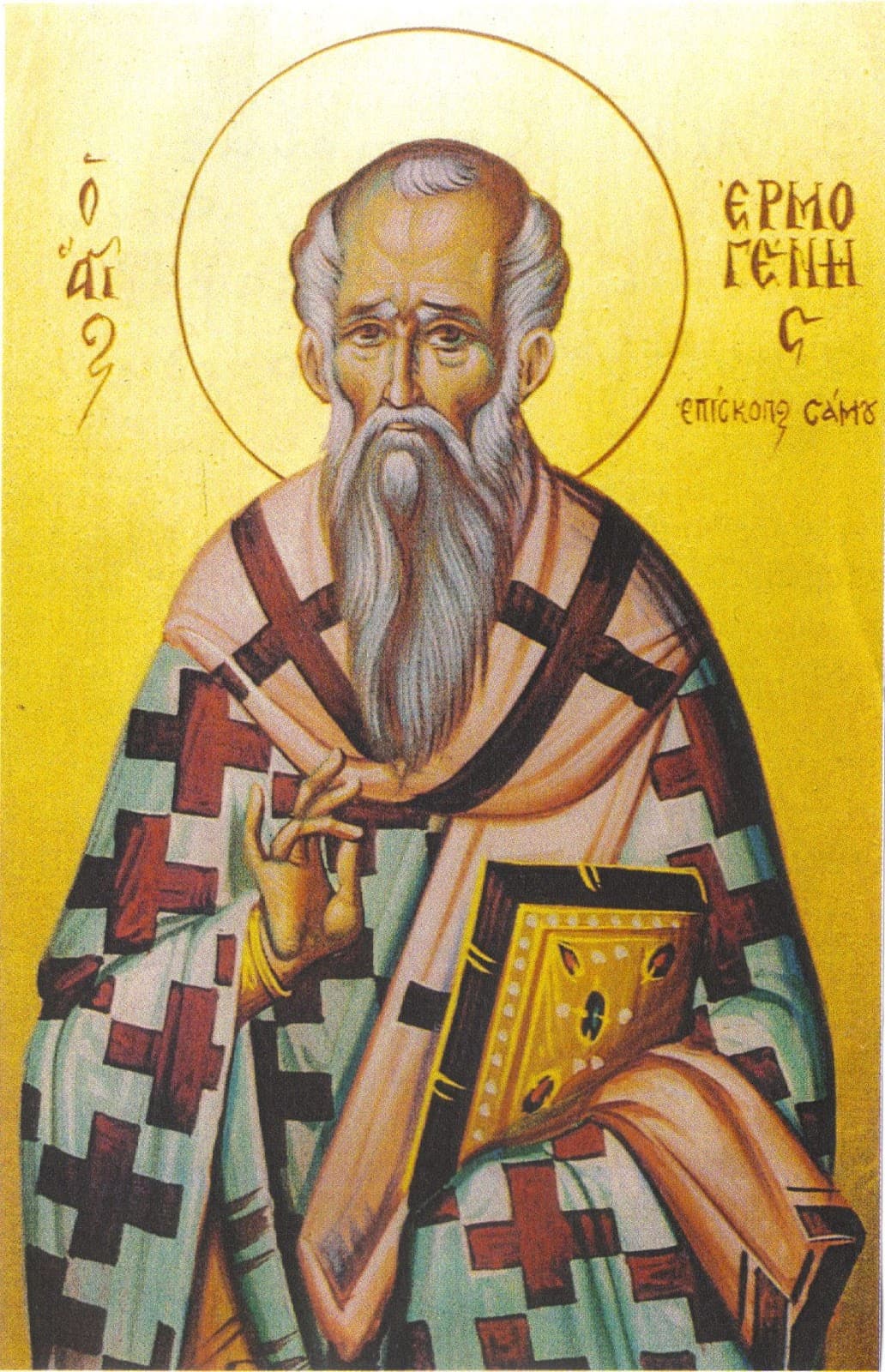
Saint Hermogenes the Wonderworker
of Samos.
Also known as Hieromartyr Hermogenes of Samos, Saint Hermogenes, Bishop of Samos, Hermogenes the Wonderworker, Bishop of Samos, Germogenes of Samos
A fourth-century bishop who shepherded the church in Samos with apostolic zeal and was martyred for refusing to renounce Christ, his relics are venerated as a source of miracles and are preserved in Cyprus.
Tone 4
The specific troparion for Saint Hermogenes of Samos from the standard Orthodox service books is not readily available in published English translations. However, the faithful are encouraged to invoke his intercession through the liturgical services composed for him, particularly the Divine Office published by Bishop Makarios of Kition in 1772 and the more recent office composed by Archimandrite Nikodemos Paulopoulos in 1991. The Church celebrates his martyrdom and wonder-working through hymns that honor his confession of faith and miraculous healings.
A Martyr
Bishop of Unwavering Faith
Saint Hermogenes was born in the fourth century in Asia Minor and, after receiving monastic formation in Egypt and ordination in Constantinople, was consecrated Bishop of Samos. There he served with apostolic zeal, converting pagans to the faith, until he was tortured and martyred for refusing to renounce Christ. His relics were miraculously conveyed by sea to Cyprus, where they have been venerated as a source of healings and wonders for nearly two millennia.
Early years
Saint Hermogenes was born in Foinikounta in the region of Attalia in Asia Minor sometime in the fourth century AD. Upon the death of his parents, leaving him an orphan, he gave away his entire fortune to the poor - a decisive act of renunciation characteristic of the ascetic calling. He then departed for Egypt to pursue the monastic life, seeking spiritual growth through prayer, fasting, and humble obedience.
After his years in Egypt, he moved to Athens and later to Constantinople, where he received priestly ordination. These formative journeys exposed him to the vibrant Christian communities and ecclesiastical traditions of the Christian East and positioned him for greater episcopal responsibilities.
In the Church
Saint Hermogenes was eventually consecrated Bishop of Samos, one of the major islands of the Aegean and an ancient seat of Christian witness. As bishop, he shepherded the flock of Christ with pastoral zeal and love, laboring tirelessly in the apostolic ministry. His episcopate was marked by effective preaching and the conversion of many pagans who, witnessing his faith and miracles, turned from idolatry to embrace the Christian gospel.
However, his success in evangelism provoked the hostility of those committed to pagan worship. The pagan inhabitants of Samos denounced their bishop to the Roman governor, Saturninus, accusing him of blasphemy and subversion of the traditional religion. The governor then subjected Saint Hermogenes to torture with the explicit demand that he renounce Christ and offer sacrifice to the gods.
Later years
Saint Hermogenes endured horrific torments with steadfast faith. He was suspended and lacerated, his wounds were burned with burning lamps, and he was cast into prison in chains. Yet Christ appeared to him in his cell, healing his wounds and strengthening his resolve. Released and brought again before the governor, he was tied to horses and dragged across the ground, his flesh tearing away. Yet he continued to proclaim the faith. His teeth were forcibly extracted and he was cast down a cliff, but the Lord preserved him and multiplied miracles of healing through his suffering body, converting witnesses to Christ. Finally, the governor, enraged by these miraculous interventions, ordered his beheading.
Faithful Christians, fearing that his holy body would be desecrated by enemies of the Church, retrieved his relics at night and placed them in a sack along with his vestments, then committed the precious burden to the sea. By divine providence, the waves guided his remains across the waters to Cyprus, where they came to shore near Kourion in the ancient city of Episkopi. Local Christians discovered the relics and honored them with devotion, immediately constructing a church at the place of their discovery - the Church of Saint Hermogenes in Kourion, which became a center of pilgrimage and miraculous healing.
Legacy and veneration
The legacy of Saint Hermogenes is one of unwavering faith, pastoral vigilance, and miraculous intercession. His feast day on October 5 is observed in the Eastern Orthodox Church, where the faithful commemorate his martyrdom and call upon his intercession. He is particularly venerated in Cyprus, where his relics remain the focal point of ecclesiastical devotion and the source of countless healings. The Church of Saint Hermogenes in Kourion has long been a place of pilgrimage and prayer.
The saint's veneration expanded significantly from the eighteenth century onward. In 1772, Bishop Makarios of Kition published a full Divine Office in honor of Saint Hermogenes at Venice, establishing a formal liturgical commemoration. In 1991, Archimandrite Nikodemos Paulopoulos of Leimonos Monastery in Lesvos composed another Divine Office for the saint, further enriching Orthodox hymnography in his honor. In 2004, Metropolitan Eusebios of Samos orchestrated the solemn transfer of a portion of the saint's skull from Limassol to Samos, where it was received with great celebration and processed to the Metropolitan Cathedral of Saint Nicholas, symbolizing the sacred bond between Samos and its renowned bishop.
Saint Hermogenes is invoked as a protector of both Samos and Cyprus, a guide in faith, and a healer of infirmities. His example of unflinching confession of Christ in the face of torture has inspired countless generations of Orthodox faithful to persevere in the faith, and his miraculous interventions continue to demonstrate the power of the risen Christ to sustain and heal His Church.
How the saint's
memory is kept.
- When is the feast day of Saint Hermogenes of Samos?
- October 5 in the Eastern Orthodox calendar (Gregorian calendar).
- Where was Saint Hermogenes of Samos born?
- Foinikounta in the region of Attalia in Asia Minor, in the fourth century AD.
- What was Saint Hermogenes' role in the Church?
- He was consecrated Bishop of Samos and shepherded the Christian community there with pastoral zeal, converting many pagans to the faith.
- How did Saint Hermogenes become a martyr?
- The pagan inhabitants of Samos denounced him to the Roman governor for refusing to renounce Christ and sacrifice to the gods. He was tortured extensively but remained faithful and was finally beheaded.
- Where are the relics of Saint Hermogenes preserved?
- His relics are primarily preserved in Cyprus, having been miraculously conveyed there by the sea. A portion of his skull was transferred to Samos in 2004.
- What is Saint Hermogenes known for?
- He is venerated as a wonderworker and hieromartyr, invoked for miraculous healings and spiritual protection. He is the patron of both Samos and Cyprus.
- How did Saint Hermogenes' relics reach Cyprus?
- After his martyrdom, faithful Christians placed his body in a sack with his vestments and committed it to the sea. By divine providence, the waves carried his relics to the shore of Cyprus near Kourion.
- What churches are dedicated to Saint Hermogenes?
- The Church of Saint Hermogenes in Kourion, Cyprus, was built at the place where his relics were discovered and has been a center of pilgrimage and miraculous healing for centuries.
Tone 1
The specific kontakion for Saint Hermogenes of Samos from the standard Orthodox service books is not readily available in published English translations. The faithful commemorate him through the Divine Office services, which include hymns of praise for his steadfast martyrdom and his protection of the faithful in Samos and Cyprus. Traditional invocations honor him as "Boast of Samos and glory of Cyprus" and as a healer who "works all forms of healings."
O Holy Hieromartyr Hermogenes, Wonderworker of Samos and Protector of Cyprus, as the sun illumined the ecumene with the radiance received from the Trinity, so too do you illuminate the hearts of all who call upon you in faith! You endured horrible torments with steadfast confession of Christ, were dragged by horses, yet healed by divine power, and finally received the crown of martyrdom. We, your unworthy servants, beseech you: entreat Christ our God on behalf of our souls, and grant us strength to stand firm in our faith in times of trial. Help us to proclaim the gospel with boldness, and extend your miraculous healing to all who suffer in body and spirit. Through your intercession, may we be delivered from the snares of the enemy, and may the Church of Christ rejoice in the fullness of your protection. Glory to Him Who made you well-pleasing to God, glory to Him Who gave you to us as a guide, glory to Him Who through you works all forms of healings.
Carry the tradition with you.
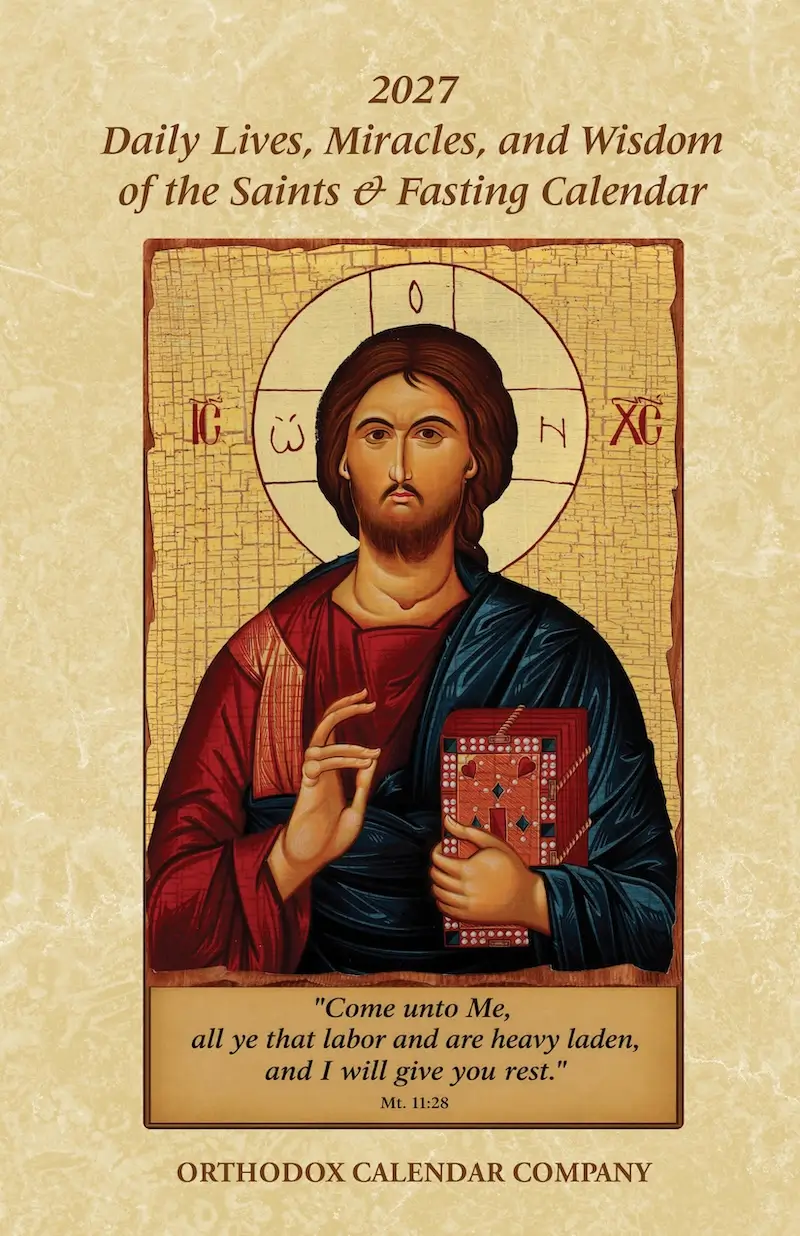
Hand-finished icons, books, and calendars to carry the Orthodox day into your home.
Read a life like this
every morning.
Meet the daily saints through Orthodox Daily Companion on iPhone and iPad, or through the Lives of the Saints web app in any modern browser.
Orthodox Daily Companion
The native Apple app, with a Home Screen widget, prayer reminders, and a private on-device journal.
Download on the App StoreLives of the Saints Web App
The browser experience for desktop, tablet, or phone, with a seven-day trial of the complete devotional library.
Open the web appGet a life like this one on every new tab - free, no account, from the same catalogue.
References and further reading
- orthodoxtimes.comhttps://orthodoxtimes.com/memory-of-hieromartyr-hermogenes-the-wonderworker-6/
- johnsanidopoulos.comhttps://www.johnsanidopoulos.com/2018/10/holy-hieromartyr-hermogenes.html
- handmadeiconsgreece.myshopify.comhttps://handmadeiconsgreece.myshopify.com/en-us/products/saint-hermogenes-the-wonderworker-and-bishop-of-samos
- en.wikipedia.orghttps://en.wikipedia.org/wiki/October_5_(Eastern_Orthodox_liturgics)
- orthodoxwiki.orghttps://orthodoxwiki.org/October_5
- oca.orghttps://www.oca.org/saints/lives/2025/05/12/101358-hieromartyr-hermogenes-patriarch-of-moscow-and-all-russia
- orthodoxwiki.orghttps://orthodoxwiki.org/Template:Saints20
- johnsanidopoulos.comhttps://www.johnsanidopoulos.com/2018/02/holy-hieromartyr-hermogenes.html
- goarch.orghttps://www.goarch.org/chapel/saints?contentid=2464
- oca.orghttps://www.oca.org/index.php/saints/lives/2000/02/17/100548-hieromartyr-hermogenes-patriarch-of-moscow-wonderworker-of-all-r
- oca.orghttps://www.oca.org/saints/lives/2025/05/12
- oca.orghttps://www.oca.org/saints/all-lives/2016/02/17
- catholic.orghttps://www.catholic.org/saints/saint.php?saint_id=3746
- saintkosmas.orghttps://saintkosmas.org/october
- orthodoxtimes.comhttps://orthodoxtimes.com/memory-of-hieromartyr-hermogenes-the-wonderworker-2/
- johnsanidopoulos.comhttps://www.johnsanidopoulos.com/2017/10/saints-and-feasts-of-october-5.html
- getgreece.comhttps://www.getgreece.com/post/greek-orthodox-feast-day-calendar
- oca.orghttps://www.oca.org/saints/lives?q=wonderworker
- orthodoxwiki.orghttps://orthodoxwiki.org/Hermogenes_of_Moscow
- greekorthodoxcommunitypg.comhttps://greekorthodoxcommunitypg.com/calendar/
More from the tradition.
Read the Journal
Essays on feasts, fasting, and the rhythm of the Church year.
ExploreOrthodox countries
How the faith is lived and kept across the Christian world.
ExploreThe 2027 Calendar
A saint, a reading, and the day's fasting guideline for every day of 2027.
ExploreMobile & web apps
Carry the daily rhythm on iPhone and iPad or continue in the web app.
Explore