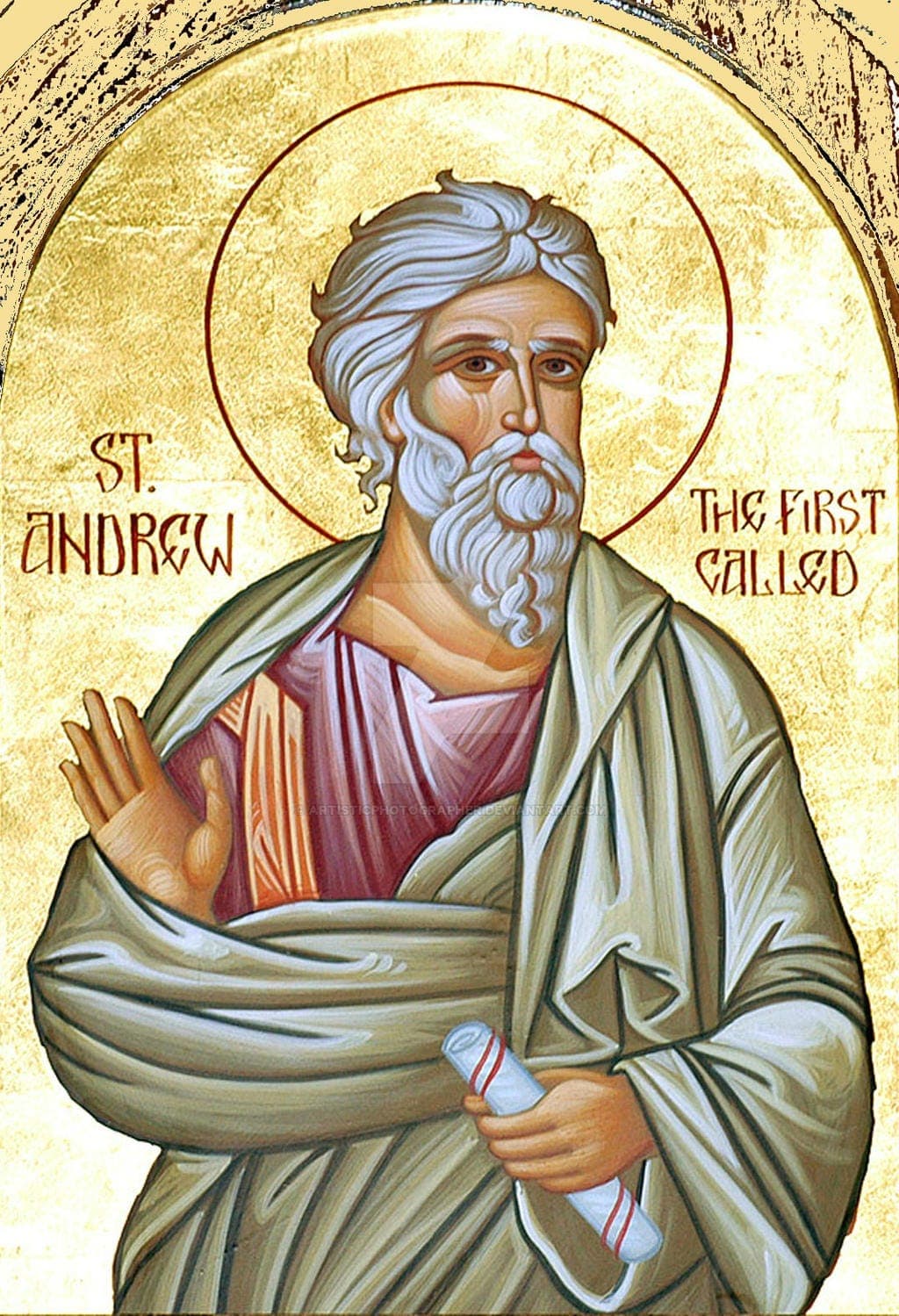
Saint Andrew the First-Called.
Also known as Apostle Andrew, Andrew Protokletos, Andrew the Apostle, Holy Andrew the First-Called
The first apostle called by Christ and brother of Peter, Andrew preached throughout Asia Minor, Greece, and Eastern lands, establishing the Church in Byzantium (Constantinople), before his martyrdom on an X-shaped cross in Patras, Greece.
Tone 4
As the first-called of the Apostles
and brother of the foremost disciple, Andrew,
entreat the Master of all
to grant peace to the world
and to our souls great mercy.
The First
Called of the Apostles
Andrew was the first disciple called by Jesus Christ and remained one of the most faithful and industrious of the Apostles, whose missionary labors extended from the coasts of the Black Sea through the ancient Near East, and whose humility and love of Christ exemplified perfect discipleship. His founding of the Church of Byzantium - later Constantinople - established a direct apostolic succession that continues to this day in the Ecumenical Patriarchate of Constantinople.
Early years
This Saint was from Bethsaida of Galilee; he was the son of Jonas and the brother of Peter, the chief of the Apostles. He did not enter into marriage, and he worked with his brother as a fisherman. When the holy Prophet, Forerunner and Baptist John began to preach, Saint Andrew became his closest disciple. Saint John the Baptist himself sent to Christ his own two disciples, the future Apostles Andrew and John the Theologian, declaring Christ to be the Lamb of God.
In the Church
After the Descent of the Holy Spirit upon the Apostles, Saint Andrew went to the Eastern lands preaching the Word of God. He went through Asia Minor, Thrace, Macedonia, he reached the River Danube, went along the coast of the Black Sea, through Crimea, the Black Sea region and along the River Dniepr he climbed to the place where the city of Kiev now stands. According to tradition, he founded the see of Byzantium (later Constantinople) in 38 AD, installing Stachys as bishop. Thrace, Peloponnese, Greece, and Epirus: he converted many to the Faith and ordained bishops and priests for them. Andrew's missionary work was characterized by tireless proclamation of the Gospel and the performing of many miracles of healing and deliverance.
Later years
St. Andrew was martyred in Peloponnese, in the city of Patras. The Lord worked many miracles through His disciple in Patra from where the Apostle preached throughout all Achaia. The infirm were made whole, and the blind received their sight. Few pagans remained at Patra, but among them was the prefect of the city, Aegeates. The Apostle Andrew repeatedly turned to him with the words of the Gospel. But even the miracles of the Apostle did not convince Aegeates.
Saint Andrew the First-Called accepted the decision of the prefect with joy and with prayer to the Lord, and went willingly to the place of execution. In order to prolong the suffering of the saint, Aegeatos gave orders not to nail the saint's hands and feet, but to tie them to the cross. For two days the apostle taught the citizens who gathered about. The people, in listening to him, with all their souls pitied him and tried to take Saint Andrew down from the cross. Fearing a riot of the people, Aegeatos gave orders to stop the execution. But the holy apostle began to pray that the Lord would grant him death on the cross. Just as the soldiers tried to take hold of the Apostle Andrew, they lost control of their hands. The crucified apostle, having given glory to God, said: "Lord Jesus Christ, receive my spirit." Then a blazing ray of divine light illumined the cross and the martyr crucified upon it. When the light faded, the holy Apostle Andrew had already given up his holy soul to the Lord.
Legacy and veneration
He is considered the founder and the first bishop of the Church of Byzantium and is consequently the patron saint of the Ecumenical Patriarchate of Constantinople. Thus, Pope Benedict XVI calls him "the Apostle of the Greek world," and since he is the brother of Saint Peter, the first bishop of Rome, their brotherhood is "symbolically expressed in the special reciprocal relations of the See of Rome and of Constantinople, which are truly Sister Churches."
His great missionary legacy led him to become the patron saint of several countries, including Romania and Scotland. St. Andrew's relics were transferred from Patra to Constantinople and placed in the church of the Holy Apostles, while a hand was taken to Moscow. The Crusaders stole the relics and cross of Saint Andrew during the sacking of Constantinople, however, in a gesture of goodwill, Pope Paul VI presented the skull of the saint back to the Greek Orthodox Church in 1964, while the cross of the saint was returned in 1980. The saint's relics and cross are now venerated in the magnificent church of Saint Andrew in Patra at the place of his martyrdom.
The flag of Scotland (and consequently the Union Flag and those of some of the former colonies of the British Empire) feature Saint Andrew's saltire cross. The saltire is also the flag of Tenerife, the former flag of Galicia and the Russian Navy Ensign.
How the saint's
memory is kept.
- When is the feast day of Saint Andrew?
- Saint Andrew is celebrated on November 30 in both the Eastern and Western churches.
- Why is Saint Andrew called the First-Called?
- Andrew was the first apostle summoned by Jesus Christ to follow Him. When John the Baptist pointed out Jesus as the Lamb of God, Andrew immediately followed Jesus, recognizing Him as the Messiah, and became His first disciple.
- What was Saint Andrew's relationship to Saint Peter?
- Saint Andrew was the brother of Saint Peter (Simon Peter). Andrew was the first to recognize Jesus as the Messiah and brought his brother Peter to Christ (John 1:35-42).
- Where did Saint Andrew preach?
- According to tradition, Andrew preached throughout Asia Minor, Thrace, Macedonia, the Black Sea region, Scythia, and Greece. He founded the Church in Byzantium (Constantinople), establishing the first see there with Stachys as its first bishop. He also reached Kiev in Russia, where he prophesied a great Christian city would arise.
- How was Saint Andrew martyred?
- Saint Andrew was crucified on an X-shaped cross (saltire) in the city of Patras, Greece, around 60 AD. He was bound (not nailed) to the cross. According to tradition, he requested this form of crucifixion because he deemed himself unworthy to be crucified on the same type of cross as Christ.
- What is Saint Andrew the patron saint of?
- Saint Andrew is the patron saint of Constantinople, Greece, Russia, Romania, Scotland, Ukraine, fishermen, and singers. He is also the spiritual founder and patron of the Ecumenical Patriarchate of Constantinople.
- Where are the relics of Saint Andrew today?
- The relics of Saint Andrew are distributed among several locations. His skull was returned to Patras, Greece in 1964 and is venerated in the Cathedral of Saint Andrew there. Other relics are kept in Amalfi, Italy, and other locations worldwide. A hand was taken to Moscow.
- What is the significance of Saint Andrew's cross?
- The X-shaped cross on which Saint Andrew was martyred is known as the saltire or crux decussata. It has become the symbol of Saint Andrew and appears on the national flags of Scotland and Russia, reflecting Andrew's patronage of these nations. The X-shape is said to represent the first letter of Christ's name in Greek (Chi).
Tone 2
Let us praise Andrew, the herald of God, the namesake of courage, the first-called of the Savior's disciples and brother of the great Apostle Peter, as we cry out in faithful supplication: Rejoice, O First-Called of the Apostles!
Through the prayers of Thine holy Apostle Andrew, O Christ Our God, confirm Thy faithful in Orthodoxy, and save us!
Carry the tradition with you.
Hand-finished icons, books, and calendars to carry the Orthodox day into your home.
Read a life like this
every morning.
Meet the daily saints through Orthodox Daily Companion on iPhone and iPad, or through the Lives of the Saints web app in any modern browser.
Orthodox Daily Companion
The native Apple app, with a Home Screen widget, prayer reminders, and a private on-device journal.
Download on the App StoreLives of the Saints Web App
The browser experience for desktop, tablet, or phone, with a seven-day trial of the complete devotional library.
Open the web appGet a life like this one on every new tab - free, no account, from the same catalogue.
References and further reading
- oca.orghttps://www.oca.org/saints/lives/2021/11/30/103450-apostle-andrew-the-holy-and-all-praised-first-called
- orthodoxwiki.orghttps://orthodoxwiki.org/Apostle_Andrew
- goarch.orghttps://www.goarch.org/chapel/saints?contentid=316
- en.wikipedia.orghttps://en.wikipedia.org/wiki/Andrew_the_Apostle
- archons.orghttps://archons.org/about/saint-andrew-the-apostle/
- britannica.comhttps://www.britannica.com/biography/Saint-Andrew
- saintandreworthodox.comhttps://saintandreworthodox.com/
- newworldencyclopedia.orghttps://www.newworldencyclopedia.org/entry/Saint_Andrew
- saintandrewgoc.orghttps://saintandrewgoc.org/blog/2012/11/30/st-andrew-the-first-called.html
- roarch.org.ukhttps://roarch.org.uk/saint-andrew-the-apostle-the-mystery-of-the-first-called/
- greekboston.comhttps://www.greekboston.com/religion/st-andrew/
- oursaints.orghttp://www.oursaints.org/st_andrew_page.html
- saint-andrew.orghttps://www.saint-andrew.org/our-patron/
- goarch.orghttps://www.goarch.org/-/department-of-religious-education-dre-s-did-you-know-apostle-andrew-the-first-called
- overviewbible.comhttps://overviewbible.com/andrew-the-apostle/
- biblehub.comhttps://biblehub.com/matthew/10-2.htm
- christianity.comhttps://www.christianity.com/wiki/people/who-was-andrew-in-the-bible-apostle-martyr.html
- vaticanstate.vahttps://www.vaticanstate.va/en/state-and-government/general-informations/saint-of-the-day/1209-30-november-saint-andrew-the-apostle.html
- biblicaltraining.orghttps://www.biblicaltraining.org/library/andrew
- gotquestions.orghttps://www.gotquestions.org/Andrew-in-the-Bible.html
More from the tradition.
Read the Journal
Essays on feasts, fasting, and the rhythm of the Church year.
ExploreOrthodox countries
How the faith is lived and kept across the Christian world.
ExploreThe 2027 Calendar
A saint, a reading, and the day's fasting guideline for every day of 2027.
ExploreMobile & web apps
Carry the daily rhythm on iPhone and iPad or continue in the web app.
Explore