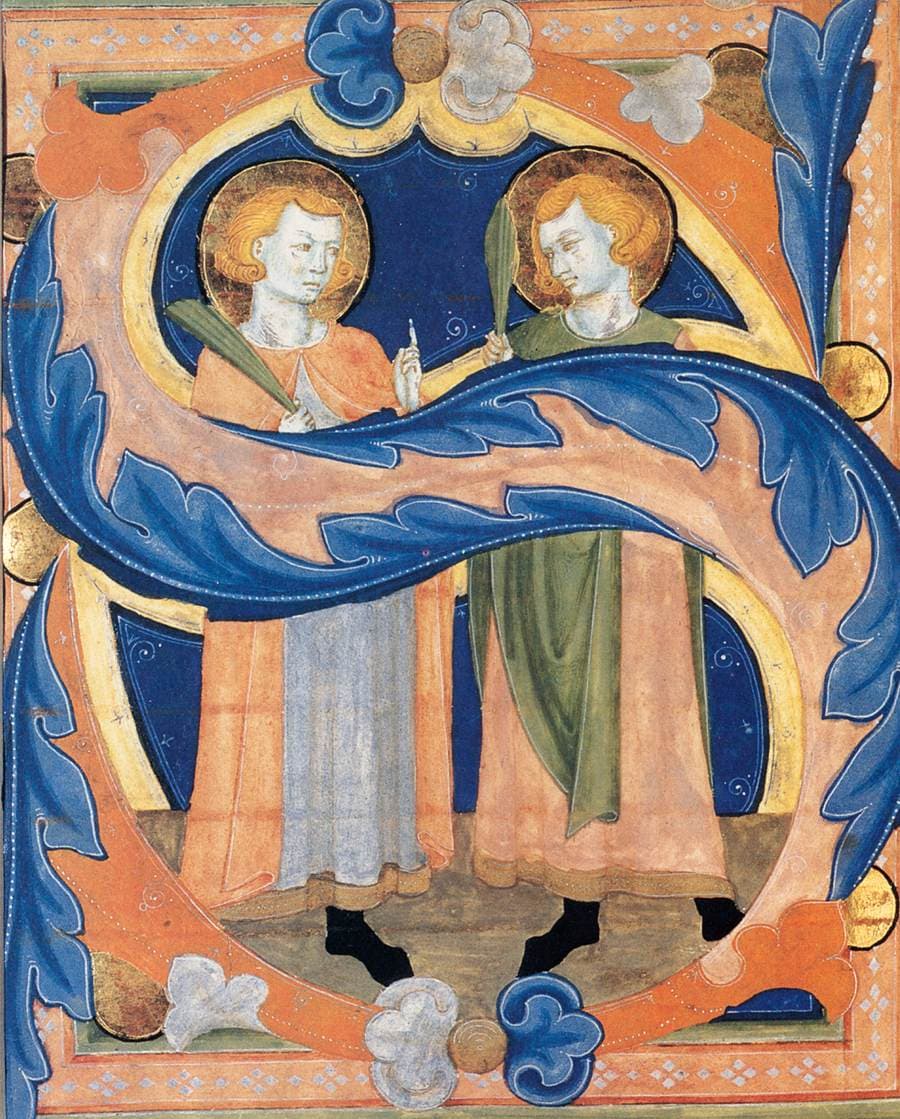
Saint Hieromartyrs Zacchaeus the Deacon and Alphaeus the Reader.
Also known as Saints Zacchaeus and Alphaeus, Martyrs Zacchaeus and Alpheus, Holy Martyrs Zacchaeus and Alphaeus, Zacchaeus of Gadara and Alphaeus of Caesarea
Two early Christian martyrs from Caesarea in Palestine who were tortured and beheaded during Emperor Diocletian's persecution for refusing to renounce Christ or offer sacrifice to pagan gods.
Your holy martyrs Zacchaeus and Alphaeus, O Lord,
through their sufferings have received incorruptible crowns from You, our God.
For having Your strength, they laid low their adversaries,
and shattered the powerless boldness of demons.
Through their intercessions, save our souls!
Two Steadfast
Confessors in the Diocletianic Persecution
Zacchaeus was a humble deacon of Gadara known for his gentleness and piety; Alphaeus was a noble-born reader and teacher at Caesarea who boldly exhorted wavering Christians to stand firm. During Emperor Diocletian's fierce persecution, both were arrested, tortured mercilessly for days, and offered their lives in exchange for mere gestures of compromise with pagan worship. Neither wavered. Instead, they encouraged each other in prison and together confessed Christ as their only King, for which they were sentenced to death and beheaded on the same day.
Early years
Saint Zacchaeus was a deacon serving in the Church of Gadara, a city beyond the Jordan in Palestine. According to the account recorded by Eusebius of Caesarea, Zacchaeus was known for his small stature and virtuous character. His fellow Christians bestowed upon him the honorable name "Zacchaeus" in remembrance of the tax collector of the Gospel account - partly because of his modest height, and partly because of the strictness and holiness of his life. Those who knew him testified that he was even more earnest than the first Zacchaeus in his desire to see and serve our Lord.
Saint Alphaeus was born into a distinguished and wealthy family of Eleutheropolis. He received a good education befitting his station and, having embraced the Christian faith, devoted himself to service in the Church of Caesarea, where he was honored with the dignity of reader and exorcist. Before he became a confessor and martyr, Alphaeus was already known as a skilled preacher and teacher of God's Word, commanding the respect and confidence of all who heard him. He was moved by deep zeal for the glory of God and profound concern for the welfare of his fellow believers.
In the Church
Zacchaeus's Ministry and Arrest: In the first year of Diocletian's general persecution of Christians, Zacchaeus was apprehended in Gadara. When brought before the judge, he openly and joyfully confessed his faith in Christ and spoke boldly the words of God. For this confession, he was delivered over to terrible torture - first scourged, then lacerated with iron combs. After these agonies, he was cast back into prison where his feet were stretched to breaking point on the wooden rack throughout a night and a day. Yet despite all his sufferings, the steadfast martyr remained cheerful and praised God continually.
Alphaeus's Witness and Arrest: Seeing the great fear and laxity that had fallen upon Christians during the fierce persecution, with many being swept toward the impious worship of idols, Alphaeus deliberated how he might stand against this evil through his own courage and bold words. Of his own accord, he threw himself into the midst of the crowds heading toward pagan temples to make sacrifice. With words of denunciation, he reproached those who through timidity had been led into error. He reminded them of Christ's words about confession and urged them not to defile themselves with impious sacrifices. When the authorities learned of his actions, Alphaeus was immediately arrested and brought before the prefect. In his first examination, he so confounded the magistrate with his fearless testimony that he was cast into prison. Later, he was summoned a second time to court, where his body was torn with whips and hooks. He was then imprisoned with Zacchaeus and both were placed in stocks.
Later years
The Final Examination and Sentence: After days of mutual encouragement and prayer in their cell, both holy martyrs were brought together before the judge at a final examination. The judge commanded them once more to offer sacrifice to the emperors. But Zacchaeus and Alphaeus stood together in perfect unity of faith and spoke with one voice: "We acknowledge one God only, the supreme sovereign of all, and Christ Jesus as our King." Because they would not recognize the earthly emperor as their supreme lord, but confessed Christ alone as King, they were condemned for treason against the empire and sentenced to death.
Martyrdom and Triumph: The next morning, the holy Martyrs Zacchaeus and Alphaeus were beheaded for confessing Christ. Thus were they numbered among the few who, out of all the Christians brought to Caesarea during that fearful persecution, "were honored with the crown of the holy martyrs." The date of their martyrdom was November 17 in the Julian calendar (the 17th day of the month Dius), which corresponds to November 18 in the current Church calendar. Of all the multitude brought in from the surrounding lands to apostasize or face death, only these two remained unshakeable, obtaining the crown of victory and eternal life with Christ.
Legacy and veneration
Commemoration and Veneration: The Holy Martyrs Zacchaeus and Alphaeus are commemorated throughout the Eastern Orthodox Church on November 18, and also on December 18, their feast days celebrated in every jurisdiction. They remain model confessors for all believers facing trials and temptation to compromise their faith. Their steadfast refusal to abandon Christ despite unspeakable torture and repeated offers of freedom and life serves as a powerful witness to the power of God's grace and the victory of the martyrs over earthly powers.
Historical Witness: The account of Zacchaeus and Alphaeus is preserved in the eyewitness testimony of Eusebius of Caesarea, the great church historian who lived through these persecutions and recorded them in his History of the Martyrs in Palestine. Because Eusebius himself was present in Caesarea during the persecutions, his account carries particular historical weight and reliability. The story of these two humble servants - a deacon and a reader - demonstrates that martyrdom is not confined to the great and mighty, but extends to all ranks of the Church who remain faithful unto death.
Spiritual Legacy: Their intercession is invoked by the faithful for courage to face trials, for steadfastness in the faith, and for the grace to refuse all compromise with evil. They exemplify the virtue of confession - the bold and public acknowledgment of Christ as Lord, even unto death. Their memory strengthens the Church in all ages, reminding believers that no earthly power can prevail against those who place their trust wholly in the King of Kings.
How the saint's
memory is kept.
- When is the feast day of Hieromartyrs Zacchaeus and Alphaeus?
- They are primarily commemorated on November 18 in the Eastern Orthodox Church calendar. They are also commemorated on December 18. Both dates correspond to their martyrdom in 303 AD during the Diocletianic persecution.
- Where were Saints Zacchaeus and Alphaeus martyred?
- They were martyred in Caesarea in Palestine. Zacchaeus was a deacon of Gadara, and Alphaeus was a reader of the church in Caesarea. Both were arrested during Emperor Diocletian's persecution and beheaded together for refusing to renounce Christ or offer sacrifice to pagan gods.
- What were the positions and roles of these martyrs in the Church?
- Saint Zacchaeus was a deacon serving the Church of Gadara, known for his gentleness and strict virtue. Saint Alphaeus was a reader and exorcist of the Church of Caesarea, serving as a preacher and teacher of God's Word. He came from a noble family of Eleutheropolis.
- What happened to Zacchaeus and Alphaeus during their persecution?
- Both were arrested during Diocletian's general persecution in 303 AD. They were tortured with scourges, iron combs, and the rack. Despite being repeatedly offered freedom if they would merely speak words honoring the emperors or gods, both steadfastly refused. They encouraged each other in prison and together confessed Christ as their only King before the judge.
- How did Saints Zacchaeus and Alphaeus die?
- They were both beheaded the morning after their final examination, when they refused to offer sacrifice to the emperors or renounce Christ. They were condemned for treason because they would not acknowledge any earthly king above Christ. Their martyrdom occurred in 303 AD.
- Who recorded the account of these martyrs?
- Eusebius of Caesarea, the great church historian, recorded their martyrdom in his work 'History of the Martyrs in Palestine.' Eusebius was an eyewitness to the persecutions in Caesarea and provided a reliable account of their suffering and steadfast witness.
- What is the spiritual significance of these martyrs for Orthodox believers today?
- Zacchaeus and Alphaeus exemplify unwavering confession of Christ, courage in the face of trials, and refusal to compromise faith for the promise of earthly safety or comfort. They model the virtue of bold Christian witness and intercede for believers facing persecution or temptation. Their feast day commemorates the victory of Christ's grace over earthly powers.
The kontakion for these saints in the standard Orthodox liturgical books has not been separately preserved or is not widely published in English translations. The troparion above serves as the primary liturgical commemoration of their witness. Believers may approach them with prayers seeking their intercession and invoking their example of steadfast confession.
A Traditional Prayer to the Holy Martyrs Zacchaeus and Alphaeus:
O holy martyrs Zacchaeus and Alphaeus, glorious confessors of Christ and victors over the demons, we honor your sacred memory and magnify your sufferings. You did not count your earthly lives precious, but poured them out as a sweet libation before the Lord, refusing all the vain promises of the tyrant. By your courage, you have shown us that Christ's grace is sufficient, and that no earthly power can separate us from the love of God.
Intercede for us before the throne of the Almighty, that we too may grow in boldness to confess the Name of Christ before a hostile world, that we may be strengthened when trials assail us, and that we may ever hold fast to Him who alone is our King and our God. Pray for our salvation and for the peace of the whole world, O holy martyrs, that all may come to know the true God and Jesus Christ whom He has sent. Amen.
Carry the tradition with you.
Hand-finished icons, books, and calendars to carry the Orthodox day into your home.
Read a life like this
every morning.
Meet the daily saints through Orthodox Daily Companion on iPhone and iPad, or through the Lives of the Saints web app in any modern browser.
Orthodox Daily Companion
The native Apple app, with a Home Screen widget, prayer reminders, and a private on-device journal.
Download on the App StoreLives of the Saints Web App
The browser experience for desktop, tablet, or phone, with a seven-day trial of the complete devotional library.
Open the web appGet a life like this one on every new tab - free, no account, from the same catalogue.
References and further reading
- oca.orghttps://www.oca.org/saints/lives/2022/11/18/103324-martyrs-zacchaeus-the-deacon-and-alphaeus-of-caesarea-in-palesti
- oca.orghttps://www.oca.org/saints/troparia/2020/11/18
- en.wikipedia.orghttps://en.wikipedia.org/wiki/Alphaeus_and_Zacchaeus
- crkvenikalendar.comhttps://www.crkvenikalendar.com/zitije_en.php?pok=0&id=ZEJB
- johnsanidopoulos.comhttps://www.johnsanidopoulos.com/2015/12/saints-zacchaeus-deacon-and-alphaeus.html
- johnsanidopoulos.comhttps://www.johnsanidopoulos.com/2016/11/holy-martyrs-alphaeus-and-zacchaeus-of.html
- orthodoxwiki.orghttps://orthodoxwiki.org/December_18
- orthodoxwiki.orghttps://orthodoxwiki.org/index.php?title=Diocletianic_Martyrs&mobileaction=toggle_view_mobile
- newadvent.orghttps://www.newadvent.org/fathers/2505.htm
- tertullian.orghttps://www.tertullian.org/fathers/eusebius_martyrs.htm
- ccel.orghttps://www.ccel.org/ccel/pearse/morefathers/files/eusebius_martyrs.htm
- oca.orghttps://www.oca.org/saints/all-lives/2015/11/18
- catholic.orghttps://www.catholic.org/saints/saint.php?saint_id=1276
- oca.orghttps://www.oca.org/saints/lives/2024/11/18
- en.wikipedia.orghttps://en.wikipedia.org/wiki/December_18_(Eastern_Orthodox_liturgics)
- orthodox.nethttps://www.orthodox.net/menaion/december.html
- oca.orghttps://www.oca.org/saints/all-lives/2023/11/18
- monasticrepublic.comhttps://www.monasticrepublic.com/en/orthodox-synaxarion/november/saint-zacchaeus-deacon-of-the-church-of-gadeira-a-city-in-spain-and-alphaeus
- orthodoxwiki.orghttps://orthodoxwiki.org/Church_Calendar
- johnsanidopoulos.comhttps://www.johnsanidopoulos.com/2017/12/saints-and-feasts-of-december-18.html
More from the tradition.
Read the Journal
Essays on feasts, fasting, and the rhythm of the Church year.
ExploreOrthodox countries
How the faith is lived and kept across the Christian world.
ExploreThe 2027 Calendar
A saint, a reading, and the day's fasting guideline for every day of 2027.
ExploreMobile & web apps
Carry the daily rhythm on iPhone and iPad or continue in the web app.
Explore