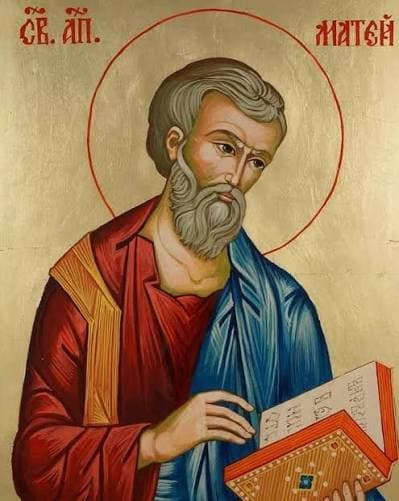
Saint Matthew the Apostle and Evangelist.
Also known as Apostle Matthew, Matthew the Evangelist, Levi, Matthew son of Alphaeus, Saint Matthew, Mattai
The Holy Apostle and Evangelist Matthew, son of Alphaeus, was a tax collector who became one of the Twelve Apostles. After receiving the Holy Spirit, the Holy Apostle preached the Gospel to the Parthians, Medes and Ethiopians.
Tone 3
With zeal, you followed Christ the Master, who in His goodness, appeared on earth to mankind. Summoning you from the custom house, He revealed you as a chosen apostle: the proclaimer of the Gospel to the whole world! Therefore, divinely eloquent Matthew, we honor your precious memory! Entreat merciful God that He may grant our souls remission of transgressions.
From Tax
Collector to Apostle and Evangelist
Matthew was originally called Levi and was the son of Alphaeus, a tax-collector at Capernaum. When Jesus called him from his tax booth, Matthew left everything and followed Christ, becoming his disciple. The holy, glorious and all-laudable Apostle and Evangelist Matthew is the author of the Gospel of Matthew and one of the Twelve Apostles. He is venerated throughout the Eastern Orthodox Church for his transformation from a despised publican into a devoted apostle and herald of the Gospel.
Early years
The Holy Apostle and Evangelist Matthew was also named Levi; he was one of the Twelve Apostles and was brother of the Apostle James Alphaeus. He was a publican, or tax-collector for Rome, in a time when the Jews were under the rule of the Roman Empire. He lived in the Galilean city of Capernaum.
Publicans who collected taxes from their countrymen did this with great profit for themselves. They were considered traitors because they worked for the despised Roman rulers. Matthew's profession made him a social outcast in Jewish society, branded as a sinner and collaborator with Rome.
In the Church
When Matthew heard the voice of Jesus Christ: "Come, follow Me," he left everything and followed the Savior. Christ and His disciples did not refuse Matthew's invitation and they visited his house, where they shared table with the publican's friends and acquaintances. Like the host, they were also publicans and known sinners. This event disturbed the pharisees and scribes a great deal.
Having received the grace of the Holy Spirit, which descended upon the Apostles on the day of Pentecost, Saint Matthew preached in Palestine for several years. At the request of the Jewish converts at Jerusalem, the holy Apostle Matthew wrote his Gospel describing the earthly life of the Savior, before leaving to preach the Gospel in faraway lands.
The Apostle Matthew preached among people who were awaiting the Messiah. His Gospel manifests itself as a vivid proof that Jesus Christ is the Messiah foretold by the prophets.
Later years
Clement of Alexandria write that Matthew ministered in Judaea for some time after Jesus' death and resurrection. He then traveled to the East, presumably to escape a persecution that began around 42 A.D. While there is some debate as to which countries were evangelized by Matthew, most ancient writers mention Ethiopia to the south of the Caspian Sea (not Ethiopia in Africa), Persia, and the kingdom of the Parthians, Macedonia and Syria.
The ruler Fulvian deeply repented of his deed, but still he had doubts. By his command, they put the body of Saint Matthew into an iron coffin and threw it into the sea. In doing this Fulvian said that if the God of Matthew would preserve the body of the apostle in the water as He preserved him in the fire, then this would be proper reason to worship this One True God. That night the Apostle Matthew appeared to Bishop Platon in a dream, and commanded him to go with clergy to the shore of the sea and to find his body there. The coffin carried by the waves was taken to the church built by the apostle. Then Fulvian begged forgiveness of the holy Apostle Matthew, after which Bishop Platon baptized him, giving him the name Matthew in obedience to a command of God.
Legacy and veneration
Although the document is internally anonymous, the authorship of this Gospel has been traditionally ascribed to St. Matthew. The surviving testimony of the Church Fathers is unanimous in this view, and the tradition had been accepted by Christians at least as early as the 2nd century up to modern times. In addition, the title "According to Matthew" is found in the earliest codices, which date to the fourth century.
Given his background, he is considered to be the Patron Saint of Tax Collectors. Taking into account that he was a publican himself, St. Matthew is considered the patron saint for tax collectors, bookkeepers, bankers, and civil servants. He is commemorated by the Church on November 16, as well as on June 30 with the Twelve.
Matthew is recognized as a saint in the Roman Catholic, Eastern Orthodox, Lutheran and Anglican churches. His tomb is located in the crypt of Salerno Cathedral in southern Italy. The relics of Saint Matthew are venerated as a source of grace and intercession for the faithful.
How the saint's
memory is kept.
- When is the feast day of Saint Matthew in the Eastern Orthodox Church?
- He is commemorated by the Church on November 16, as well as on June 30 with the Twelve.
- What was Saint Matthew's occupation before becoming an apostle?
- He was the son of Alphaeus and was by profession a publican, or tax-collector, at Capernaum.
- What is the meaning of the name Matthew?
- "Matthew" means "Gift of the Lord."
- What Gospel did Saint Matthew write?
- The holy, glorious and all-laudable Apostle and Evangelist Matthew is the author of the Gospel of Matthew and one of the Twelve Apostles.
- What is the symbol of Saint Matthew in Orthodox iconography?
- The apostle's symbol is an angel.
- What happened to Matthew's body after his martyrdom?
- After Matthew willingly gave up his soul to the Lord, his body was put in a coffin and cast into the sea. It washed up at the site of the church he had built.
- Where are the relics of Saint Matthew venerated today?
- His tomb is located in the crypt of Salerno Cathedral in southern Italy.
Tone 4
Casting aside the bonds of the custom house for the yoke of justice, you were revealed as an excellent merchant, rich in wisdom from on high. You proclaimed the word of truth and roused the souls of the slothful by writing of the hour of Judgment.
With zeal, you followed Christ the Master, / who in His goodness, appeared on earth to mankind. / Summoning you from the custom house, / He revealed you as a chosen apostle: / the proclaimer of the the Gospel to the whole world! / Therefore, divinely eloquent Matthew, / we honor your precious memory! / Entreat merciful God that He may grant our souls remission of transgressions.
Carry the tradition with you.
Hand-finished icons, books, and calendars to carry the Orthodox day into your home.

Read a life like this
every morning.
Meet the daily saints through Orthodox Daily Companion on iPhone and iPad, or through the Lives of the Saints web app in any modern browser.
Orthodox Daily Companion
The native Apple app, with a Home Screen widget, prayer reminders, and a private on-device journal.
Download on the App StoreLives of the Saints Web App
The browser experience for desktop, tablet, or phone, with a seven-day trial of the complete devotional library.
Open the web appGet a life like this one on every new tab - free, no account, from the same catalogue.
References and further reading
- orthodoxwiki.orghttps://orthodoxwiki.org/Apostle_Matthew
- oca.orghttps://www.oca.org/saints/lives/2021/11/16/103313-apostle-and-evangelist-matthew
- orthodoxybr.comhttps://www.orthodoxybr.com/our-patron
- lychnos.orghttps://lychnos.org/saints-and-feasts/nov16-saint-matthew-the-evangelist-and-apostle/
- saintandrewgoc.orghttps://saintandrewgoc.org/blog/2017/11/16/the-feast-day-of-the-holy-apostle-matthew-the-evangelist
- britannica.comhttps://www.britannica.com/biography/Saint-Matthew
- en.wikipedia.orghttps://en.wikipedia.org/wiki/Matthew_the_Apostle
- oca.orghttps://www.oca.org/saints/troparia/2018/11/16/103313-apostle-and-evangelist-matthew
- ww1.antiochian.orghttp://ww1.antiochian.org/content/st-matthew-evangelist
- greekboston.comhttps://www.greekboston.com/religion/st-matthew/
- russianicon.comhttps://russianicon.com/st-matthew-icon-key-features-and-symbols/
- russianicon.comhttps://russianicon.com/orthodox-icons-st-matthew-apostle/
- britannica.comhttps://www.britannica.com/topic/Gospel-According-to-Matthew
- orthodoxtimes.comhttps://orthodoxtimes.com/memory-of-apostle-and-evangelist-matthew/
- en.wikipedia.orghttps://en.wikipedia.org/wiki/Relic
- orthodoxtimes.comhttps://orthodoxtimes.com/the-archbishop-of-salerno-presented-the-ecumenical-patriarch-with-a-part-of-a-relic-of-the-apostle-matthew/
- russianstore.comhttps://www.russianstore.com/en/online-store/catholic-reliquaries/item/939-silver-theca-with-the-first-class-relic-of-saint-mathew-the-apostle-and-evangelist
- thecollector.comhttps://www.thecollector.com/matthew-twelve-disciples-bio-legacy-death/
- stinnocentmonastery.orghttps://stinnocentmonastery.org/stfulvianusmatthewprinceofethiopia
- atlgoc.orghttps://www.atlgoc.org/downloads/2024/10/14/feast-of-saint-matthew-the-apostle-and-evangelist-november-16-2024
More from the tradition.
Read the Journal
Essays on feasts, fasting, and the rhythm of the Church year.
ExploreOrthodox countries
How the faith is lived and kept across the Christian world.
ExploreThe 2027 Calendar
A saint, a reading, and the day's fasting guideline for every day of 2027.
ExploreMobile & web apps
Carry the daily rhythm on iPhone and iPad or continue in the web app.
Explore