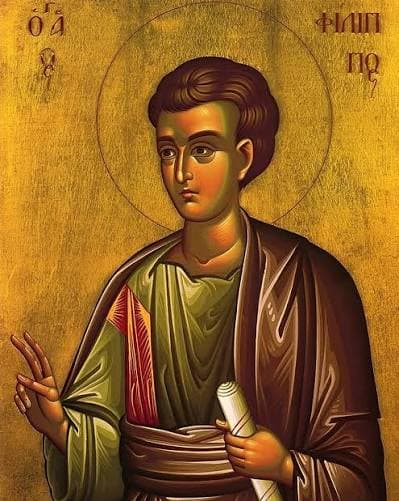
Saint Apostle Philip.
Also known as Saint Philip the Apostle, Philip the Apostle, Holy Apostle Philip, Philip of the Twelve
One of the Twelve Apostles of Jesus, Philip preached the Gospel in Phrygia, Greece, and Asia Minor, and was martyred by crucifixion in Hierapolis.
Tone 3
Holy Apostle Philip, entreat the merciful God
to grant our souls forgiveness of transgressions.
Apostle, Evangelist,
and Martyr
Philip was one of the first disciples called directly by Jesus. Renowned for his scriptural knowledge and immediate recognition of Christ as the Messiah, he became a devoted evangelist whose apostolic labors extended across the Mediterranean world. He sealed his faith with his blood in Hierapolis, and the Church honors him as a great apostle and martyr.
Early years
Philip is described as a disciple from the city of Bethsaida, and the evangelist connects him with Andrew and Peter, who were from the same town. The Gospel of John states that Jesus found and called Philip directly, without mentioning any prior discipleship under John the Baptist (John 1:43). Upon meeting Jesus, Philip immediately recognized Him as the promised Messiah and brought his friend Nathanael (Bartholomew) to meet the Lord, saying, "We have found the one about whom Moses wrote in the law, and also the prophets, Jesus, son of Joseph, from Nazareth."
Philip appears throughout the Gospel accounts as a thoughtful and practical disciple. He was present at the multiplication of the loaves and fishes, where he estimated the cost of feeding the five thousand. He also served as a bridge between Jesus and the Gentile world, bringing Greek-speaking seekers to the Lord. At the Last Supper, Philip asked Jesus to show the disciples the Father - a request that prompted one of Jesus' most profound teachings on His unity with the Father.
In the Church
According to the Acts of Philip, following the resurrection of Jesus, Philip was sent with his sister Mariamne and Bartholomew to preach in Greece, Phrygia, and Syria. After Pentecost, St. Philip preached in Asia and Greece. In Greece, the Jews hated him and the high priest even ran at him to club him to death, but miraculously this Jewish priest was blinded and turned completely black. Then the earth opened up and swallowed him. Many of the sick were healed, and many pagans believed.
The Apostle Philip arrived in the city of Phrygian Hieropolis, where there were many pagan temples. There was also a pagan temple where people worshiped an enormous serpent as a god. The Apostle Philip by the power of prayer killed the serpent and healed many bitten by snakes. Among those healed was the wife of the city prefect, Amphipatos. Having learned that his wife had accepted Christianity, the prefect Amphipatos gave orders to arrest Saint Philip, his sister, and the Apostle Bartholomew traveling with them.
Later years
At the urging of the pagan priests of the temple of the serpent, Amphipatos ordered the holy Apostles Philip and Bartholomew to be crucified. Suddenly, an earthquake struck, and it knocked down all those present at the place of judgment. Hanging upon the cross by the pagan temple of the serpent, the Apostle Philip prayed for those who had crucified him, asking God to save them from the ravages of the earthquake. Through prayer he killed a giant snake that the pagans worshipped, which angered the unbaptized so much that they crucified him and St. Bartholomew upside-down. Again, the earth opened and swallowed his judge along with many pagans, and being terribly afraid the people rushed to bring the Apostles down from their torment. But St. Philip had already reposed. St. Bartholomew then ordained Stachys - whom St. Philip had healed of a forty-year blindness and baptized - as bishop for those who were baptized in that area.
This wonderful Apostle suffered in the year 86, in the time of the Emperor Domitian. His martyrdom in Hierapolis became a focal point for early Christian pilgrimage and veneration, and the site of his passion was eventually marked by a great church complex in the 4th and 5th centuries.
Legacy and veneration
Philip is always listed on the fifth place among the apostles, reflecting his prominence in the early apostolic tradition. His feast day on November 14 is the day before beginning of the Nativity Fast in the Eastern Orthodox Church, which is sometimes called Philip's Fast (or the Philippian Fast). In 2012, Bartholomew, the patriarch of Constantinople and primate of the Orthodox church, celebrated the liturgy of St. Philip in the Church of the Sepulchre and in the martyrion church of the apostle.
Philip is venerated throughout the Orthodox Church as a great apostle and martyr whose missionary labors were accompanied by miracles and whose faith remained unwavering even unto a cruel death. His example of bringing others to Christ, his pastoral gentleness, and his steadfast martyrdom have made him a beloved saint. Philip is the patron saint of bakers and merchants. Many believers pray to him for wisdom and courage in proclaiming the faith, especially in missionary efforts.
In 2011, Italian archaeologist Francesco D'Andria claimed to have discovered the tomb of Philip during excavations in ancient Hierapolis, close to the modern Turkish city of Denizli. The 1st-century tomb, found to be empty of relics, stood at the centre of a 4th- or 5th-century three-naved basilica, the Church of the Sepulchre, which was one of the focal points of an ancient pilgrimage hill complex dedicated to Philip.
How the saint's
memory is kept.
- When is the feast day of Saint Philip the Apostle?
- November 14 in the Eastern Orthodox Church. This feast falls on the eve of the Nativity Fast, sometimes called Philip's Fast.
- Where was Saint Philip the Apostle born?
- Bethsaida in Galilee, the same town as Peter and Andrew.
- What are the relics of Saint Philip today?
- His relics are located in the Basilica dei Santi Apostoli (Church of the Holy Apostles) in Rome, in the crypt beneath the main altar, where his foot is venerated alongside relics of Saint James the Less.
- How was Saint Philip martyred?
- He was crucified upside-down in Hierapolis, Phrygia, around 80-86 AD, after he killed a serpent that pagans worshipped and healed the wife of the city prefect.
- What is Saint Philip the patron saint of?
- Saint Philip is the patron saint of bakers, merchants, missionaries, and evangelists. He is invoked for wisdom and courage in proclaiming the faith.
- What role did Philip play in the Gospels?
- Philip brought Nathanael (Bartholomew) to Jesus, questioned Jesus about feeding the five thousand, brought Greek-speaking seekers to meet Jesus, and asked Jesus to show the disciples the Father at the Last Supper.
- Where did Saint Philip preach after Pentecost?
- He preached in Galilee, Greece, Parthia, Asia Minor, and Phrygia. He eventually settled in Hierapolis where he was martyred.
Tone 8
Your disciple, friend and imitator of Your passion,
the God-preaching Philip, proclaimed You to the universe!
By his prayers deliver Your Church from her enemies;
through the Theotokos protect every city, most merciful Christ!
O Holy Apostle Philip, intercede to our merciful God, that He may grant our souls forgiveness of sins. You who were counted worthy to be called directly by the Lord Jesus and to walk with Him throughout His earthly ministry, remember us sinners as we venerate your holy memory. Grant us the grace to proclaim Christ with boldness as you did, and to love our neighbor with the same zeal and compassion you showed in bringing Nathanael and so many others to know the Savior. By your intercessions before the throne of God, deliver us from all enemies both visible and invisible, and guide us into the kingdom of light. Amen.
Carry the tradition with you.
Hand-finished icons, books, and calendars to carry the Orthodox day into your home.
Read a life like this
every morning.
Meet the daily saints through Orthodox Daily Companion on iPhone and iPad, or through the Lives of the Saints web app in any modern browser.
Orthodox Daily Companion
The native Apple app, with a Home Screen widget, prayer reminders, and a private on-device journal.
Download on the App StoreLives of the Saints Web App
The browser experience for desktop, tablet, or phone, with a seven-day trial of the complete devotional library.
Open the web appGet a life like this one on every new tab - free, no account, from the same catalogue.
References and further reading
- en.wikipedia.orghttps://en.wikipedia.org/wiki/Philip_the_Apostle
- greekboston.comhttps://www.greekboston.com/religion/st-philip/
- orthodoxwiki.orghttps://orthodoxwiki.org/Apostle_Philip_(of_the_Twelve)
- oca.orghttps://www.oca.org/saints/lives/2010/11/14/103299-holy-all-praised-apostle-philip
- en.wikipedia.orghttps://en.wikipedia.org/wiki/November_14_(Eastern_Orthodox_liturgics)
- orthodox.nethttps://www.orthodox.net/menaion-november/14-the-holy-apostle-philip.html
- basilica.rohttps://basilica.ro/en/orthodox-calendar-november-14/
- orthodoxwiki.orghttps://orthodoxwiki.org/November_14
- italianderutapottery.comhttps://italianderutapottery.com/blog-discover-italy/did-you-know-st-james-st-philip-are-buried-in-rome/
- antiochpatriarchate.orghttps://www.antiochpatriarchate.org/en/page/867/
- goarch.orghttps://www.goarch.org/chapel/saints?contentid=291
- iconreader.wordpress.comhttps://iconreader.wordpress.com/2010/08/17/how-to-recognize-the-holy-apostles-in-icons/
- orthodoxwiki.orghttps://orthodoxwiki.org/Apostle_Philip_(of_the_Seventy)
- st-philip.nethttps://www.st-philip.net/whoarewe
- stmaryorthodoxchurch.orghttps://www.stmaryorthodoxchurch.org/orthodoxy/sermons/2004/stphilip
- en.wikipedia.orghttps://en.wikipedia.org/wiki/Philip_the_Evangelist
- oca.orghttps://www.oca.org/saints/lives/2024/10/11/102936-apostle-philip-of-the-seventy-one-of-the-seven-deacons
- challengesforfilipinos.wordpress.comhttps://challengesforfilipinos.wordpress.com/2013/03/31/philip-the-apostle/
- mycatholic.lifehttps://mycatholic.life/saints/saints-of-the-liturgical-year/may-3-saints-philip-and-james-apostles/
- marayam.comhttps://marayam.com/martyrdom-of-saint-philip-the-apostle
More from the tradition.
Read the Journal
Essays on feasts, fasting, and the rhythm of the Church year.
ExploreOrthodox countries
How the faith is lived and kept across the Christian world.
ExploreThe 2027 Calendar
A saint, a reading, and the day's fasting guideline for every day of 2027.
ExploreMobile & web apps
Carry the daily rhythm on iPhone and iPad or continue in the web app.
Explore