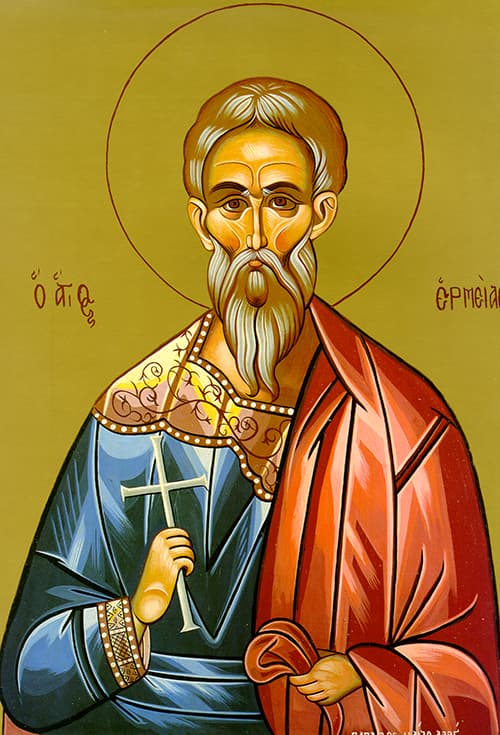
Saint Apostle Hermes
of the Seventy, Bishop of Dalmatia.
Also known as Hermes, Saint Hermes, Hermes of Dalmatia, Ermis, Hermes of Spalato
One of the Seventy Apostles, bishop of Dalmatia, greeted by St. Paul in Romans 16:14, who underwent persecution and was venerated as a martyr in the early Church.
Tone 1
Let us praise in hymns the six–fold choir of Apostles: Herodion and Agabus, Rufus, Asyncritus, Phlegon and holy Hermes.
They ever entreat the Trinity for our souls!
The Apostle
and Bishop of Dalmatia
Apostle Hermes was one of the Seventy Apostles commissioned by Christ and is remembered for his apostolic ministry as Bishop of Dalmatia. Mentioned by name in the Epistle to the Romans, he represents the faithful evangelical work of the early Church in the Balkans and endured suffering for the faith he proclaimed.
Early years
The early biographical details of Apostle Hermes remain obscure in the surviving historical record. In the Synaxarion of Hippolyte Delehaye (1902) he is called Ermylos. Like many of the Seventy Apostles, his name appears in Sacred Scripture as one chosen personally by the Lord Jesus and appointed as a missionary herald of the Gospel. The apostles of this second rank were drawn from faithful disciples who had witnessed the Resurrection and received the commission to evangelize the known world.
In the Church
He is usually identified with the Hermes mentioned by Paul in Romans 16:14, and said to have succeeded Titus as Bishop of Dalmatia. In this episcopal capacity, Hermes oversaw the fledgling Christian community in Dalmatia - a region encompassing the eastern coast of the Adriatic Sea (in the territory of modern-day Croatia and Bosnia). As a bishop and shepherd of the Church, he would have been responsible for instructing the faithful, celebrating the sacred mysteries, and strengthening the believers in their newfound faith amid a pagan environment.
Hermes worked to establish and build up the Christian community in Dalmatia, converting many from idolatry and founding or consolidating the ecclesiastical structures that would endure. His episcopate coincided with the apostolic age, making him a direct witness and successor to the teachings of the Apostles themselves.
Later years
All these disciples for their intrepid service to Christ underwent fierce sufferings and were found worthy of a martyr's crown. Apostle Hermes' steadfast proclamation of the Gospel and his refusal to abandon the faith eventually brought him into conflict with pagan authorities. Rather than compromise the truth entrusted to him, he endured persecution and martyrdom, sealing his apostolic witness with his blood.
His martyrdom is commemorated by the Church as testimony to his unwavering fidelity to Christ in the face of worldly opposition. The tradition of persecution and suffering became the mark of apostolic faithfulness in those early centuries, and Hermes joined the glorious company of apostles and martyrs who preferred death to denying their Lord.
Legacy and veneration
The veneration of Apostle Hermes extended throughout Christian lands, particularly in regions connected to Dalmatia. Some of his relics were given to Spoleto by Gregory the Great. Other relics went to Lothair I by Pope Leo IV; Lothair brought them first to Cornelismünster, near Aachen. The relics were recovered in 940 and housed in a Romanesque-style crypt in 1083. The church of Saint Hermes was consecrated in 1129. These relic translations demonstrate the widespread honor accorded to the martyr apostle in medieval Christendom.
In the Eastern Orthodox tradition, Apostle Hermes is remembered as a faithful shepherd of the Church and a bold proclaimer of Christ. His feast days are celebrated on April 8 with his fellow martyrs, and on January 4 among the Seventy. The Church honors him not only on his individual commemoration but also in the annual remembrance of all the Seventy Apostles, recognizing his role in the apostolic mission and his enduring intercession for all believers.
How the saint's
memory is kept.
- Who was Apostle Hermes?
- Apostle Hermes was one of the Seventy Apostles chosen by Christ, bishop of Dalmatia, and is mentioned by name in Romans 16:14 by St. Paul. He evangelized the Dalmatian region and is venerated as a martyr who suffered for the Christian faith.
- When is the feast day of Apostle Hermes?
- Apostle Hermes is commemorated on April 8 together with his fellow apostles Herodion, Agabus, Rufus, Asyncritus, and Phlegon. He is also remembered on January 4 among the Seventy Apostles.
- What is known about Hermes' ministry?
- Apostle Hermes served as Bishop of Dalmatia, where he established and strengthened the Christian community. He succeeded Titus as bishop and labored to convert the pagan inhabitants of the region to the Christian faith through apostolic preaching.
- How did Apostle Hermes die?
- Apostle Hermes is venerated as a martyr. He underwent persecution and suffering for his bold proclamation of the Gospel and his refusal to abandon Christ, ultimately receiving the martyr's crown through martyrdom.
- What happened to Apostle Hermes' relics?
- Portions of his relics were distributed throughout Christendom. Some were given to Spoleto by Pope Gregory the Great, while others were taken to the West and eventually housed in a crypt at Ronse, Belgium, where a church in his honor was erected in 1129.
- Where is Apostle Hermes mentioned in Scripture?
- Apostle Hermes is mentioned by name in Romans 16:14, where St. Paul writes: 'Greet Asyncritus, Phlegon, Hermas, Patrobas, Hermes, and the brethren which are with them.' This biblical reference confirms his presence among the apostles in the early Church.
- How is Apostle Hermes distinguished from other Hermas?
- Apostle Hermes of Dalmatia (feast April 8) is distinct from Apostle Hermas of Philippopolis (feast May 31), though both are among the Seventy and both mentioned in Romans 16:14. Hermes served in Dalmatia and Hermas in Philippopolis, Thrace.
Tone 2
You became the disciples of Christ
And all-holy Apostles, O glorious Herodion, Agabus and Rufus,
Asyncritus, Phlegon and Hermes.
Ever entreat the Lord
To grant forgiveness of transgressions
To us who sing your praises.
O holy Apostle Hermés, who art one of the glorious Seventy, entreat the merciful God to grant our souls forgiveness of transgressions. Through thy prayers illumine the way of the faithful with the light of the Holy Spirit, as thou didst dispel the darkness of error in thy apostolic age. Rejoice with thy fellow apostles Herodion, Agabus, Rufus, Asyncritus, and Phlegon before the throne of the Trinity, and ever make intercession for us who honor thy holy memory, O great Apostle.
Carry the tradition with you.
Hand-finished icons, books, and calendars to carry the Orthodox day into your home.

Read a life like this
every morning.
Meet the daily saints through Orthodox Daily Companion on iPhone and iPad, or through the Lives of the Saints web app in any modern browser.
Orthodox Daily Companion
The native Apple app, with a Home Screen widget, prayer reminders, and a private on-device journal.
Download on the App StoreLives of the Saints Web App
The browser experience for desktop, tablet, or phone, with a seven-day trial of the complete devotional library.
Open the web appGet a life like this one on every new tab - free, no account, from the same catalogue.
References and further reading
- orthodoxwiki.orghttps://orthodoxwiki.org/Apostle_Hermes_(bishop)
- en.wikipedia.orghttps://en.wikipedia.org/wiki/Hermas_of_Dalmatia
- oca.orghttps://www.oca.org/saints/lives/2021/03/08/100701-apostle-hermes-of-the-seventy
- orthochristian.comhttps://orthochristian.com/102586.html
- brightonoratory.orghttps://brightonoratory.org/2012/08/28/todays-saints-st-hermes-bishop-martyr/
- catholic.orghttps://www.catholic.org/encyclopedia/view.php?id=5713
- johnsanidopoulos.comhttps://www.johnsanidopoulos.com/2017/03/holy-apostle-hermas-of-seventy.html
- orthodoxwiki.orghttps://orthodoxwiki.org/Apostle_Hermas
- oca.orghttps://www.oca.org/saints/lives/2017/05/31/101567-apostle-hermas-of-the-seventy
- oca.orghttps://www.oca.org/saints/lives/1993/03/08/100701-apostle-hermes-of-the-seventy
- en.wikipedia.orghttps://en.wikipedia.org/wiki/Hermes_of_Philippopolis
- oca.orghttps://www.oca.org/saints/lives/2022/04/08/101024-apostle-herodion-of-the-seventy-and-those-with-him
- goarch.orghttps://www.goarch.org/chapel/saints?contentid=2012
- holytrinityorthodox.comhttps://www.holytrinityorthodox.com/calendar/los/March/08-04.htm
- oca.orghttps://www.oca.org/saints/lives/2015/11/04/103172-hieromartyrs-nicander-bishop-of-myra-and-hermas-the-presbyter
- orthochristian.comhttps://orthochristian.com/89702.html
- en.wikipedia.orghttps://en.wikipedia.org/wiki/Hermas_(freedman)
- biblestudytools.comhttps://www.biblestudytools.com/msg/romans/16-14.html
- studylight.orghttps://www.studylight.org/bible/eng/rhe/romans/16-14.html
- biblestudytools.comhttps://www.biblestudytools.com/kjv/romans/16-14.html
More from the tradition.
Read the Journal
Essays on feasts, fasting, and the rhythm of the Church year.
ExploreOrthodox countries
How the faith is lived and kept across the Christian world.
ExploreThe 2027 Calendar
A saint, a reading, and the day's fasting guideline for every day of 2027.
ExploreMobile & web apps
Carry the daily rhythm on iPhone and iPad or continue in the web app.
Explore