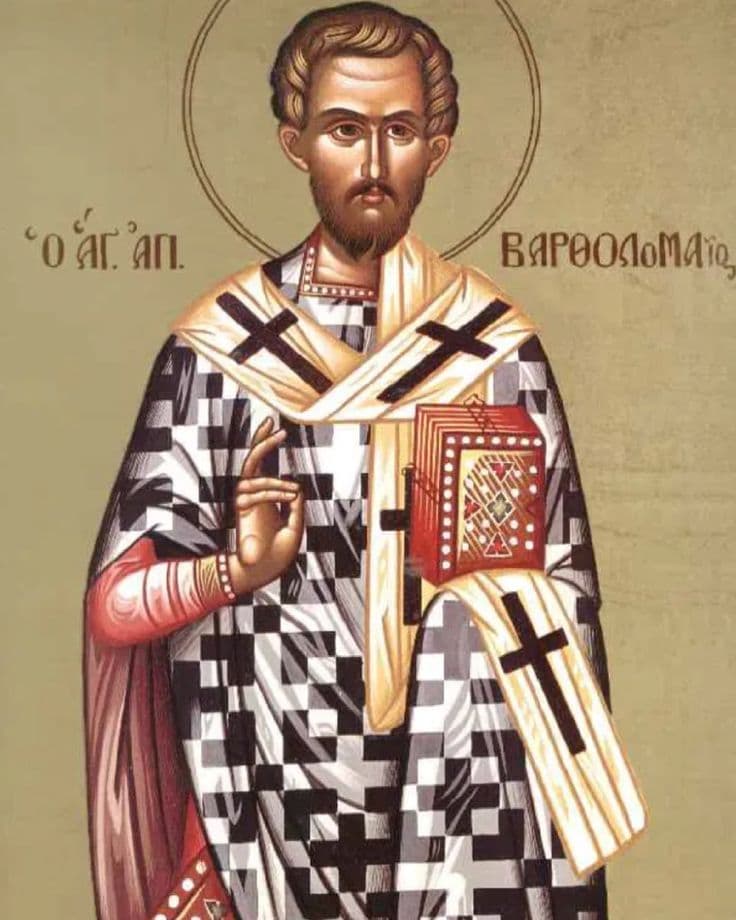
Saint Apostle Bartholomew (also called Nathanael)
of the Twelve.
Also known as Saint Bartholomew, Bartholomaios, Nathanael of Cana, Bartholomew the Apostle, Nathaniel
One of the Twelve Apostles, identified with Nathanael in the Gospel of John, he preached the Gospel in Asia Minor, India, and Armenia before being martyred by crucifixion and flaying in Armenia.
Tone 3
Holy Apostles Bartholomew and Barnabas,
entreat the merciful God
to grant our souls forgiveness of transgressions.
The Apostle
Nathanael, Known as Bartholomew
Apostle Bartholomew, also known as Nathanael, was one of the Twelve chosen by Jesus Christ. Identified since ancient times with the Nathanael of the Gospel of John by the Fathers of the Church, he was brought to Christ by Philip and immediately recognized Jesus as the Son of God and King of Israel. He preached the Gospel throughout Asia Minor, India, and Armenia, performing mighty miracles and converting many to Christ, before suffering a martyr's death for his unwavering faith.
Early years
The Holy Apostle Bartholomew was born at Cana of Galilee and was one of the Twelve Apostles of Christ. His name Bartholomew, from Aramaic "Bar-Tolmai," means "son of Tolmai." Saints John Chrysostom, Cyril of Alexandria, Epiphanius of Cyprus and other Fathers of the Church regard the Apostle Bartholomew (the son of Tholomai) as the same person as Nathanael. Thus, his name would be Nathanael, and his patronymic would be Bartholomew.
In John's Gospel, Nathanael appears as a man of sincere faith. Saint Nathanael, whose name means "the gift of God," was from Cana of Galilee (John 21:2). He was brought to the Savior by Phillip, as described in the Fourth Gospel (John 1:45-51). When Philip told him of Jesus of Nazareth, Nathanael's initial skepticism gave way to profound conviction when Jesus demonstrated divine knowledge of him. Christ calls him a true Israelite, which means "one who sees God." Nathanael was amazed when Christ says that He had seen him under the fig tree. Then He says that Nathanael will see even greater things; he will see the heavens opened, and "the angels of God ascending and descending upon the Son of Man."
In the Church
After the Descent of the Holy Spirit on the Day of Pentecost, it fell by lot to the holy Apostles Bartholomew and Philip (November 14) to preach the Gospel in Syria and Asia Minor. Accompanying the holy Apostle Philip was his sister, the holy virgin Saint Mariamnne. Traversing the cities of Syria and Myzia, they underwent much hardship and tribulations, they were stoned and they were locked up in prison.
In one of the villages they met up with the Apostle John the Theologian, and together they set off to Phrygia. In the city of Hieropolis by the power of their prayers they destroyed an enormous viper, which the pagans worshipped as a god. The holy Apostles Bartholomew and Philip with his sister confirmed their preaching with many miracles. Thinking that perhaps some sort of magic power was hidden away in the clothes of the apostles, the prefect gave orders to strip them. But Saint Mariamne became like a fiery torch before their eyes, and none dared touch her. They sentenced the saints to death. The Apostle Philip was crucified upside down. Suddenly there was an earthquake, and a fissure in the earth swallowed up the prefect of the city, together with the pagan priests and many of the people. Others took fright and rushed to take down the apostles from the crosses. Since the Apostle Bartholomew had not been suspended very high, they soon managed to take him down. The Apostle Philip, however, had died.
Later years
The Apostle Bartholomew went to India, where he translated the Gospel of Matthew into their language, and he converted many pagans to Christ. He also visited Greater Armenia (the country between the River Kura and the upper stretches of the Tigrus and Euphrates Rivers), where he worked many miracles and healed the daughter of King Polymios from the demons afflicting her. In gratitude, the king sent gifts to the apostle, who refused to accept them, saying that he sought only the salvation of the souls of mankind. Then Polymios together with his wife, daughter, and many of those close to them accepted Baptism. And people from more than ten cities of Greater Armenia followed their example.
But through the intrigues of the pagan priests, the Apostle Bartholomew was seized by the king's brother Astiagus in the city of Alban (now the city of Baku), and crucified upside down. But even from the cross he did not cease to proclaim the good news about Christ the Savior. Finally, on orders from Astiagus, they flayed the skin from the Apostle Bartholomew and cut off his head. Believers placed his relics in a leaden coffin and buried him.
Legacy and veneration
The holy Apostle Bartholomew is mentioned in the Life of Saint Joseph the Hymnographer (April 4). Having received from a certain man part of the relics of the Apostle Bartholomew, Saint Joseph conveyed them to his own monastery near Constantinople, and he built a church in the name of the Apostle Bartholomew, placing in it a portion of the relics. Saint Joseph ardently desired to compose hymns of praise in honor of the saint, and he fervently besought God to grant him the ability to do so. On the Feast day in memory of the Apostle Bartholomew, Saint Joseph saw him at the altar. He beckoned to Joseph and took the holy Gospel from the altar table and pressed it to his bosom with the words, "May the Lord bless you, and may your song delight the whole world." And from that time Saint Joseph began to write hymns and canons to adorn not only the Feast day of the Apostle Bartholomew, but also the Feast days of many other saints, composing about 300 canons in all.
He also appeared to Emperor Anastasius I (491-518) and told him that he would protect the new town of Dara. Along with his fellow apostle Jude "Thaddeus", Bartholomew is reputed to have brought and preach Christianity to Armenia in the 1st century; as a result, in 301 the Armenian kingdom became the first state in history to embrace Christianity officially. The apostle's faithfulness unto death, combined with his many miracles and missionary achievements, has made him a greatly venerated saint in both Eastern Orthodox and Western Christian tradition.
How the saint's
memory is kept.
- When is the feast day of Saint Bartholomew in the Eastern Orthodox Church?
- The Eastern Orthodox Church venerates Bartholomew on June 11.
- Is Saint Bartholomew the same person as Nathanael?
- Saints John Chrysostom, Cyril of Alexandria, Epiphanius of Cyprus and other Fathers of the Church regard the Apostle Bartholomew as being the same person as Nathanael. Thus, his name would be Nathanael, and his patronymic would be Bartholomew.
- Where did Saint Bartholomew preach the Gospel?
- After the Descent of the Holy Spirit on the Day of Pentecost, it fell by lot to the holy Apostles Bartholomew and Philip to preach the Gospel in Syria and Asia Minor. He also went to India and Armenia.
- How was Saint Bartholomew martyred?
- The Apostle Bartholomew was seized by the king's brother Astiagus in the city of Alban (now the city of Baku), and crucified upside down. Finally, on orders from Astiagus, they flayed the skin from the Apostle Bartholomew and cut off his head.
- What is the significance of the knife in Saint Bartholomew's iconography?
- In artistic depictions, Bartholomew is most commonly depicted holding his flayed skin and the knife with which he was skinned. The knife refers to the mode of his martyrdom.
- Why is Saint Bartholomew a patron saint of tanners and leatherworkers?
- Due to the nature of his martyrdom, Bartholomew is the patron saint of tanners, plasterers, tailors, leatherworkers, bookbinders, farmers, housepainters, butchers, and glove makers.
- Where are the relics of Saint Bartholomew today?
- The Basilica of St. Bartholomew on the Island (Italian: Basilica di San Bartolomeo all'Isola, Latin: Basilica S. Bartholomaei in Insula) is a titular minor basilica, located in Rome, Italy. It was founded in 998 by Otto III, Holy Roman Emperor and contains the putative relics of St. Bartholomew the Apostle.
- What did Saint Bartholomew accomplish in Armenia?
- He visited Greater Armenia, where he worked many miracles and healed the daughter of King Polymios from the demons afflicting her. In gratitude, the king sent gifts to the apostle, who refused to accept them, saying that he sought only the salvation of the souls of mankind. Then Polymios together with his wife, daughter, and many of those close to them accepted Baptism. And people from more than ten cities of Greater Armenia followed their example.
Tone 4
You have appeared to the universe as a great sun,
shining with the radiance of your teachings and awesome miracles.
You enlighten those who honor you, apostle of the Lord, Bartholomew.
O Holy Apostles, intercede to our merciful God, that He may grant our souls forgiveness of sins.
Carry the tradition with you.
Hand-finished icons, books, and calendars to carry the Orthodox day into your home.
Read a life like this
every morning.
Meet the daily saints through Orthodox Daily Companion on iPhone and iPad, or through the Lives of the Saints web app in any modern browser.
Orthodox Daily Companion
The native Apple app, with a Home Screen widget, prayer reminders, and a private on-device journal.
Download on the App StoreLives of the Saints Web App
The browser experience for desktop, tablet, or phone, with a seven-day trial of the complete devotional library.
Open the web appGet a life like this one on every new tab - free, no account, from the same catalogue.
References and further reading
- orthodoxwiki.orghttps://orthodoxwiki.org/Apostle_Bartholomew
- oca.orghttps://www.oca.org/saints/lives/2017/06/11/101690-apostle-bartholomew-of-the-twelve
- goarch.orghttps://www.goarch.org/chapel/saints?contentid=83
- en.wikipedia.orghttps://en.wikipedia.org/wiki/Bartholomew_the_Apostle
- britannica.comhttps://www.britannica.com/biography/Saint-Bartholomew
- sjohndc.orghttps://sjohndc.org/en/list-of-relics/bartholomew-nathaniel-apostle-twelve
- antiochian.orghttps://www.antiochian.org/
- orthodoxmonasteryicons.comhttps://orthodoxmonasteryicons.com/products/st-bartholomew-or-nathaniel-the-apostle-icon
- greekboston.comhttps://www.greekboston.com/religion/st-bartholomew/
- en.chateauversailles.frhttps://en.chateauversailles.fr/node/5920/saint-bartholomew
- spicathedral.orghttps://spicathedral.org/blog/st-bartholomew-the-apostle/
- ccjc3.orghttps://www.ccjc3.org/st-bartholomew-a-saint-for-truth/
- livesofthesaints.comhttps://www.livesofthesaints.com/saint-bartholomew/
- goarchdiocese.cahttps://goarchdiocese.ca/holy-apostle-bartholomew/
- oca.orghttps://www.oca.org/saints/lives/2007/04/22/101180-apostle-nathaniel-of-the-seventy
- stjohndc.orghttps://stjohndc.org/en/list-of-relics/bartholomew-nathaniel-apostle-twelve
- stbartholomewca.orghttps://stbartholomewca.org/our-patron
- orthodox.nethttps://orthodox.net/menaion-june/11-the-holy-apostle-bartholomew.html
- en.wikipedia.orghttps://en.wikipedia.org/wiki/Feast_of_Saint_Bartholomew
- orthodoxtimes.comhttps://orthodoxtimes.com/apostle-bartholomew-of-the-twelve-11-june/
More from the tradition.
Read the Journal
Essays on feasts, fasting, and the rhythm of the Church year.
ExploreOrthodox countries
How the faith is lived and kept across the Christian world.
ExploreThe 2027 Calendar
A saint, a reading, and the day's fasting guideline for every day of 2027.
ExploreMobile & web apps
Carry the daily rhythm on iPhone and iPad or continue in the web app.
Explore