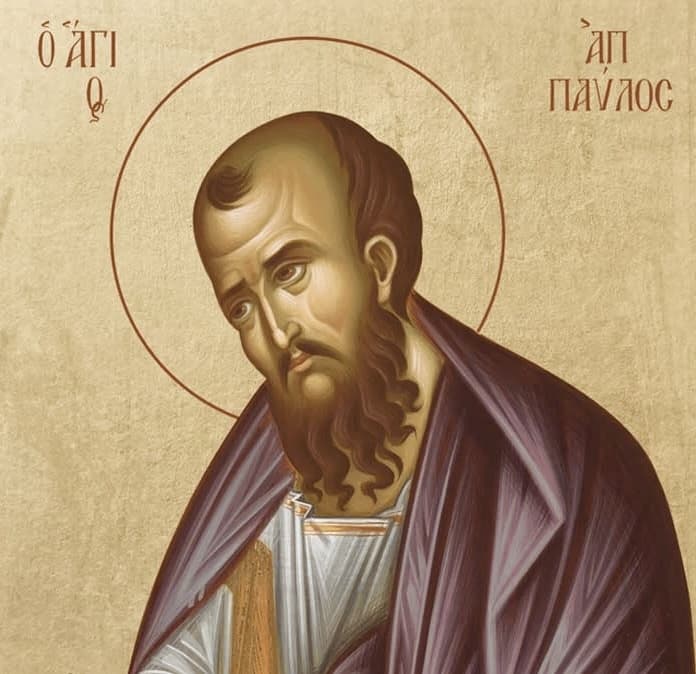
Saint Apostle Paul the Apostle to the Gentiles.
Also known as Saint Paul, Paul of Tarsus, Saul of Tarsus, Apostle to the Gentiles, Paul the Apostle
The great Apostle to the Gentiles, Paul authored epistles that form the foundation of Christian theology and planted churches throughout the Mediterranean world. A former persecutor of Christians, he was miraculously converted on the Damascus Road and died a martyr under Nero in Rome circa AD 64–67.
Tone 4
O foremost of the Apostles and teachers of the inhabited earth,
intercede with the Master of all
to grant peace to the world and great mercy to our souls.
The Apostle
to the Gentiles
Paul was born Saul in Tarsus, a Greek-speaking Jew of the tribe of Benjamin, and was trained as a strict Pharisee in Jerusalem. Before his dramatic conversion on the road to Damascus, he was a zealous persecutor of the early Church. His miraculous encounter with the risen Christ transformed him into Christianity's greatest missionary, writing epistles that became foundational texts of the New Testament and establishing churches across Asia Minor, Greece, and Rome.
Early years
Paul was likely born between the years of 5 BC and 5 AD. The Book of Acts and modern scholars agree that Paul came from the city of Tarsus, which was part of the Roman province of Cilicia. Paul the Apostle of the Gentiles, was born a Jew at Tarsus and studied under the respected Rabbi Gamaliel as a strict Pharisee at Jerusalem (Acts 22:3). The Acts of the Apostles indicates that Paul was a Roman citizen by birth, and scholars largely accept this claim.
In his childhood and youth, Paul learned how to "work with [his] own hands" (1 Corinthians 4:12). His trade, tent making, which he continued to practice after his conversion to Christianity, helps to explain important aspects of his apostleship.
In the Church
While he was not one of the Twelve Apostles and did not know Jesus during his lifetime, Paul experienced a vision of the ascended Jesus on the road to Damascus. The account says that "He fell to the ground and heard a voice saying to him, 'Saul, Saul, why do you persecute me?' He asked, 'Who are you, Lord?' The reply came, 'I am Jesus, whom you are persecuting'." When Ananias of Damascus arrived, he laid his hands on him and said: "Brother Saul, the Lord Jesus, that appeared unto thee in the way as thou camest, hath sent me, that thou mightest receive thy sight, and be filled with the Holy Spirit." His sight was restored, he got up and was baptized.
Paul founded several Christian communities in Asia Minor and Europe from the mid-40s to the mid-50s AD. This vision of the glory of God is the call by which Paul becomes the Apostle to the Gentiles, the greatest missionary in the history of Christianity. It is through his missionary efforts that Christianity, originally a sect of Judaism, becomes a world religion.
Later years
Paul was attacked and beaten by a mob for preaching against the enactments of the Jewish Law, but Paul invoked his privileges as a Roman citizen and eventually appealed to Caesar for a trial at Rome, as his life was in danger. On the voyage to Rome he suffered shipwreck at Malta. When he reached it, he was under house arrest for two years, during which time he wrote the four 'captivity' epistles.
St. Paul, a Roman citizen, was beheaded. Led in chains under the escort of three soldiers, St. Paul was condemned to death at Acque Salvie, three miles from the city of Rome (today the site of the Three Fountains Abbey).
Legacy and veneration
Of the 27 books of the New Testament, 13 are traditionally attributed to Saint Paul, though several may have been written by his disciples. Paul's epistles continue to be vital roots of the theology, worship, and pastoral life in the Latin and Protestant traditions of the West, as well as the Eastern Catholic and Orthodox traditions of the East. Paul's influence on Christian thought and practice is pervasive in scope and profound in impact.
At the time of his death, Paul was the founder of many of the ancient Orthodox churches of the East, but he is perhaps most closely associated with the Church of Antioch, which includes him with St. Peter as its patron saint. The Church remembers St. Paul together with St. Peter on June 29.
How the saint's
memory is kept.
- When is the feast day of Apostle Paul?
- Apostle Paul is commemorated on June 29 together with Saint Peter in the Eastern Orthodox Church. This feast celebrates both the Apostles' martyrdom and is one of the oldest liturgical celebrations in Christian tradition.
- Who was Apostle Paul before his conversion?
- Paul was born Saul in Tarsus, a city in Cilicia (modern Turkey). He was a Pharisee trained under Rabbi Gamaliel in Jerusalem and became a zealous persecutor of early Christians before his dramatic conversion on the Damascus Road.
- How did Apostle Paul become Christian?
- On the road to Damascus, where he was traveling to arrest Christians, Saul experienced a vision of the risen Christ and was blinded by a brilliant light. After three days, the disciple Ananias restored his sight through prayer and baptized him. This vision transformed him into the Apostle Paul and the greatest missionary to the Gentiles.
- What did Apostle Paul write?
- Paul authored at least fourteen epistles (letters) to various churches and individuals. These letters form a major part of the New Testament and became foundational theological texts for the entire Christian Church, addressing issues of faith, conduct, and Christian community life.
- What is Apostle Paul the patron saint of?
- Paul is the patron saint of the Gentiles, missionaries, voyagers and sailors, teachers and preachers, Rome, Malta, and the Church of Antioch. He is invoked by those engaged in missionary work and evangelization.
- How did Apostle Paul die?
- Paul was beheaded in Rome during the persecution under Emperor Nero, likely around 64-67 AD. According to tradition, he died at the same time as Saint Peter. His remains are venerated in the Basilica of St. Paul Outside the Walls in Rome.
- Where are the relics of Apostle Paul today?
- The relics of Saint Paul are housed in the Basilica of St. Paul Outside the Walls (Basilica Papale di San Paolo fuori le Mura) in Rome, built near the original site of his martyrdom and burial. The basilica was constructed by Saint Constantine and later decorated and enlarged by Theodosius I and Pope Gregory the Great.
Tone 2
As the light of the faithful, teacher and radiant consecrated gift, great Apostle,
make us incline daily toward Christ the Creator of all, O richly renowned,
that we obtain Divine mercy.
O Holy Apostle Paul, preacher of truth and teacher of the Gentiles, intercede with the Lord our God that He may grant us remission of our many sins, and that He may incline our hearts to keep His commandments. Glory to the power that was given unto thee! Glory to him that wrought in thee, O blessed one! Glory to Him that through thee worketh healing unto all!
Carry the tradition with you.
Hand-finished icons, books, and calendars to carry the Orthodox day into your home.
Read a life like this
every morning.
Meet the daily saints through Orthodox Daily Companion on iPhone and iPad, or through the Lives of the Saints web app in any modern browser.
Orthodox Daily Companion
The native Apple app, with a Home Screen widget, prayer reminders, and a private on-device journal.
Download on the App StoreLives of the Saints Web App
The browser experience for desktop, tablet, or phone, with a seven-day trial of the complete devotional library.
Open the web appGet a life like this one on every new tab - free, no account, from the same catalogue.
References and further reading
- orthodoxwiki.orghttps://orthodoxwiki.org/Apostle_Paul
- oca.orghttps://www.oca.org/saints/troparia/2025/06/29/101840-the-holy-glorious-and-all-praised-leaders-of-the-apostles-peter
- britannica.comhttps://www.britannica.com/biography/Saint-Paul-the-Apostle
- en.wikipedia.orghttps://en.wikipedia.org/wiki/Paul_the_Apostle
- stpaul-orthodox.orghttps://www.stpaul-orthodox.org/life-of-st-paul
- stpaulsirvine.orghttps://stpaulsirvine.org/saint-paul-apostle-to-the-gentiles/
- saintpaulemmaus.orghttps://www.saintpaulemmaus.org/patron-saint-paul-the-apostle
- annunciationwi.orghttps://www.annunciationwi.org/about/iconography/apostle-paul
- orthodoxartsjournal.orghttps://orthodoxartsjournal.org/st-peter-on-the-right-st-paul-on-the-left/
- relicshunter.comhttps://www.relicshunter.com/relics-st-paul-apostle/
- newworldencyclopedia.orghttp://www.newworldencyclopedia.org/entry/Paul_of_Tarsus
- christianity.fandom.comhttps://christianity.fandom.com/wiki/Paul_of_Tarsus
- biblicaltheology.comhttps://www.biblicaltheology.com/Research/WallaceQ01.html
- jewishencyclopedia.comhttps://www.jewishencyclopedia.com/articles/11952-paul-of-tarsus
- oca.orghttps://www.oca.org/saints/troparia/0577/08/30/102422-saint-paul-the-new-patriarch-of-constantinople
- holytrinityorthodox.comhttp://www.holytrinityorthodox.com/calendar/rss/troparion.htm
- oca.orghttps://www.oca.org/saints/troparia/2026/03/07/100693-saint-paul-the-confessor-bishop-of-plousias-in-bithynia
- oca.orghttps://www.oca.org/saints/troparia/2022/01/15/100196-venerable-paul-of-thebes
- open.spotify.comhttps://open.spotify.com/track/1DW8sd0hDCRSfB5FG6cwON
- oca.orghttps://www.oca.org/saints/troparia/2016/06/28/101838-saint-paul-physician-of-corinth
More from the tradition.
Read the Journal
Essays on feasts, fasting, and the rhythm of the Church year.
ExploreOrthodox countries
How the faith is lived and kept across the Christian world.
ExploreThe 2027 Calendar
A saint, a reading, and the day's fasting guideline for every day of 2027.
ExploreMobile & web apps
Carry the daily rhythm on iPhone and iPad or continue in the web app.
Explore