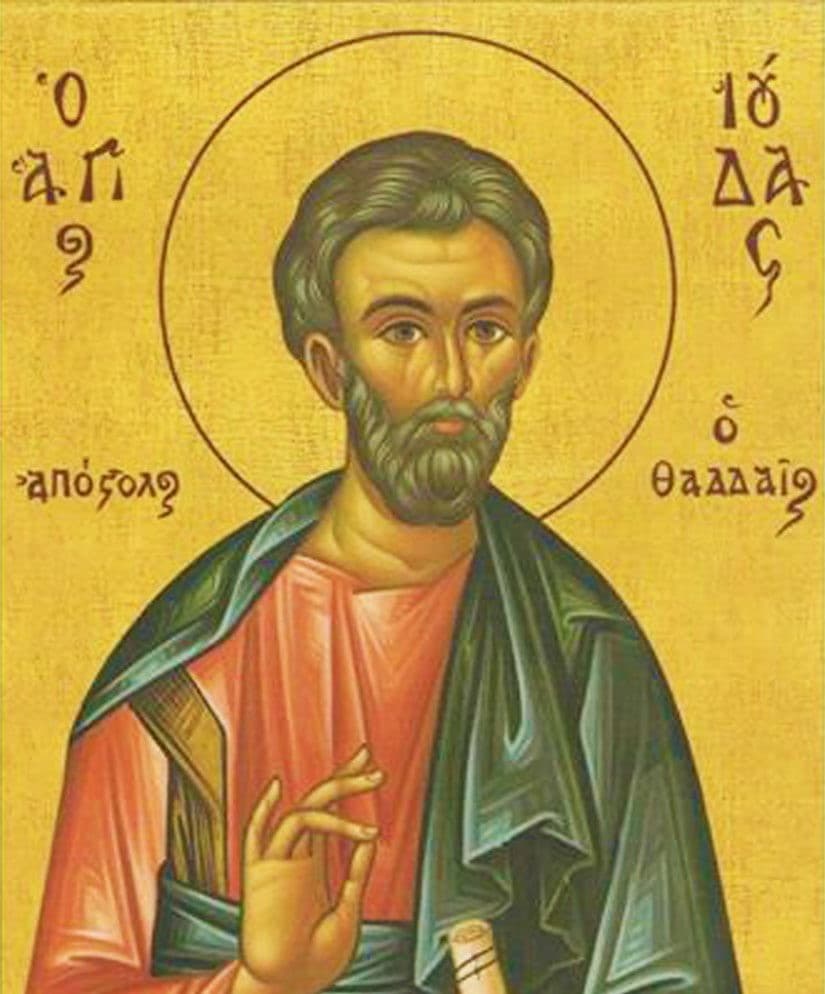
Saint Apostle Jude Thaddaeus.
Also known as Saint Jude the Apostle, Judas Thaddaeus, Jude of James, Lebbaeus, Thaddeus, Thaddaeus
One of the Twelve Apostles and kinsman of the Lord, Jude Thaddaeus preached the Gospel across Judea, Mesopotamia, Persia, and Armenia before his martyrdom, and authored the canonical Epistle of Jude.
Tone 1
Divinely we praise you, O Jude, as a faithful witness, knowing you to be the brother of Christ. You trampled on delusion, and so preserved the faith. Today as we celebrate your holy memory, by your intercessions we receive remission of sins.
The Apostle
Kinsman and Missionary to the East
Jude Thaddaeus was one of the Twelve Apostles, a kinsman of Jesus by virtue of being the son of Saint Joseph the Betrothed. Though he initially struggled to believe in Christ's divinity, he became a devoted apostle and missionary. He preached across the eastern lands and authored the Epistle of Jude, one of the shortest but most powerful letters in the New Testament. Tradition records his martyrdom in Armenia around the year 80.
Early years
The Holy Apostle Jude was a son of Righteous Joseph the Betrothed by his first wife, descended from King David and Solomon. At the beginning of the Lord Jesus Christ's earthly ministry, Joseph's sons, Jude among them, did not believe in His divine nature. The brothers were opposed to Joseph's desire to allot a share of his inheritance to Jesus because He was born of another mother.
Only James, later called "The Brother of God," offered to share his portion with Him. Jude came to believe in Christ the Savior as the awaited Messiah, and he followed Him and was chosen as one of the twelve Apostles. According to John 14:22–23, after Jesus completed the Last Supper and announced his manifestation to his disciples, Jude asks, "Lord, how is it that you will reveal yourself to us, and not to the world?"
In the Church
After the Ascension he preached the Gospel in Judea, Samaria, Galilee, Idumea, Syria, Arabia, Mesopotamia, and Armenia. Finally, he went to the city of Edessa. Here he finished the work that was not completed by his predecessor, Saint Thaddeus, Apostle of the Seventy (August 21).
There is a tradition that Saint Jude went to Persia, where he wrote his catholic Epistle in Greek. The Apostle urges believers to guard themselves against fleshly impurity, to be diligent in prayer, faith and love, to convert the lost to the path of salvation, and to guard themselves from the teachings of heretics. He also says that it is not enough just to be converted to Christianity, but faith must be demonstrated by good works.
Later years
Laboring in this manner for the enlightenment of the pagan peoples and converting them from their former superstitions to the light of the true knowledge of Christ, he made his way to the lands around Mount Ararat, where he converted a multitude of people to Christianity. Having stirred up the pagan unbelievers, there they seized him and subjected him to tortures. Then they hung him up and shot arrows through him.
According to various traditions, the core tradition is consistent across East and West: he died a martyr for Christ in the eastern regions (Persia/Armenia) in the mid-to-late first century. The Armenian Apostolic Church - the world's oldest national Christian church, having adopted Christianity as a state religion in 301 AD - traces its founding directly to two apostles: Thaddaeus and Bartholomew. According to Armenian tradition, Thaddaeus arrived in the Armenian kingdom around 43–66 AD, preaching in the regions of Artaz, Vaspurakan, Goghtn, Derzjan, and Sper. He reportedly converted members of the royal family, including King Sanatrouk's daughter Sandukht, who became the first Armenian martyr.
Legacy and veneration
He is referenced in the Synoptic Gospels, the Acts of the Apostles, and wrote an epistle which is part of the New Testament. The Epistle of Jude stands as his enduring witness to the Church, warning against false teachings and encouraging steadfastness in apostolic faith. From the perspective of the Syriac Orthodox Church, St. Jude Thaddeus occupies a position of unique significance and honor. He is not merely one apostle among twelve, but the very foundation of our Church, the apostolic father of Syriac Christianity, the one through whom the Gospel came to our ancestors and established our ecclesiastical identity. Without St. Jude Thaddeus, there would be no Church of Edessa, no Syriac Christian tradition, no continuity with the apostolic age in our region.
In Armenia, he is an apostolic founder - a man who brought the kerygma to their ancestors, who shed his blood on their soil, whose presence is embedded in their national and ecclesiastical identity. The Armenian Apostolic Church venerates him as one of its founding apostles. Churches dedicated to his name, particularly in the Middle East and across Eastern Christian lands, serve as centers of pilgrimage and devotion.
How the saint's
memory is kept.
- When is the feast day of Apostle Jude Thaddaeus?
- June 19 in the Eastern Orthodox Church. He is also commemorated on June 30 with the Synaxis of the Twelve Apostles.
- What is Apostle Jude also known as?
- He is also called Thaddaeus, Lebbaeus, Jude of James, and Judas son of James in various New Testament passages and traditions.
- What did Apostle Jude write?
- He is the author of the Epistle of Jude, a short but powerful New Testament letter warning against false teachings and urging steadfastness in apostolic faith.
- Where did Apostle Jude preach?
- He preached in Judea, Samaria, Galilee, Idumea, Syria, Arabia, Mesopotamia (including Edessa), Persia, and Armenia.
- How did Apostle Jude die?
- He was martyred around the year 80 AD in the region around Mount Ararat in Armenia, either by crucifixion or by being shot with arrows.
- What is Apostle Jude's relationship to Jesus?
- Jude was a kinsman of the Lord through being the son of Saint Joseph the Betrothed. He was the brother of James, who became the first Bishop of Jerusalem.
Tone 2
You were chosen as a disciple for your firmness of mind: An unshakable pillar of the Church of Christ, you proclaimed His word to the Gentiles, telling them to believe in one Godhead. You were glorified by Him, receiving the grace of healing, healing the ills of all who came to you, O most praised Apostle Jude!
O Holy Apostle Jude, kinsman of our Lord Jesus Christ and faithful servant of His Gospel, we honor you as a pillar of the early Church and a beacon of apostolic faith. You preached tirelessly across distant lands, converting multitudes from darkness to the light of Christ, and you sealed your witness with your martyrdom. We beseech you, O blessed Apostle, to intercede for us before the throne of God, that we may grow steadfast in faith, courageous in adversity, and faithful in keeping the apostolic traditions delivered to us. May we, like you, trample upon delusion and preserve the true faith in our hearts. By your intercessions, grant us remission of our sins and draw us closer to the love of Christ. Amen.
Carry the tradition with you.
Hand-finished icons, books, and calendars to carry the Orthodox day into your home.


Read a life like this
every morning.
Meet the daily saints through Orthodox Daily Companion on iPhone and iPad, or through the Lives of the Saints web app in any modern browser.
Orthodox Daily Companion
The native Apple app, with a Home Screen widget, prayer reminders, and a private on-device journal.
Download on the App StoreLives of the Saints Web App
The browser experience for desktop, tablet, or phone, with a seven-day trial of the complete devotional library.
Open the web appGet a life like this one on every new tab - free, no account, from the same catalogue.
References and further reading
- orthodoxwiki.orghttps://orthodoxwiki.org/Apostle_Jude
- oca.orghttps://www.oca.org/saints/lives/2008/06/19/101752-apostle-jude-the-brother-of-the-lord/
- oca.orghttps://www.oca.org/saints/troparia/0216/06/19/101752-apostle-jude-the-brother-of-the-lord
- ww1.antiochian.orghttp://ww1.antiochian.org/node/30859
- en.wikipedia.orghttps://en.wikipedia.org/wiki/Jude_Thaddeus_the_Apostle
- britannica.comhttps://www.britannica.com/biography/Saint-Jude-Apostle
- johnsanidopoulos.comhttps://www.johnsanidopoulos.com/2017/06/holy-apostle-jude-of-twelve.html
- oursaints.orghttps://www.oursaints.org/st_jude_thaddeus.html
- greekboston.comhttps://www.greekboston.com/religion/st-jude/
- jesusleadershiptraining.comhttps://jesusleadershiptraining.com/thaddaeus-in-the-bible/
- religion.fandom.comhttps://religion.fandom.com/wiki/Jude_the_Apostle
- churchpedia.orghttps://churchpedia.org/thaddaeus-saint-apostle/
- christholdfast.orghttps://christholdfast.org/people-characters-in-the-bible/thaddaeus/
- shrineofstjude.orghttps://shrineofstjude.org/saint-jude-thaddeus-lozano/
- catholic.orghttps://www.catholic.org/saints/saint.php?saint_id=127
- stjuderc.orghttps://www.stjuderc.org/our-patron-saint-st-jude-thaddaeus
- checkiday.comhttps://www.checkiday.com/ce61c4e0c1ee084dc238db7f89f73f0a/st-judes-feast-day
- saintsophiadc.orghttps://www.saintsophiadc.org/thaddeus-jude-the-apostle-brother-of-our-lord/
- saintforaminute.comhttps://saintforaminute.com/saints/saint_jude_thaddeus
- newworldencyclopedia.orghttps://www.newworldencyclopedia.org/entry/Jude_the_Apostle
More from the tradition.
Read the Journal
Essays on feasts, fasting, and the rhythm of the Church year.
ExploreOrthodox countries
How the faith is lived and kept across the Christian world.
ExploreThe 2027 Calendar
A saint, a reading, and the day's fasting guideline for every day of 2027.
ExploreMobile & web apps
Carry the daily rhythm on iPhone and iPad or continue in the web app.
Explore