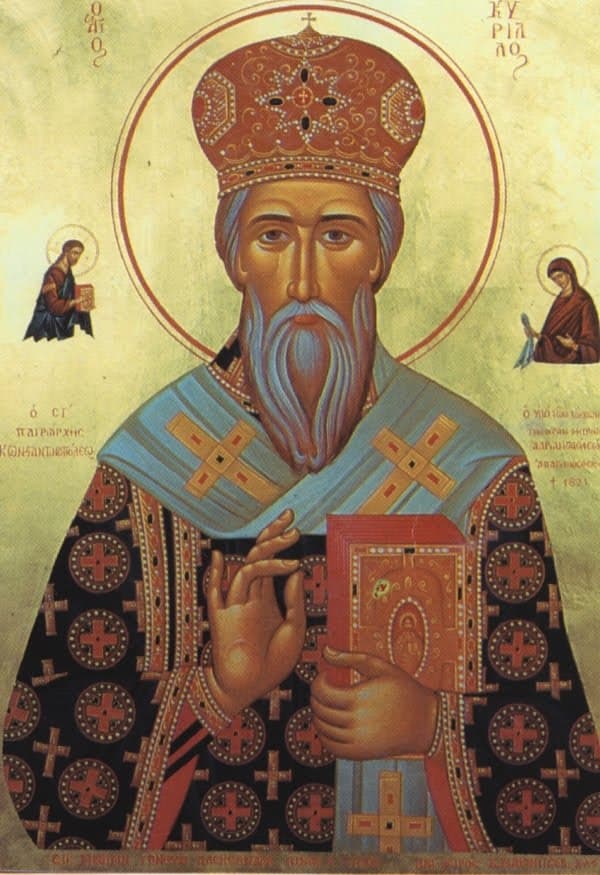
Saint Hieromartyr Cyril VI, Patriarch
of Constantinople.
Also known as Kyrillos VI of Constantinople, Cyril VI of Constantinople, Patriarch Cyril VI, Konstantin Serpentzoglou, Konstantinos Serpentzoglou
Ecumenical Patriarch of Constantinople (1813–1818) who was hanged by the Ottomans on April 18, 1821, during the Greek War of Independence, becoming a hieromartyr for the Orthodox faith.
No specific troparion for this saint is currently included in standard Orthodox service books. However, the faithful may commemorate Hieromartyr Cyril VI using general troparia for patriarchs and hieromartyr confessors, as maintained by the Church of Greece in its Synaxarium.
The Theologian-Patriarch
and Martyr of the Greek War of Independence
Patriarch Cyril VI was an advocate for Orthodox education and ecclesiastical reform who served as the highest-ranking bishop of the Ecumenical Patriarchate during a turbulent period. He initiated reforms in Byzantine music notation, restored the Patriarchal Press, and strengthened the Great School of the Nation. His martyrdom by hanging in 1821, though he was not involved in the Greek rebellion, exemplified the persecution faced by Orthodox clergy during the Greek War of Independence.
Early years
Cyril was born in 1769 in Edirne, where he finished school. He was a smart and good student. He was put under the protection of the local metropolitan bishop (and later Ecumenical Patriarch) Callinicus V of Constantinople, who ordained him deacon in 1791 and hired him as a secretary.
In 1801, when Callinicus V was elected Patriarch, Cyril was appointed great archdeacon of the Patriarchate. From that position, he was especially occupied with the reorganisation of the Great School of the Nation, which was then moved to Kuruçeşme. This early responsibility demonstrated his commitment to the preservation and advancement of Orthodox learning.
In the Church
In September 1803 he was elected Metropolitan bishop of Konya, serving as such for seven years. There, he worked hard for the establishment of schools, the funding of impecunious students, the distribution of books and the general education. His tenure as Metropolitan revealed his pastoral vision for educational reform throughout the Orthodox Church.
On March 4, 1813, he was elected Ecumenical Patriarch of Constantinople. As Ecumenical Patriarch, he showed special interest in the development of education, founded a music school and published many books, mainly religious. He fixed the economical problems of the Patriarchate and reopened the Patriarchal Press and the Great School of the Nation. In 1814, Patriarch Cyril presided over the adoption by the Holy Synod of the Church of Constantinople of the New Method of teaching and learning Byzantine music that had been developed by the "Three Teachers", Gregory Protopsaltes the Byzantios, Chrysanthos, and Chourmouzios Chartophylax.
Later years
The Sultan Mahmud II made him resign on 13 December 1818. After his resignation, he retired to Edirne. Though deposed from his patriarchal throne, Cyril maintained his spiritual dignity and continued to witness to Orthodox faith even in exile.
When the Greek War of Independence broke out, his name was included in the decree of the Sultan where the command to execute 30 priests and kodjabashis of Edirne was given. He was executed on 18 April 1821 by hanging in the gate of the Metropolis and his body stayed hanging for three days (the first time the rope broke and the Ottomans considered it a superstition). This was nine days following the martyrdom of Ecumenical Patriarch Gregory V (+ April 10, 1821).
Legacy and veneration
His holy relic was thrown into the Ebro (Iberus) River, but Divine Providence took care to bank it by a tree near the village Pythio. He was buried in this border village in Thrace and thereafter performed miracles to benefit the pious people. In Pythio a church was erected in his honor. On May 11, 1989, his tomb was opened at which time his relics began to give off myrrh that gave off a fragrance throughout the village of Pythio. On September 8, 1991, a church in remembrance of Patriarch Cyril was dedicated.
On July 8, 1993 the Holy Synod of the Church of Greece added the Holy New Hieromartyr Cyril VI, Patriarch of Constantinople, to the List of Saints of the Church. His memory is venerated as a faithful pastor who gave his life for the Orthodox Church and his people, enduring martyrdom during the upheaval of the Greek War of Independence. His contributions to the reform of Byzantine music and the strengthening of Orthodox education remain significant legacies in the Church.
How the saint's
memory is kept.
- When was Hieromartyr Cyril VI, Patriarch of Constantinople, martyred?
- He was martyred by hanging on April 18, 1821, during the Greek War of Independence, in Adrianople (Edirne).
- What was Cyril VI's role in the Orthodox Church?
- He served as the Ecumenical Patriarch of Constantinople from 1813 to 1818, the highest-ranking bishop of the Patriarchate responsible for overseeing the Orthodox Church throughout the Ottoman Empire.
- What reforms did Patriarch Cyril VI implement?
- He founded a music school, published religious books, reopened the Patriarchal Press and the Great School of the Nation, and presided over the adoption of the New Method of Byzantine music notation in 1814.
- Why was Cyril VI executed if he was not involved in the Greek rebellion?
- The Ottoman authorities used collective punishment against Orthodox clergy as retaliation for the Greek War of Independence. Though Cyril VI was not personally involved in the rebellion, he was executed as part of systematic persecution of the Orthodox hierarchy.
- Where are the relics of Saint Cyril VI today?
- A portion of his relics is preserved at Vatopaidi Monastery on Mount Athos in a small silver reliquary. The remainder was originally discovered near the village of Pythio in Thrace, where a church was built in his honor.
- When was Cyril VI canonized as a saint?
- He was canonized by the Holy Synod of the Church of Greece on July 8, 1993, as a Holy New Hieromartyr (New Martyr) of the Orthodox Church.
- What was significant about Cyril VI's relics?
- When his tomb was opened on May 11, 1989, his relics were found to be incorrupt and began to give off the fragrance of myrrh, a sign of sanctity and divine blessing in the Orthodox tradition.
No specific kontakion for this saint is currently included in standard Orthodox service books. The faithful may commemorate Hieromartyr Cyril VI using general kontakia for patriarchs and new martyrs, as authorized by the Holy Synod of the Church of Greece when he was canonized on July 8, 1993.
O Holy Hieromartyr and Ecumenical Patriarch Cyril, who didst suffer martyrdom for the Orthodox faith during the time of the Greek War of Independence, and who labored diligently for the education and reformation of the Church: intercede with Christ our God on behalf of all who honor thy memory, that He may grant us strength to remain faithful witnesses to the ancient traditions of the Orthodox Church, and grant us courage to stand firm in times of trial and persecution, that we too might offer our lives as a sacrifice acceptable to God. Through thy prayers, O Father, save our souls. Amen.
Carry the tradition with you.
Hand-finished icons, books, and calendars to carry the Orthodox day into your home.
Read a life like this
every morning.
Meet the daily saints through Orthodox Daily Companion on iPhone and iPad, or through the Lives of the Saints web app in any modern browser.
Orthodox Daily Companion
The native Apple app, with a Home Screen widget, prayer reminders, and a private on-device journal.
Download on the App StoreLives of the Saints Web App
The browser experience for desktop, tablet, or phone, with a seven-day trial of the complete devotional library.
Open the web appGet a life like this one on every new tab - free, no account, from the same catalogue.
References and further reading
- orthodoxwiki.orghttps://orthodoxwiki.org/Cyril_VI_of_Constantinople
- en.wikipedia.orghttps://en.wikipedia.org/wiki/Cyril_VI_of_Constantinople
- johnsanidopoulos.comhttps://www.johnsanidopoulos.com/2011/04/saint-cyril-vi-patriarch-of.html
- en.wikipedia.orghttps://en.wikipedia.org/wiki/Constantinople_massacre_of_1821
- greekcitytimes.comhttps://greekcitytimes.com/2021/04/04/4-april-1821/
- en.wikipedia.orghttps://en.wikipedia.org/wiki/Massacres_in_the_Greek_War_of_Independence
- orthodoxwiki.orghttps://orthodoxwiki.org/Chrysanthos_of_Madytos
- vesnavestments.comhttps://vesnavestments.com/a-brief-explanation-of-orthodox-vestments/
- saintjohnchurch.orghttps://www.saintjohnchurch.org/orthodox-liturgical-vestments/
- orthodoxwiki.orghttps://orthodoxwiki.org/Cyril_IV_of_Constantinople
- johnsanidopoulos.comhttps://www.johnsanidopoulos.com/2013/03/patriarchs-of-constantinople-killed.html
- raymondibrahim.comhttps://www.raymondibrahim.com/05/16/2013/assassination-plot-points-to-perilous-position-of-patriarch
- en.wikipedia.orghttps://en.wikipedia.org/wiki/Cyril_V_of_Constantinople
- grokipedia.comhttps://grokipedia.com/page/cyril_vi_of_constantinople
- wikidata.orghttps://www.wikidata.org/wiki/Q407365
- lacopts.orghttps://www.lacopts.org/story/practical-and-mystical-patriarch-kyrillos-vi-1959-1971/
- orthodoxwiki.orghttps://orthodoxwiki.org/Cyril_Lucaris
- orthodoxwiki.orghttps://orthodoxwiki.org/Cyril_VI_(Atta)_of_Alexandria
- theartoforthodoxy.comhttps://theartoforthodoxy.com/2019/03/28/random-pieces-about-st-kyrillos-vi/
- copticchurch.nethttps://www.copticchurch.net/synaxarium/saints/popecyril4.html
More from the tradition.
Read the Journal
Essays on feasts, fasting, and the rhythm of the Church year.
ExploreOrthodox countries
How the faith is lived and kept across the Christian world.
ExploreThe 2027 Calendar
A saint, a reading, and the day's fasting guideline for every day of 2027.
ExploreMobile & web apps
Carry the daily rhythm on iPhone and iPad or continue in the web app.
Explore