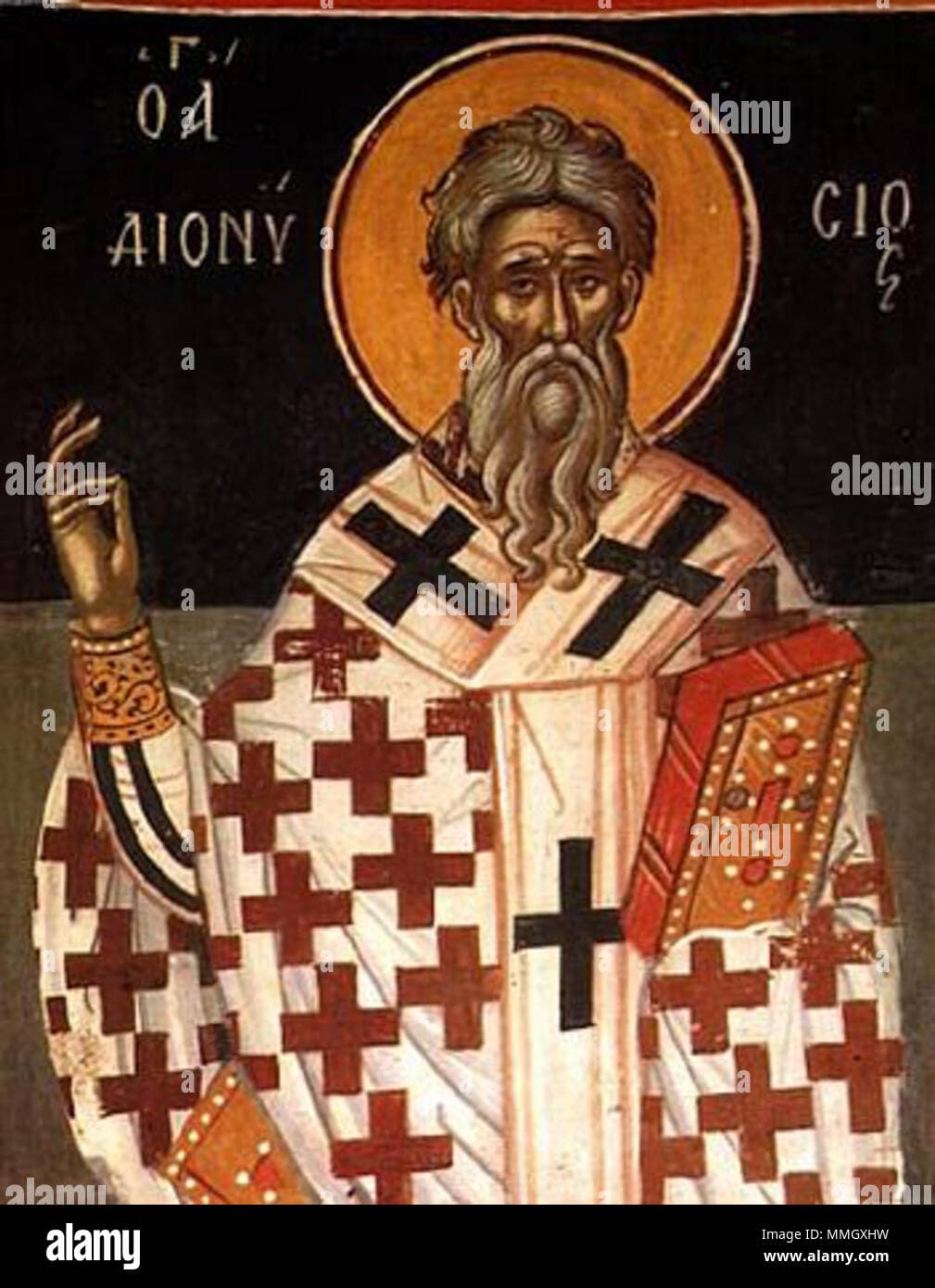
Saint Hieromartyr Dionysius
of Alexandria.
Also known as Saint Dionysios of Alexandria, Dionysius Bishop of Alexandria, Dionysius the Great, Pope Dionysius of Alexandria
Bishop of Alexandria (d. 264–265) who became head of the Catechetical School before his elevation to bishop in 247; he suffered exile to Libya under Emperor Valerian and returned to face civil war, famine, and plague.
The specific troparion for Saint Dionysius of Alexandria in the Eastern Orthodox tradition is preserved in liturgical service books of the Orthodox Church. The OCA and other Orthodox jurisdictions commemorate him on October 5 with a troparion suited to his rank as a bishop confessor and hieromartyr. For the precise liturgical text, reference should be made to the current Orthodox service books used by the Church.
A Shepherd
in Persecution and Plague
Dionysius the Great was the 14th Pope and Patriarch of Alexandria from 28 December 248 until his death on 22 March 264. Called "the Great" by Eusebius, Basil of Caesarea and others, he was characterized as "undoubtedly, after St. Cyprian, the most eminent bishop of the third century." Saint Dionysius devoted much effort to defend the Church from heresy, and he encouraged his flock in the firm confession of Orthodoxy during the persecution under the emperors Decius (249-251) and Valerian (253-259). His pastoral care extended to both Christian and pagan sick during the plague, and his extensive correspondence shaped the life of the early Church.
Early years
Dionysius was born to a wealthy polytheistic family around 190 and spent much time reading books and carefully studying the traditions of polytheists. As a young man, he read St Paul's epistles, came to faith in Christ and was baptised by Dimitrios, the then Bishop of Alexandria. He became a pupil of Origen and joined the Catechetical School of Alexandria where he became a student of Origen and Heraklas.
In 232, as Heraklas became the Bishop of Alexandria, Dionysius, now a priest, succeeded him as leader of the school. He became Bishop of Alexandria in the year 247.
In the Church
The influence of Saint Dionysius extended beyond the limits of his diocese, and his writings dealt with practical as well as theological subjects ("On Nature," "On Temptations," "On the Promises," etc.). He was also familiar with Greek philosophy. Only fragments of his writings survive today, most of them preserved in Eusebius, who mentions him in his CHURCH HISTORY (Book 7) and calls him "Dionysius the Great." Two complete letters of Saint Dionysius are extant, one addressed to Novatian, and the other to Basilides.
Dionysius of Alexandria accepted the pope's judgment and repudiated the Sabellians' charges, but he insisted that the Trinity consisted of three inseparable persons. Semantics was at the root of the difficulty; Greek and Roman understandings of the same terms differed, and his position has since been vindicated by the church.
Later years
In 249, a riot against Christians arose in Alexandria, nurtured by a popular pagan prophet and poet, during which Christians were at risk from mobs. Soon, the riots became legal persecutions instituted by the new Emperor Decius. The Christians were subjected to all kinds of cruelty, tortures of all sorts, all aimed to drive the victim Christians to sacrifice to the gods. Dionysius joined those who fled, but was identified and made prisoner. News of Dionysius' capture soon became known to a party of Christians who descended on the soldiers, holding him, who took flight. Dionysius remained in the desert until the persecutions stopped in 251.
In 252 an outbreak of plague ravaged Alexandria, and Dionysios, along with other priests and deacons, took it upon themselves to assist the sick and dying. The Saint called upon his flock to tend sick Christians and pagans alike, and to bury the dead. In 257, St. Dionysius was exiled to Kephro in the Mareotis, after being tried together with one priest and two deacons before Æmilianus, the prefect of Egypt. In all he lived there for twelve years and underwent much tribulation and suffering in an unhealthy environment. When Gallienus, son of Valerian, took over the empire he released all the believers who were in prison and brought back those in exile. Gallienus wrote to Dionysios and the bishops a letter to assure their safety in opening the churches.
Legacy and veneration
He was called Dionysius the Great by Eusebius of Caesarea, St. Basil the Great, and others. His correspondence with bishops throughout Christendom on the crucial issues of his day - the Novatianist schism, the readmission of the lapsed, heretical baptism, and the proper understanding of the Trinity - profoundly influenced the development of Orthodox ecclesiology and doctrine. Among his writings are a few canons which were adopted by the Church, and his letter against Novatius is also regarded as a canonical writing.
Saint Dionysius' witness during the Decian and Valerian persecutions, combined with his pastoral compassion during plague, established him as one of the greatest bishops of the ancient Church. His careful pastoral management and doctrinal firmness made Alexandria a beacon of Orthodoxy in the third century, and his spiritual children continued his legacy of service and fidelity to Christ.
How the saint's
memory is kept.
- When is the feast day of Saint Dionysius of Alexandria?
- His feast day is October 5.
- What was Saint Dionysius's role in the Church?
- He became Bishop of Alexandria in the year 247. He led the Alexandrian Catechetical School before becoming the bishop of Alexandria.
- What persecutions did Saint Dionysius endure?
- When the Decian persecution broke out, Saint Dionysius was forced to flee Alexandria, but returned when the Emperor died. He was later exiled to Libya during the reign of Valerian.
- What theological issues did Saint Dionysius address?
- Dionysius of Alexandria was involved in Trinitarian controversies, with protests sent to Pope St. Dionysius in Rome. Dionysius of Alexandria accepted the pope's judgment and repudiated the Sabellians' charges, but he insisted that the Trinity consisted of three inseparable persons.
- How did Saint Dionysius respond to the plague in Alexandria?
- In 252 an outbreak of plague ravaged Alexandria, and Dionysios, along with other priests and deacons, took it upon themselves to assist the sick and dying. The Saint called upon his flock to tend sick Christians and pagans alike, and to bury the dead.
- Who were the deacons that accompanied Saint Dionysius?
- Saints Gaius, Faustus, Eusebius, and Chaeremon were deacons and disciples of Saint Dionysius of Alexandria. They were arrested and banished from Alexandria along with Saint Dionysius.
The specific kontakion for Saint Dionysius of Alexandria in the Eastern Orthodox tradition is preserved in liturgical service books of the Orthodox Church. The OCA and other Orthodox jurisdictions commemorate him on October 5 with appropriate kontakion prayers suited to his rank as a bishop confessor and hieromartyr. For the precise liturgical text, reference should be made to the current Orthodox service books used by the Church.
The following prayer is addressed to Saint Dionysius the Great, Bishop and Confessor of Alexandria:
O holy hierarch Dionysius the Great, pastor of the Lord's flock and teacher of the Orthodox faith, we beseech thee to pray unto Christ our God for the salvation of our souls. As thou didst shepherd thy people through persecution and plague, guide us, we pray, by thy holy intercessions through the tribulations of this world. Strengthen us in the true faith against all heresies and deceit. Grant that we may follow thy example of pastoral compassion and doctrinal faithfulness, loving one another in Christ and serving both brother and stranger in their need. Through thy prayers, O holy father, may we be granted peace, wisdom, and steadfastness in the Orthodox faith. Amen.
Carry the tradition with you.
Hand-finished icons, books, and calendars to carry the Orthodox day into your home.

Read a life like this
every morning.
Meet the daily saints through Orthodox Daily Companion on iPhone and iPad, or through the Lives of the Saints web app in any modern browser.
Orthodox Daily Companion
The native Apple app, with a Home Screen widget, prayer reminders, and a private on-device journal.
Download on the App StoreLives of the Saints Web App
The browser experience for desktop, tablet, or phone, with a seven-day trial of the complete devotional library.
Open the web appGet a life like this one on every new tab - free, no account, from the same catalogue.
References and further reading
- oca.orghttps://www.oca.org/saints/lives/2025/10/05/102880-hieromartyr-dionysius-bishop-of-alexandria
- orthodoxwiki.orghttps://orthodoxwiki.org/Dionysius_of_Alexandria
- britannica.comhttps://www.britannica.com/biography/Saint-Dionysius-of-Alexandria
- en.wikipedia.orghttps://en.wikipedia.org/wiki/Dionysius_of_Alexandria
- orthodox.nethttps://www.orthodox.net/menaion-october/05-the-hieromartyr-dionysius-bishop-of-alexandria.html
- johnsanidopoulos.comhttps://www.johnsanidopoulos.com/2017/10/holy-hieromartyr-dionysios-bishop-of.html
- newadvent.orghttps://www.newadvent.org/cathen/05011a.htm
- encyclopedia.comhttps://www.encyclopedia.com/religion/encyclopedias-almanacs-transcripts-and-maps/dionysius-alexandria-st
- oca.orghttps://www.oca.org/saints/troparia/2021/10/04/102857-martyrs-gaius-faustus-eusebius-and-chaeremon-of-alexandria
- textus-receptus.comhttp://textus-receptus.com/wiki/Pope_Dionysius_of_Alexandria
- stjohndc.orghttps://stjohndc.org/en/list-of-relics/dionysius-great-bishop-alexandria-confessor-hieromartyr
- catholic.comhttps://www.catholic.com/encyclopedia/dionysius-of-alexandria
- en.wikipedia.orghttps://en.wikipedia.org/wiki/Pope_Dionysius_of_Alexandria
- gutenberg.orghttps://www.gutenberg.org/files/36539/36539-h/36539-h.htm
- en.wikipedia.orghttps://en.wikipedia.org/wiki/Pope_Dionysius
- oca.orghttps://www.oca.org/saints/lives/2024/10/03/102843-hieromartyr-dionysius-the-areopagite-bishop-of-athens
- saintsophiadc.orghttps://www.saintsophiadc.org/hieromartyr-dionysius-areopagite-bishop-athens/
- ancientfaith.comhttps://www.ancientfaith.com/podcasts/saintoftheday/holy_hieromartyr_dionysius_bishop_of_alexandria_and_his_disciples_258/
- homecomers.orghttps://www.homecomers.org/mirror/martyrs017.htm
- newworldencyclopedia.orghttps://www.newworldencyclopedia.org/entry/Pope_Dionysius
More from the tradition.
Read the Journal
Essays on feasts, fasting, and the rhythm of the Church year.
ExploreOrthodox countries
How the faith is lived and kept across the Christian world.
ExploreThe 2027 Calendar
A saint, a reading, and the day's fasting guideline for every day of 2027.
ExploreMobile & web apps
Carry the daily rhythm on iPhone and iPad or continue in the web app.
Explore