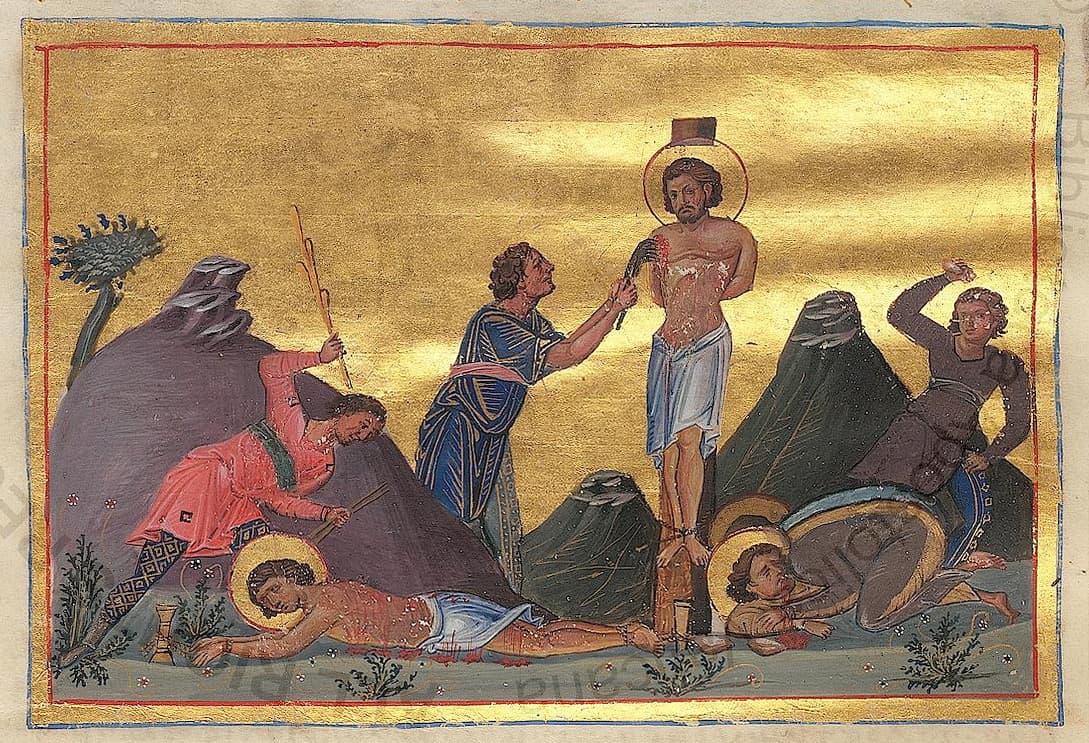
Saint Hieromartyr Gaius and Faustus, Deacons
of Alexandria.
Also known as Gaius and Faustus of Alexandria, Deacons Gaius and Faustus, Holy Martyrs Gaius and Faustus, Saints Gaius and Faustus
Deacons of the Church of Alexandria under Bishop Dionysius who were exiled to Libya during the persecution under Emperor Valerian, where they suffered and died as martyrs, c. 264–265.
- Fell asleep
- c. 264–265
- Feast day
- October 5 (New) · October 18 (Old)
Get a reminder on the feast in Orthodox Daily Companion →
Troparion of St. Hieromartyr Gaius and Faustus, Deacons of Alexandria
Tone 4
Your holy martyrs O Lord, / through their sufferings have received incorruptible crowns from You, our God. / For having Your strength, they laid low their adversaries, / and shattered the powerless boldness of demons.
The life of St. Hieromartyr Gaius and Faustus, Deacons of Alexandria Faithful Deacons
and Companions of Saint Dionysius
Gaius and Faustus were deacons serving under Saint Dionysius, the Bishop of Alexandria, during the third-century persecutions. They were arrested alongside their bishop during Valerian's persecution and exiled to the remote Libyan desert, where they endured years of suffering before receiving the crown of martyrdom through beheading.
Early years
Little is recorded about the early lives of Gaius and Faustus before they became deacons in the Church of Alexandria. They were deacons and disciples of Saint Dionysius of Alexandria, having chosen to serve the Church under one of the third century's greatest bishops. Their position as deacons indicates they held a position of trust and responsibility in the Alexandrian community, entrusted with the care of the poor, the administration of church resources, and service at the altar. By the time the persecution under Emperor Valerian erupted, they had already distinguished themselves through their faithful service alongside their bishop.
In the Church
Gaius and Faustus were deacons and disciples of Saint Dionysius of Alexandria. They served in the ranks of Alexandria's ordained clergy during a critical period in the Church's history. They were arrested and banished from Alexandria along with Saint Dionysius when the governor Aemilianus sought to crush the Christian faith throughout Egypt.
Rather than deny their Lord or flee in secret, these deacons chose to remain faithful to their bishop and their ordination vows. The deacons Faustus, Eusebius, and Chaeremon, along with Dionysius and Maximus the presbyter, and a brother from Rome, went before the prefect Aemilianus. When summoned to renounce Christ, they refused, choosing instead to accept exile as the consequence of their fidelity.
Later years
Gaius and Faustus were exiled with their teacher Saint Dionysios to Libya, and after suffering much together for many years, they died there a martyric death. The Bishop and his disciples lived amidst terrible sufferings and hardships for more than twelve years in the wilderness. The remote desert village of Cephro became the place of their long captivity, where they remained separated from the Christian community that depended upon their ministry.
Faustus, who was distinguished for his confession, was preserved until the persecution in those days, when being very old and full of days, he closed his life by martyrdom, being beheaded. Both were tortured and beheaded during the persecution of Valerian (253-259). Though their martyrdom came in exile far from Alexandria, their deaths completed the testimony they had begun when they chose to follow their bishop rather than abandon their faith.
Legacy and veneration
Gaius and Faustus were deacons and disciples of Saint Dionysius of Alexandria, and their martyrdom is forever linked to his name and to the great trials of the Alexandrian church. They are commemorated on October 5 as Hieromartyrs Dionysius of Alexandria, Bishop of Alexandria, and the Deacons Gaius and Faustus (264-265). Their witness, recorded in the Church History of Eusebius of Caesarea through the letters of Saint Dionysius himself, has been preserved for nearly two millennia as a testament to the faithfulness of simple deacons who chose martyrdom rather than apostasy.
The veneration of these deacons extends throughout the Eastern Orthodox Church, where they are remembered as models of fidelity in tribulation and of faithful service in the Church's hierarchy. Their liturgical commemoration ensures that each October 5, the faithful are reminded of the cost of Christian discipleship and the endurance of those who, like Gaius and Faustus, preferred death to denial of Christ.
Veneration of St. Hieromartyr Gaius and Faustus, Deacons of Alexandria How the saint's
memory is kept.
- Patronage
- Patron of Egypt, Deacons, Martyrs under persecution, Steadfastness in faith.
- Relics of Gaius and Faustus
- The earthly remains of Gaius and Faustus are lost to history, dispersed in the remote deserts of Libya where they received martyrdom. No tradition records the recovery or preservation of their relics in any known reliquary or church of the Christian world.
- Iconography
- Gaius and Faustus are typically depicted together in Orthodox iconography as deacons, wearing the distinctive vestments of their order: the sticharion (a white liturgical tunic) and the orarion (deacon's stole), often colored white or gold to signify their status as martyrs and confessors. They frequently appear in icons of Saint Dionysius, shown accompanying their bishop during his persecution or in his company during the exile in Libya. As martyrs, they are often shown bearing the instruments of their passion - a sword or axe indicating their beheading - or bearing palm fronds as symbols of their victory over death. When depicted together, Gaius and Faustus stand as faithful witnesses to the power of Christ and the endurance granted by divine grace in times of persecution and suffering.
Frequently asked Questions about
St. Hieromartyr Gaius and Faustus, Deacons of Alexandria.
- Who were Gaius and Faustus of Alexandria?
- Gaius and Faustus were deacons of the Church of Alexandria serving under Bishop Dionysius in the third century. They were arrested and exiled to Libya during Emperor Valerian's persecution, where they suffered and were ultimately martyred by beheading around 264–265 AD.
- What is their feast day in the Orthodox Church?
- The feast day of Hieromartyr Gaius and Faustus is October 5 in the Eastern Orthodox Church, celebrated together with Bishop Dionysius and the other deacons of Alexandria.
- How did Gaius and Faustus die?
- Gaius and Faustus were tortured and then beheaded during the Valerian persecution. They died in exile in the remote Libyan desert after enduring years of suffering and hardship far from their home church in Alexandria.
- What is the significance of their martyrdom?
- Their martyrdom exemplifies faithful Christian service and steadfast confession of faith in the face of imperial persecution. They chose to remain with their bishop rather than abandon him, and sealed their discipleship with their blood as deacons of the Church.
- Were Gaius and Faustus part of a larger group of martyrs?
- Yes, they were among several faithful companions of Saint Dionysius of Alexandria. Though commonly mentioned with deacons Eusebius and Chaeremon, Gaius and Faustus specifically shared the exile in Libya and died together in that remote location.
- What historical sources record their martyrdom?
- The primary historical source for the martyrdom of Gaius and Faustus is Eusebius of Caesarea's Church History, which preserves the letters of Saint Dionysius himself describing the persecution and exile of these deacons.
- What is St. Hieromartyr Gaius and Faustus, Deacons of Alexandria the patron saint of?
- St. Hieromartyr Gaius and Faustus, Deacons of Alexandria is the patron saint of Egypt, Deacons, Martyrs under persecution, and Steadfastness in faith.
- Where are the relics of St. Hieromartyr Gaius and Faustus, Deacons of Alexandria?
- The earthly remains of Gaius and Faustus are lost to history, dispersed in the remote deserts of Libya where they received martyrdom. No tradition records the recovery or preservation of their relics in any known reliquary or church of the Christian world.
Kontakion of St. Hieromartyr Gaius and Faustus, Deacons of Alexandria
No kontakion specific to these saints is included in standard Orthodox service books; they are commemorated with Bishop Dionysius and the other deacons Eusebius and Chaeremon as a group commemoration.
Prayer to St. Hieromartyr Gaius and Faustus, Deacons of Alexandria
O holy Martyrs Gaius and Faustus, faithful deacons and companions of the great Bishop Dionysius, intercede for us before the throne of God! You who endured long exile in the desert wilderness, who refused to deny your faith before tyrants, and who sealed your witness with your blood, pray for us who remain in this world of trials and temptations. By your holy prayers, strengthen us in faith, grant us courage to confess Christ before all people, and lead us at last to that heavenly kingdom where you now dwell in glory. Amen.
A saint for every day.
A saint, a reading, and the day's fasting guideline for every day of the year - with gifts for the icon corner beside it.
- Ships in 2–3 business days
- Secure checkout · Stripe
- Gift note at checkout
- Arrives damaged? Replaced

Also remembered in October.
- Oct 5 · Oct 18Saint Hieromartyr Dionysius of Alexandria
- Oct 5 · Oct 18Saint Hermogenes the Wonderworker of Samos
- Oct 6 · Oct 19Saint Apostle Thomas
- Oct 12 · Oct 25Saint Nicholas Mogilevsky of Alma-Ata
- Oct 18 · Oct 31Saint Apostle and Evangelist Luke
- Oct 19 · Nov 1Saint John of Rila
- Oct 23 · Nov 5Saint Apostle James the Brother of the Lord
- Oct 28 · Nov 10Saint Demetrius of Rostov
- Oct 30 · Nov 12Saint Stefan Milutin
Read a life like this
every morning.
Meet the daily saints through Orthodox Daily Companion on iPhone and Android, or through the Lives of the Saints web app in any modern browser.
Orthodox Daily Companion
The native app for iPhone, iPad, and Android, with daily prayer reminders and a private journal.
Lives of the Saints Web App
The browser experience for desktop, tablet, or phone, with a seven-day trial of the complete devotional library.
Open the web appGet a life like this one on every new tab - free, no account, from the same catalogue.
§ SourcesReferences and further reading (20)
- oca.orghttps://www.oca.org/saints/troparia/2021/10/04/102857-martyrs-gaius-faustus-eusebius-and-chaeremon-of-alexandria
- oca.orghttps://www.oca.org/saints/lives/2022/10/04/102857-martyrs-gaius-faustus-eusebius-and-chaeremon-of-alexandria
- johnsanidopoulos.comhttps://www.johnsanidopoulos.com/2017/10/holy-martyrs-gaius-faustus-eusebius-and.html
- en.wikisource.orghttps://en.wikisource.org/wiki/Ante-Nicene_Fathers/Volume_VI/Dionysius/Extant_Fragments/Containing_Epistles,_or_Fragments_of_Epistles/To_Domitius_and_Didymus
- catholic.comhttps://www.catholic.com/encyclopedia/coptic-persecutions
- en.wikipedia.orghttps://en.wikipedia.org/wiki/October_5_(Eastern_Orthodox_liturgics)
- orthodoxwiki.orghttps://orthodoxwiki.org/October_5
- oca.orghttps://www.oca.org/saints/lives/2019/10/05/102880-hieromartyr-dionysius-bishop-of-alexandria
- catholic.comhttps://www.catholic.com/encyclopedia/dionysius-of-alexandria
- britannica.comhttps://www.britannica.com/biography/Saint-Dionysius-of-Alexandria
- orthodoxwiki.orghttps://orthodoxwiki.org/Dionysius_of_Alexandria
- newadvent.orghttps://www.newadvent.org/cathen/05011a.htm
- newadvent.orghttps://www.newadvent.org/fathers/250107.htm
- ancientfaith.comhttps://www.ancientfaith.com/podcasts/saintoftheday/holy_hieromartyr_dionysius_bishop_of_alexandria_and_his_disciples_258/
- oca.orghttps://www.oca.org/saints/lives/1951/10/04
- oca.orghttps://www.oca.org/saints/lives/2026/09/06/102524-martyrs-cyriacus-faustus-the-presbyter-abibas-the-deacon-and-11
- catholic.orghttps://www.catholic.org/saints/saint.php?saint_id=6291
- data.over-blog-kiwi.comhttps://data.over-blog-kiwi.com/6/96/15/16/20230823/ob_82b8ca_54307349084.pdf
- en.wikipedia.orghttps://en.wikipedia.org/wiki/Faustus,_Abibus_and_Dionysius_of_Alexandria
- classicalchristianity.comhttps://classicalchristianity.com/category/bysaint/st-dionysius-of-alexandria-died-ca-265/
More from the tradition.
Read the Journal
Essays on feasts, fasting, and the rhythm of the Church year.
ExploreOrthodox countries
How the faith is lived and kept across the Christian world.
ExploreThe 2027 Calendar
A saint, a reading, and the day's fasting guideline for every day of 2027.
ExploreMobile & web apps
Carry the daily rhythm on iPhone and Android or continue in the web app.
Explore