Skip to content
Orthodox Daily Companion · Download free
Full life
· A true story of quiet courage ·

Saint Joseph the Hesychast

Icon of Saint Joseph the Hesychast
Mount Athos, Greece · 1897 – 1959
Feast day
August 16
Lived
1897 – 1959, Greece and Mount Athos
Known for
Reviving the Jesus Prayer on Mount Athos
The prayer he loved most

“Lord Jesus Christ, have mercy on me.”

Saint Joseph taught his disciples to repeat this short prayer, called the Jesus Prayer, all through the day.
§ I

Who was this saint?

Saint Joseph the Hesychast is one of the most beloved and most recent saints of the Orthodox Church. He lived from 1897 to 1959 - mostly hidden in caves and tiny wooden huts on Mount Athos, the ancient monastic peninsula in northern Greece often called the Holy Mountain. His birth name was Francis Kottis, and he grew up on the little island of Paros in the Aegean Sea. The word 'Hesychast' comes from the Greek word for stillness. A hesychast is a monk who tries to become quiet inside - quiet enough to hear God - by constantly repeating the Jesus Prayer: "Lord Jesus Christ, have mercy on me." Saint Joseph taught this prayer to a small group of disciples in a time when very few people on Mount Athos still practiced it. Through him, that ancient way of prayer came alive again all over the Orthodox world. His disciples went on to become abbots of some of the greatest monasteries on Mount Athos, and one of them, Elder Ephraim of Arizona, planted many Orthodox monasteries in the United States and Canada. Saint Joseph fell asleep in the Lord in 1959, and the Ecumenical Patriarch of Constantinople officially added him to the calendar of saints in 2020.

§ II

A saint's story.

Follow Francis Kottis from a small village on Paros to the caves of Mount Athos, and see how a poor Greek boy became one of the newest saints of the Orthodox Church.

Chapter 11897–1915

A Poor Boy from Paros.

In a small stone village called Lefkes, on the sunny Greek island of Paros in the Aegean Sea, a boy was born on February 12, 1897. His parents named him Francis (Fragkiskos in Greek), and his family name was Kottis. He was one of seven children born to George and Maria, a poor but very devout couple. When Francis was still young, his father died. That single event changed everything. Francis had to leave school to help support his mother and brothers and sisters. Even so, his mother - a woman who loved the Church deeply - kept teaching her children to pray and to trust God. She once had a mysterious vision of an angel and quietly believed that God had special plans for this particular boy.

Chapter 2around 1915–1921

The Dream of a Palace.

When he was about 18, Francis left Paros for the big port city of Piraeus, near Athens, to find work. He served in the Greek Navy, and later became a small merchant - a street vendor - selling goods in the bustling streets of the capital. He was strong, brave, and clever, and his little business was doing well. Then one night he had a vivid dream. He saw himself inside a magnificent palace and heard a voice telling him he would serve there. Around this time, friends gave him a book about the lives of the saints and the ancient desert monks. Francis was amazed that people had actually lived like that for Christ. He began giving money to the poor, praying long into the night, and even climbing Mount Penteli near Athens to pray alone in caves - like the hermits he was reading about.

Chapter 31921–1925

Climbing the Holy Mountain.

In 1921, Francis sailed to Mount Athos - the ancient monastic peninsula in northern Greece, sometimes called the Holy Mountain, where monks have been praying without stopping for more than a thousand years. He wanted to find a wise elder, called a 'geronda' in Greek, who could teach him how to pray with his whole heart. On the Feast of the Transfiguration, he climbed all the way to the rocky summit of Athos, to the little Chapel of the Transfiguration at the top. There he met a young monk named Arsenios, who would become his lifelong companion and co-struggler. Together they searched for a spiritual father. On August 31, 1925, in the cave once used by Saint Athanasius the Athonite, Francis was tonsured a monk and given a new name: Joseph.

Chapter 41928–1938

The Hidden Years in the Wilderness.

Joseph and Arsenios wanted total silence so they could pray without stopping. In 1928 they moved into a rugged, lonely place high above the sea called the Skete of Saint Basil. Their life there was almost unbelievably strict. Joseph often ate only about three ounces of dried bread, called rusks, a day, sometimes with a few boiled wild greens. He did not even use a bed - he sat on a wooden chair to sleep, so he would wake up quickly for prayer. Every evening he would go to a quiet spot and repeat the Jesus Prayer - 'Lord Jesus Christ, have mercy on me' - for six hours straight, timing himself with an alarm clock. This kind of prayer, called hesychasm, means 'stillness': quieting the mind and gently placing it in the heart before God.

Chapter 51938–1953

Teacher of the Jesus Prayer.

In 1938, Joseph's small brotherhood moved to Little Saint Anne's Skete, where they lived in caves near a chapel of Saint John the Forerunner that they built with their own hands. Slowly, word spread around Mount Athos about a hidden monk who truly knew the Jesus Prayer, and young men began to come to him. Joseph was a very strict but loving spiritual father. He taught his disciples to be humble, to obey their elder, and never to stop praying in the heart. Among those who came were his own brother Nicholas (who became the monk Athanasios), Joseph the Cypriot (later the famous Elder Joseph of Vatopedi), and in 1947 a young man named John Moraitis - who would grow up to be Elder Ephraim of Philotheou and later of Arizona, and would plant seventeen Orthodox monasteries across the United States and Canada.

Chapter 61953–1959

Falling Asleep on the Day of the Theotokos.

In 1953, the brotherhood settled at the New Skete of Mount Athos, near the sea. By this time, Joseph's body was worn out by decades of fasting and vigils. He loved the Virgin Mary - the Panagia, or 'All-Holy' one - very deeply, and he asked her to take him on the day of her own Dormition (falling asleep). On August 14, 1959, he attended the all-night vigil for the Dormition and received Holy Communion. The very next day, August 15, 1959, Elder Joseph the Hesychast fell asleep in the Lord - exactly as he had asked. Sixty years later, in October 2019, Ecumenical Patriarch Bartholomew announced from Mount Athos that Joseph was a saint, and on March 9, 2020, the Holy Synod in Constantinople officially added his name to the calendar of the Orthodox Church. His feast is kept on August 16.

§ III

A little prayer.

A short prayer asking Saint Joseph to pray with us:

Holy Father Joseph, hidden hermit of Mount Athos,
you loved the Jesus Prayer with all your heart.
Teach me to be still, even for a little while,
and to whisper with you:
"Lord Jesus Christ, have mercy on me."
Pray to God for me and for my family,
that we may love Christ and His most-holy Mother
the way you did. Amen.

Amen.
§ IV

Did you know?

A few surprising things about this quiet monk of Mount Athos:

⚓

He was a sailor first

Before he ever wore monk's robes, young Francis Kottis served in the Greek Navy and then worked as a street vendor in Piraeus and Athens.

🪑

He slept on a chair

Instead of a bed, Saint Joseph slept sitting on a wooden chair so he would not sleep too long and could get up quickly to pray.

🍞

Three ounces of bread a day

For long stretches at the Skete of Saint Basil, he ate only about three ounces of dried bread called 'rusks' each day, sometimes with a few boiled wild greens.

⏰

A six-hour prayer alarm

Every evening he prayed the Jesus Prayer for six straight hours, using an alarm clock set far away so its ticking would not disturb him.

✉️

Sixty-five famous letters

His spiritual advice survives in 65 letters, published by the Monastery of Philotheou, that are still read by monks and families all over the world.

🌎

Grandfather of American monasteries

His disciple Elder Ephraim of Arizona founded 17 Orthodox monasteries across the United States and Canada, all rooted in Saint Joseph's teaching.

§ V · For grown-ups

A note for grown-ups

Saint Joseph the Hesychast (1897–1959) is one of the newest saints on the Orthodox calendar, glorified by the Ecumenical Patriarchate of Constantinople in 2020. His life is important because he almost single-handedly helped revive the ancient hesychast tradition of the Jesus Prayer on Mount Athos in the 20th century, and his spiritual grandchildren - especially Elder Ephraim of Arizona - brought that tradition to North America.

Because his asceticism was extreme (very little food, sleep on a chair, hours of solitary prayer), children may need help understanding that these are practices for a monk called to the desert, not a rule for everyone. What we can imitate is his love for the Jesus Prayer, his devotion to the Theotokos, his humility, and his obedience. Older children may also enjoy hearing that a modern actor, Jonathan Jackson, portrayed him in a 2019 documentary produced by the Monastery of Vatopedi.

Read the full life
§ VI

Meet more saints.

If you liked Saint Joseph's story, you might want to meet these other Orthodox saints of the Holy Mountain:
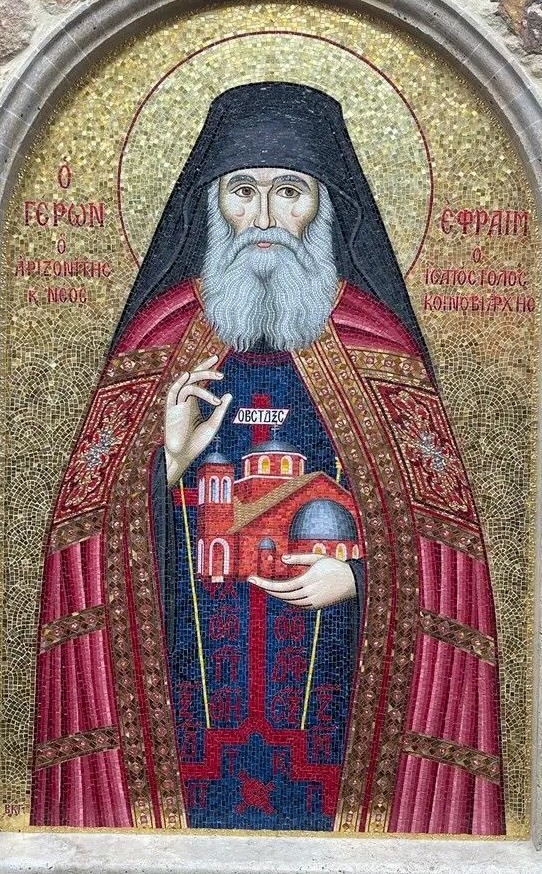
Icon of Elder Ephraim of Arizona

Elder Ephraim of Arizona

A true story of prayer and courage
Icon of Saint Nektarios of Aegina, Metropolitan of Pentapolis

Saint Nektarios of Aegina, Metropolitan of Pentapolis

A true story of humility and healing