United States.
The United States is home to a vibrant, multi-ethnic Eastern Orthodox community rooted in the 1794 Russian mission to Alaska, now organized under numerous canonical jurisdictions coordinated by the Assembly of Canonical Orthodox Bishops.
Orthodoxy in
United States.
A living tradition — its history, its faithful, its sacred places.
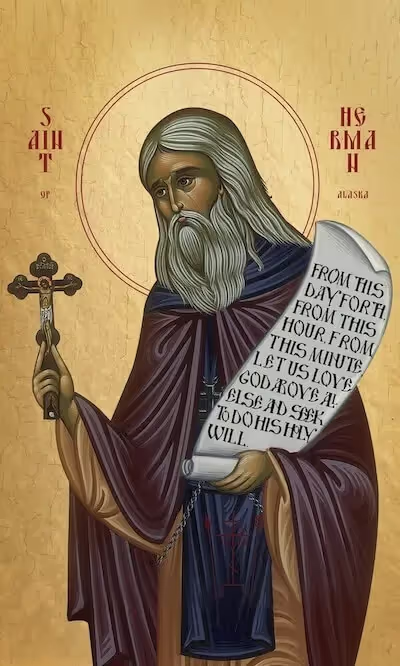
Eastern Orthodox Christianity in the United States traces its continuous history to 1794, when a group of Russian monks from Valaam Monastery arrived on Kodiak Island, Alaska, to evangelize the native peoples of what was then Russian America. Among them was Saint Herman of Alaska, who remained in the mission for four decades and is venerated as the first glorified saint of the American land.
From Alaska to the Lower 48
After the 1867 purchase of Alaska by the United States, the Russian diocese relocated its see from Sitka to San Francisco in 1872, and subsequently to New York City in the early twentieth century. Saint Innocent (Veniaminov), consecrated in 1840, was the first Orthodox missionary bishop in America, translating liturgical texts into Aleut and other native languages. In the late nineteenth and early twentieth centuries, waves of immigrants from Greece, the Russian Empire, the Ottoman Levant, the Balkans, and the Carpathian lands established parishes across the country.
Jurisdictional landscape
Unlike historically Orthodox nations, the United States has no single autocephalous national Church. Instead, canonical Eastern Orthodoxy is organized through a number of overlapping jurisdictions, the largest of which include:
The Greek Orthodox Archdiocese of America, under the Ecumenical Patriarchate of Constantinople
The Orthodox Church in America (OCA), which received a Tomos of autocephaly from the Moscow Patriarchate in 1970
The Antiochian Orthodox Christian Archdiocese of North America, under the Patriarchate of Antioch
The Russian Orthodox Church Outside of Russia (ROCOR), reconciled with the Moscow Patriarchate in 2007
The Serbian, Romanian, Bulgarian, Georgian, Ukrainian, and Albanian Orthodox dioceses, each linked to their mother Churches
Unity and cooperation
Since 2010, the canonical bishops serving in the United States have met as the Assembly of Canonical Orthodox Bishops of the United States of America, successor to SCOBA, which coordinates pan-Orthodox ministries in chaplaincy, missions, theological education, and charitable work. The seminaries of St. Vladimir's (Yonkers, NY), St. Tikhon's (South Canaan, PA), and Holy Cross (Brookline, MA) form Orthodox clergy for parishes across the continent.
Orthodoxy today
While Orthodox Christians remain a small minority of the U.S. population, the faith has grown steadily through both immigration and conversion. English has become a widespread liturgical language alongside Greek, Church Slavonic, Arabic, Romanian, and other traditional tongues. Monastic life has also flourished in recent decades, with communities such as St. Tikhon's Monastery in Pennsylvania — the oldest operating Orthodox monastery in North America — continuing to anchor the spiritual life of American Orthodoxy.
Saints of
United States.
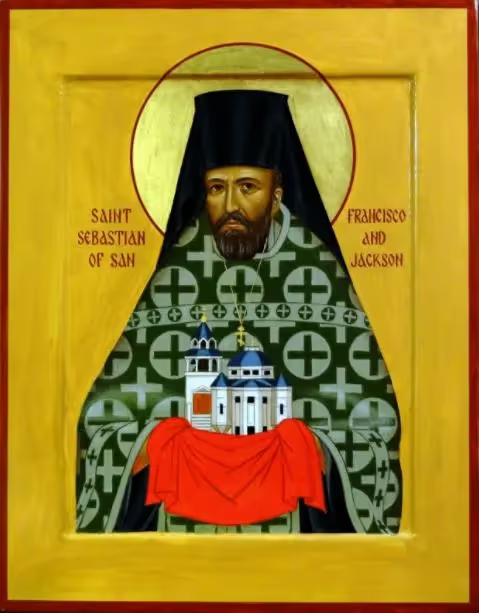
3 venerated souls with ties to this land — fathers and mothers of the faith who are remembered here still.

Famous Orthodox churches and monasteries in the United States
The sacred architecture of Orthodox United States — cathedrals, parishes, and the mountain monasteries that keep the lamps burning.
- Holy Resurrection Cathedral, Kodiak (Alaska) — Historic seat of the Diocese of Alaska of the Orthodox Church in America, on the island where the first Russian Orthodox missionaries landed in 1794.
- St. Nicholas Russian Orthodox Cathedral, New York City — Built 1901–1902 to designs by architect John Bergesen, with seed money donated by Tsar Nicholas II; a historic center of Russian Orthodox life in America and a designated New York City landmark.
- Holy Trinity Orthodox Cathedral, Chicago (Illinois) — See cathedral of the OCA Diocese of the Midwest, and one of only two houses of worship designed by the celebrated American architect Louis Sullivan; listed on the U.S. National Register of Historic Places and designated a Chicago Landmark.
- St. Nicholas Greek Orthodox Church and National Shrine, World Trade Center (New York City) — Rebuilt after its destruction on September 11, 2001, designed by Santiago Calatrava and reopened to the public in December 2022 in Liberty Park overlooking Ground Zero.
- Archdiocesan Cathedral of the Holy Trinity, New York City — Cathedral of the Greek Orthodox Archdiocese of America, one of the largest Eastern Orthodox cathedrals in the Western Hemisphere.
- St. Tikhon of Zadonsk Monastery, South Canaan (Pennsylvania) — Founded in 1905 under the oversight of the future Patriarch Tikhon of Moscow, it is the oldest operating Orthodox monastery in North America, attached to St. Tikhon's Orthodox Theological Seminary.
Orthodoxy
kept here.
The shape of the faith as it is lived and prayed across United States today.
Eastern Orthodoxy in the United States is remarkable for its multi-ethnic character and its coexistence of many canonical jurisdictions within a single secular state. Parishes may worship in English, Greek, Church Slavonic, Arabic, Romanian, Serbian, Georgian, or Ukrainian — sometimes several languages in a single service — reflecting both immigrant heritage and a growing number of American converts.
The Greek Orthodox Archdiocese of America and the Orthodox Church in America are among the largest canonical bodies, followed by the Antiochian Archdiocese, ROCOR, and the Serbian, Romanian, Bulgarian, and other national dioceses. All canonical bishops cooperate through the Assembly of Canonical Orthodox Bishops of the United States of America. Oriental Orthodox bodies (Coptic, Armenian Apostolic, Ethiopian, Eritrean, Syriac, and Indian Malankara) are not part of this Eastern Orthodox communion and are represented separately.
Because the United States has constitutional separation of Church and state, Orthodoxy here enjoys no established status. Parishes are self-supporting, lay involvement in parish councils is strong, and monastic communities — Greek, Russian, Romanian, Serbian, and OCA — have multiplied in recent decades. According to the 2020 U.S. Religion Census coordinated by Alexei Krindatch, Eastern Orthodox parishes reported approximately 676,000 adherents, while broader survey data from Pew Research suggests a somewhat larger self-identifying population when all who call themselves Orthodox are counted.
Asked
of this land.
Frequently asked questions about Orthodoxy in the United States
Is there an autocephalous Orthodox Church of the United States?
There is no single national autocephalous Church. The Orthodox Church in America (OCA) received a Tomos of autocephaly from the Moscow Patriarchate in 1970, but this autocephaly is not universally recognized by the other autocephalous Churches. Other jurisdictions — Greek, Antiochian, Serbian, Romanian, Bulgarian, Georgian, and others — remain under their mother Churches.
When did Orthodoxy arrive in America?
The first Orthodox mission arrived on Kodiak Island, Alaska, in September 1794, sent by the Russian Orthodox Church from Valaam Monastery. Among the monastic missionaries was Saint Herman of Alaska, the first canonized saint of America.
What languages are used in Orthodox services in the U.S.?
American parishes serve the Divine Liturgy in a wide variety of languages, including English, Greek, Church Slavonic, Arabic, Romanian, Serbian, Georgian, and Ukrainian. English has become increasingly common, especially among younger generations and converts.
How many Orthodox Christians are there in the United States?
Estimates vary by methodology. The 2020 U.S. Religion Census counted approximately 675,765 adherents in Eastern Orthodox parishes. Survey-based estimates from Pew Research and others suggest a larger self-identifying Orthodox population when counting all who call themselves Orthodox, regardless of parish affiliation.
Are the Coptic and Armenian churches considered Eastern Orthodox here?
No. The Coptic, Armenian Apostolic, Ethiopian, Eritrean, Syriac, and Indian Malankara Churches belong to the Oriental Orthodox communion, which is distinct from the Eastern Orthodox (Chalcedonian) Church and not in sacramental communion with it.
What coordinating body unites Orthodox jurisdictions in the U.S.?
Since 2010, the Assembly of Canonical Orthodox Bishops of the United States of America has brought together canonical Eastern Orthodox bishops serving in the country for cooperation in missions, education, charitable work, and pan-Orthodox witness. It is the successor to SCOBA (the Standing Conference of Canonical Orthodox Bishops in the Americas).