United Kingdom.
Eastern Orthodoxy in the United Kingdom is a growing minority faith, organised as canonical diaspora jurisdictions led by the Greek Archdiocese of Thyateira and Great Britain, with vibrant Russian, Romanian, Serbian, Antiochian and other communities.
Orthodoxy in
United Kingdom.
A living tradition - its history, its faithful, its sacred places.
Orthodox Christianity in the United Kingdom
Eastern Orthodox Christianity in the United Kingdom is a minority but vigorous and growing confession, sustained primarily by long-established immigrant communities, post-war refugees, and more recent waves of migration from Eastern Europe. It is organised as a mosaic of canonical diaspora jurisdictions, each under the spiritual authority of its mother Church abroad.
The largest body is the Greek Orthodox Archdiocese of Thyateira and Great Britain, under the Ecumenical Patriarchate of Constantinople. The majority of Orthodox in the United Kingdom belong to the Ecumenical Patriarchate's Archdiocese of Thyateira and Great Britain, which is based in London and which has had a presence in Britain since the 17th Century. The Archdiocese's jurisdiction covers Great Britain, the Isle of Man, and the Channel Islands, and its primate is traditionally regarded as primus inter pares among the Orthodox hierarchs in Britain.
History and Jurisdictional Development
A continuous Greek merchant community worshipped in London from the seventeenth century onward, and the first permanent Greek church was built in Bayswater in the 1870s. Russian Orthodox presence grew substantially after the 1917 Revolution with émigré clergy and laity; the Diocese of Sourozh of the Russian Orthodox Church (Moscow Patriarchate) was established for Great Britain and Ireland, long associated with Metropolitan Anthony (Bloom). A parallel Russian-tradition presence persists through the Deanery of Great Britain and Ireland within the Archdiocese of Russian Orthodox Churches in Western Europe.
The twentieth century brought ethnic Orthodox communities from across the Orthodox world. As OrthodoxWiki notes, "Various forms of ethnic Orthodoxy entered Britain during the twentieth century with refugees from eastern Europe and migrant workers." Romanian Orthodox life expanded dramatically after 2007, leading the Holy Synod of the Romanian Orthodox Church to erect a dedicated Romanian Orthodox Archdiocese of Great Britain and Northern Ireland. The Serbian Orthodox Eparchy of Britain and Ireland was founded in November 2024, with its seat in London, succeeding the former Diocese of Great Britain and Scandinavia.
Other Canonical Jurisdictions
Antiochian Orthodox Deanery of the United Kingdom and Ireland - created in 1995 to serve communities of Orthodox Christians, many of whom had converted from the Church of England.
Bulgarian Orthodox parishes under the Diocese of Western and Central Europe.
Georgian Orthodox Church, with the Cathedral of the Nativity of Our Lord in Upper Clapton, London.
Patriarchal Stavropegic Monastery of St John the Baptist in Tolleshunt Knights, Essex - a mixed monastic community directly under the Ecumenical Patriarchate.
Orthodoxy Today
Numbers have risen markedly in the twenty-first century because of migration from Romania, Bulgaria, Greece, Cyprus, the former Soviet Union, and the Middle East. Parishes are typically multi-ethnic in outlook even when centred on a particular mother Church, and English is now widely used liturgically alongside Greek, Church Slavonic, Romanian, Serbian, Arabic and Georgian. Although Orthodoxy remains a small fraction of the British religious landscape, it forms a living and increasingly visible witness in cities across England, Scotland, Wales and Northern Ireland.
Saints of
United Kingdom.
2 venerated souls with ties to this land - fathers and mothers of the faith who are remembered here still.
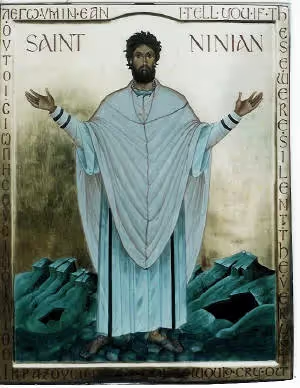
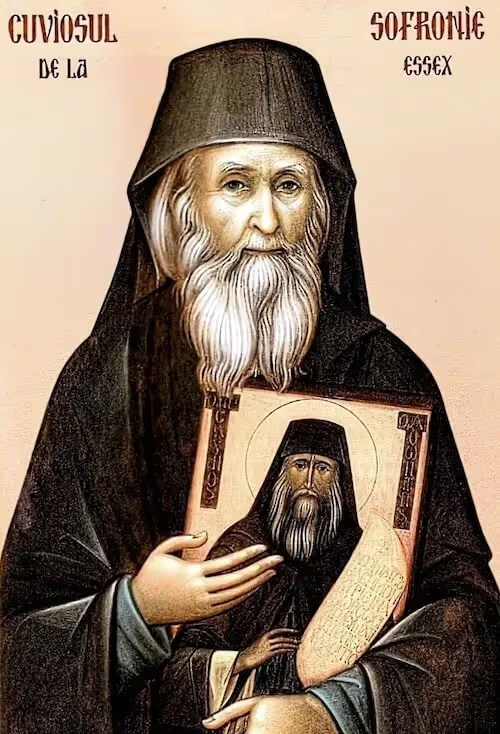
Famous Orthodox churches and monasteries in the United Kingdom
The sacred architecture of Orthodox United Kingdom - cathedrals, parishes, and the mountain monasteries that keep the lamps burning.
- Saint Sophia Greek Orthodox Cathedral, Bayswater, London - dedicated to the Holy Wisdom and consecrated on 5 February 1882 by Antonios, Metropolitan of Corfu, for the Greek community of London. In 1922 it became the cathedral of the Metropolis (later Archdiocese) of Thyateira and Great Britain.
- Russian Orthodox Cathedral of the Dormition of the Mother of God and All Saints, Knightsbridge, London - seat of the Diocese of Sourozh (Moscow Patriarchate) at 67 Ennismore Gardens; its façade is a close copy of the Basilica of San Zeno in Verona.
- Patriarchal Stavropegic Monastery of St John the Baptist, Tolleshunt Knights, Essex - founded in 1959 by Archimandrite Sophrony (Sakharov), a disciple of Saint Silouan the Athonite; a mixed community for men and women under the Ecumenical Patriarchate, and the oldest Orthodox religious community in Britain.
- Cathedral of the Nativity of Our Lord, Upper Clapton, London - the principal Georgian Orthodox church in London, serving as the sole London outpost of the Georgian Patriarchate.
- Serbian Orthodox Church of St Sava, Notting Hill, London - the principal Serbian Orthodox church in Britain, now part of the Serbian Orthodox Eparchy of Britain and Ireland founded in November 2024 and headquartered in London.
- Church of St Edward the Martyr, Brookwood, Surrey - houses the relics of Saint Edward the Martyr, King of England (murdered in 978), enshrined at Brookwood in 1984 and cared for by a resident Orthodox monastic brotherhood.
Orthodoxy
kept here.
The shape of the faith as it is lived and prayed across United Kingdom today.
Orthodoxy in the United Kingdom is fundamentally a diaspora reality: there is no autocephalous British Orthodox Church, and the faithful are distributed among canonical jurisdictions of the Ecumenical Patriarchate and of the ancient patriarchates and autocephalous churches of Eastern Europe and the Middle East. The Archdiocese of Thyateira and Great Britain is the senior and largest body, but Romanian, Russian, Serbian, Antiochian, Bulgarian and Georgian jurisdictions all maintain parishes and clergy in the country.
Liturgical life in Britain reflects this diversity. Services are celebrated in Greek, Church Slavonic, Russian, Romanian, Serbian, Arabic, Georgian and increasingly in English, often in combination within a single parish. Many parishes, particularly Antiochian ones, have absorbed significant numbers of native British converts, and the use of English in the Divine Liturgy has grown correspondingly.
The Orthodox Church holds no established status in the United Kingdom, which confessionally recognises the Church of England (in England) and the Church of Scotland. Orthodox communities generally function as registered charities, and their cathedrals in London - such as Saint Sophia in Bayswater and the Dormition Cathedral in Knightsbridge - serve as cultural as well as spiritual anchors for their respective communities. The Patriarchal Stavropegic Monastery of St John the Baptist in Essex, founded in 1959 by Archimandrite Sophrony (Sakharov), is the oldest Orthodox monastic community in Britain and a major centre of pilgrimage.
Recent decades have seen Orthodoxy in Britain shift from a cluster of chaplaincies serving particular ethnic groups to a more outward-facing confession, with pan-Orthodox cooperation, English-language catechesis, and a growing number of converts. Migration from Romania, Bulgaria, Poland, Ukraine, Greece, Cyprus, Georgia and the Levant continues to reshape and enlarge the Orthodox presence across the United Kingdom.
Asked
of this land.
Frequently asked questions about Orthodoxy in the United Kingdom
Is there a single Orthodox Church of the United Kingdom?
No. The United Kingdom is not a historically Orthodox country and has no autocephalous Orthodox Church. Instead, Orthodox Christians are organised under a number of canonical jurisdictions, each linked to a mother Church abroad - Greek, Russian, Romanian, Serbian, Antiochian, Bulgarian, Georgian and others.
Which is the largest Orthodox jurisdiction in Britain?
The Greek Orthodox Archdiocese of Thyateira and Great Britain, under the Ecumenical Patriarchate of Constantinople, is the largest and senior jurisdiction. Its archbishop (currently Archbishop Nikitas Loulias) is seated in London and is regarded as first among the Orthodox hierarchs in the country.
When did Orthodoxy first come to Britain?
Britain was part of the undivided Christian Church of the first millennium and is home to many pre-schism saints venerated by the Orthodox, including Saint Edward the Martyr and Saint Cuthbert. Modern Orthodox presence, however, dates from the seventeenth century with the Greek merchant community in London, expanding greatly in the twentieth century with Russian, Eastern European and Middle Eastern immigration.
In what languages are services held?
Services are celebrated in Greek, Church Slavonic, Romanian, Serbian, Arabic, Georgian and Bulgarian, and increasingly in English. Many parishes combine the traditional liturgical language of their mother Church with English, especially where there is a substantial British convert population.
Are there Orthodox monasteries in the United Kingdom?
Yes. The most important is the Patriarchal Stavropegic Monastery of St John the Baptist at Tolleshunt Knights in Essex, founded in 1959 by Elder Sophrony (Sakharov), a disciple of Saint Silouan the Athonite. It is directly under the Ecumenical Patriarchate and is the oldest Orthodox religious community in the country.
How many Orthodox Christians live in the United Kingdom?
There is no single authoritative figure, but around 450,000–500,000 Eastern Orthodox Christians are generally estimated to live in the United Kingdom, the number having grown considerably with migration from Romania, Bulgaria, Poland, Ukraine, Greece and the Middle East.
Ukraine.
United States.
More from the tradition.
Meet the saints
The lives behind the icons, calendars, and books we print.
ExploreRead the Journal
Essays on feasts, fasting, and the rhythm of the Church year.
ExploreThe 2027 Calendar
A saint for every day of the year - now open for pre-order.
ExploreMobile & web apps
Carry the daily rhythm on iPhone and iPad or continue in the web app.
Explore