China.
Eastern Orthodoxy has a small but historic presence in China, rooted in the Albazinian Cossacks of 17th-century Beijing and the Russian Spiritual Mission. The autonomous Chinese Orthodox Church counts only about 20,000 faithful today.
Orthodoxy in
China.
A living tradition - its history, its faithful, its sacred places.
Eastern Orthodox Christianity in China is a small but deeply rooted tradition whose history stretches back more than three centuries. It arrived not through large-scale mission but through a remarkable accident of frontier history, and survives today in a handful of parishes in Beijing, Harbin, Shanghai and the Russian-Chinese border regions.
Origins: the Albazinians and the Russian Spiritual Mission
The first Orthodox community in China was formed from a group of captured Russian Cossacks from the fortress of Albazin on the Amur River. After the Qing assault of 1685, a group of roughly forty-five Albazinian Cossacks, including the priest Maxim Leontiev, was resettled in Beijing, where the Kangxi Emperor assigned them a former Buddhist temple for use as a church. A permanent Russian Spiritual Mission in Beijing was formally organised in the early 18th century, with Archimandrite Hilarion (Lezhaysky) arriving with icons, liturgical books and church utensils in 1716. For 150 years the Mission remained largely confined to Beijing, serving Albazinian descendants and a small number of Chinese converts while also performing diplomatic and scholarly functions.
Expansion, martyrdom, and Chinese clergy
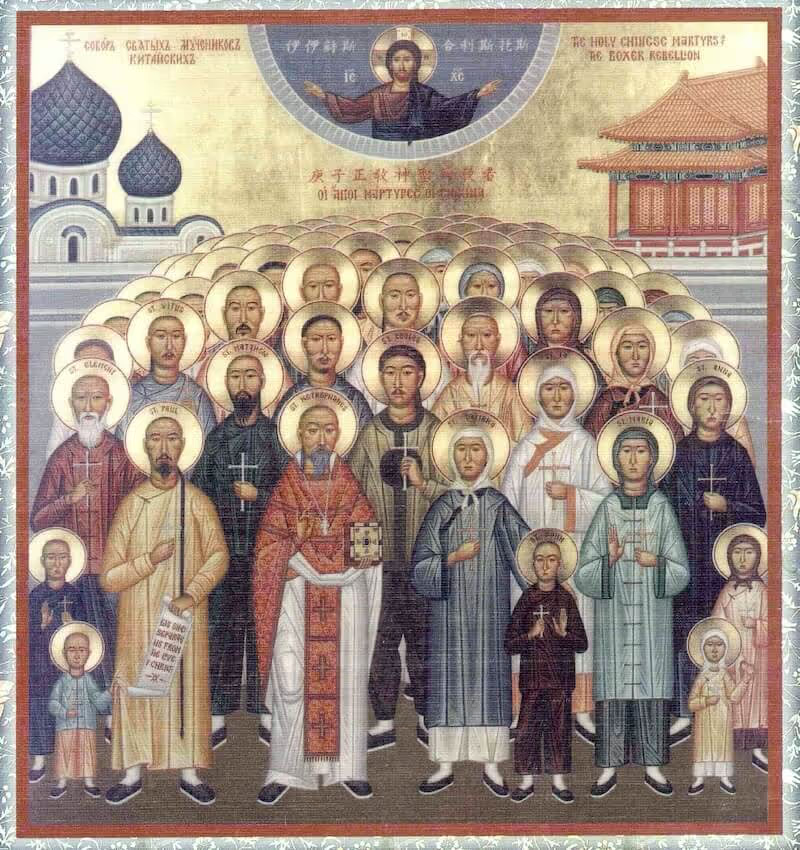
During the 19th century the Mission expanded into a proper missionary church, producing a Chinese-language liturgy and ordaining Chinese clergy. The most severe trial came during the Boxer Rebellion of 1900, when 222 Chinese Orthodox Christians were killed, among them St. Mitrophan Chi Sung, the first Chinese Orthodox priest, who was martyred together with his family and parishioners. Despite this catastrophe, by 1902 the Church in China had recovered to around 32 churches and close to 6,000 faithful, operating schools and orphanages. The Russian Revolution of 1917 produced a second wave: tens of thousands of émigrés settled in Harbin, Shanghai, Tianjin and Xinjiang, dramatically enlarging the Orthodox community and building cathedrals still famous today.
Autonomy and the Cultural Revolution
In 1957 the Moscow Patriarchate granted autonomy to the Chinese Orthodox Church, consecrating Archimandrite Vasily (Shuang) as Bishop of Beijing. The young autonomous church, however, was devastated by the Cultural Revolution (1966–1976), which closed churches, destroyed properties, and left the Church without a functioning hierarchy after the death of its last bishops. Most estimates place the pre-Cultural-Revolution faithful at around twenty thousand.
The Church today
The Chinese Orthodox Church remains canonically autonomous under the Moscow Patriarchate but has no bishop of its own; pastoral care is largely arranged through the Russian Orthodox Church's Department for External Church Relations. Orthodox worship in China is legally constrained: only ethnic Russian citizens are formally recognised as an Orthodox minority. Nonetheless, Divine Liturgy is celebrated at the Church of the Dormition in the Russian Embassy compound in Beijing, at the Russian Consulate chapel in Shanghai, at the Church of the Intercession in Harbin, and at several parishes in Inner Mongolia and Xinjiang serving descendants of Russian settlers. The visit of Patriarch Kirill in 2013 - the first ever by a Russian Patriarch to China - is widely regarded as the beginning of a slow institutional revival.
Saints of
China.
1 venerated soul with ties to this land - fathers and mothers of the faith who are remembered here still.
Famous Orthodox churches and monasteries in China
The sacred architecture of Orthodox China - cathedrals, parishes, and the mountain monasteries that keep the lamps burning.
- Church of the Dormition of the Most Holy Theotokos, Beijing - Located within the compound of the Russian Embassy on the grounds of the former Russian Spiritual Mission, this church is the spiritual heir of the original Albazinian church established in 1685 and is the principal Orthodox place of worship in the Chinese capital.
- Church of the Intercession of the Mother of God, Harbin - Built in its present form in 1930 on the site of an earlier prayer house, this is the only Orthodox church in mainland China open to Chinese nationals for regular worship, and falls under the jurisdiction of the Chinese Orthodox Church.
- Saint Sophia Cathedral, Harbin - Begun in 1907 by the Russian military and rebuilt in brick between 1923 and 1932, this magnificent domed cathedral became the largest Eastern Orthodox church in the Far East. It now functions as a protected architectural museum.
- Cathedral of the "Surety of Sinners" Icon of the Theotokos, Shanghai - Commissioned by Archbishop Simon and completed in the mid-1930s in the former French Concession (now on Xinle Road, Xuhui District), this was the principal cathedral of the Russian émigré community in Shanghai. Closed during the Cultural Revolution, its building survives as a heritage site.
- Church of St. Innocent of Irkutsk, Labdarin (Ergun, Inner Mongolia) - A stone church built in 1990 at the expense of the Hulunbuir local government to compensate for earlier destroyed churches in the Three Rivers (Trekhrechye) Russian settlements. Metropolitan Hilarion of Volokolamsk celebrated the Divine Liturgy there in 2015.
- St. Innocent Cathedral, Manzhouli (Inner Mongolia) - One of several churches historically under the Diocese of Harbin serving the Russian-descended population of the Sino-Russian frontier.
Orthodoxy
kept here.
The shape of the faith as it is lived and prayed across China today.
Eastern Orthodoxy in China is organised as the Chinese Autonomous Orthodox Church, which received its autonomy from the Moscow Patriarchate in 1957. Since the death of its last canonical bishops during the Cultural Revolution era, the Church has lacked its own resident hierarch, and pastoral oversight is exercised in cooperation with the Russian Orthodox Church. Liturgy is celebrated primarily in Church Slavonic and increasingly in Chinese, reflecting both the historic Russian émigré community and a growing interest among ethnic Chinese faithful.
Orthodoxy is a legally recognised religion only in certain regions - notably Heilongjiang, Inner Mongolia, and Xinjiang - where it is permitted as part of the cultural heritage of the officially recognised "Russian" ethnic minority. Outside these areas, services at the Russian Embassy in Beijing and the Russian Consulate in Shanghai primarily serve foreign nationals and diplomatic staff, with the Church of the Intercession in Harbin remaining the only Orthodox church in mainland China open to Chinese nationals for regular worship.
The total Orthodox population is very small - Pew Research Center's 2010 study of Christianity in China estimated only about twenty thousand Orthodox Christians nationwide, concentrated in the northern and northeastern regions and among descendants of early-20th-century Russian émigrés and Albazinian Cossacks. A handful of ethnic Chinese men have been sent to Russia for seminary training, and both Moscow and the Ecumenical Patriarchate (through Hong Kong) maintain pastoral concern for the Orthodox faithful in the country.
Asked
of this land.
Frequently asked questions about Orthodoxy in China
When did Orthodox Christianity arrive in China?
Orthodoxy reached China in 1685, when a group of about forty-five Albazinian Cossacks, including the priest Maxim Leontiev, were resettled to Beijing after the Qing capture of the Russian fortress of Albazin on the Amur River. A permanent Russian Spiritual Mission was then organised in Beijing in the early 18th century.
Is there a Chinese Orthodox Church?
Yes. The Chinese Autonomous Orthodox Church was granted autonomy by the Moscow Patriarchate in 1957. It remains canonically Orthodox, although it has been without a resident bishop since the Cultural Revolution, and pastoral care is carried out in coordination with the Russian Orthodox Church.
How many Orthodox Christians are there in China?
Reliable figures are scarce. The Pew Research Center estimated around 20,000 Orthodox Christians in China in 2010, making them fewer than 1% of the country's Christians. Most are descendants of Russian émigrés, Albazinian Cossacks, and the officially recognised Russian ethnic minority.
Where can one attend Orthodox services in China?
The Church of the Dormition in the Russian Embassy compound in Beijing, the Russian Consulate chapel in Shanghai, and the Church of the Intercession in Harbin hold regular services. Additional parishes function in Inner Mongolia (Labdarin, Manzhouli, Hailar) and Xinjiang (Ürümqi, Ghulja) for Russian-descended communities.
Who are the Chinese Orthodox martyrs?
During the Boxer Rebellion of 1900, 222 Chinese Orthodox Christians were killed for their faith, led by St. Mitrophan Chi Sung - the first Chinese Orthodox priest, who had been ordained by St. Nicholas of Japan. They are commemorated by the Church as the Holy Martyrs of China.
What language is the Liturgy celebrated in?
Services in China are celebrated primarily in Church Slavonic, with increasing use of Chinese in homilies and select liturgical texts. Chinese-language Orthodox liturgical books, dating back to the work of the 19th-century Russian Spiritual Mission, remain in use today.
More from the tradition.
Meet the saints
The lives behind the icons, calendars, and books we print.
ExploreRead the Journal
Essays on feasts, fasting, and the rhythm of the Church year.
ExploreThe 2027 Calendar
A saint for every day of the year - now open for pre-order.
ExploreMobile & web apps
Carry the daily rhythm on iPhone and iPad or continue in the web app.
Explore