Germany.
Germany is home to a large and growing Eastern Orthodox community - around 1.5 million faithful - shaped by 19th-century royal chapels and, above all, post-war and recent immigration from Greece, Romania, Russia, Serbia and Ukraine.
Orthodoxy in
Germany.
A living tradition - its history, its faithful, its sacred places.
The Eastern Orthodox Church in Germany is one of the country's most dynamic Christian communities, formed almost entirely by immigration and today organised through the canonical jurisdictions of several mother churches in communion with the Ecumenical Patriarchate of Constantinople.
Early presence
A continuous Orthodox presence in German lands dates from the 18th and 19th centuries, when dynastic marriages and the arrival of Greek and Russian merchants and students led to the establishment of embassy and royal chapels. In Munich, the medieval Salvatorkirche was handed over to the Greek Orthodox community in 1829, becoming the headquarters of the Metropolitan of Germany; since 1829 the church has been used by Greek Orthodox Christians and served as the seat of the Metropolitan of Germany and Exarch of Central Europe. A Russian chapel had already existed in Berlin from 1718, expanded under later treaties between Prussia and the Russian Empire.
Twentieth-century growth
The community grew massively through three waves: Russian émigrés fleeing the Bolshevik Revolution, Greek Gastarbeiter (guest workers) from the 1960s onwards, and refugees from the former Yugoslavia, Romania, and the former Soviet Union. The Greek Orthodox Metropolis of Germany was established in 1963 under the Ecumenical Patriarchate, with its seat in Bonn. Russian parishes developed along two strands - the Moscow Patriarchate's Diocese of Berlin and Germany and the parallel Russian Orthodox Church Outside of Russia (ROCOR) - which since the 2007 reconciliation form parts of a single canonical family.
Jurisdictional landscape today
Orthodoxy in Germany is organised through parallel ethnic jurisdictions that are nonetheless in full eucharistic communion. The main bodies include:
The Greek Orthodox Metropolis of Germany (Ecumenical Patriarchate), seated in Bonn.
The Romanian Orthodox Metropolis of Germany, Central and Northern Europe, seated in Nuremberg.
The Serbian Orthodox Eparchy of Düsseldorf and all of Germany, with its monastic center at Himmelsthür near Hildesheim.
The Russian Orthodox Diocese of Berlin and Germany (Moscow Patriarchate) and the parallel ROCOR Diocese of Berlin and Germany.
Bulgarian, Georgian, Antiochian, and Ukrainian (Ecumenical Patriarchate) parishes.
The Bishops' Conference
Since February 2010, these jurisdictions have coordinated through the Orthodox Bishops' Conference in Germany (Orthodoxe Bischofskonferenz in Deutschland, OBKD), chaired by the Greek Orthodox Metropolitan of Germany. The conference represents the faithful to the federal government and the two historic German Churches, and has obtained public-law recognition for several member jurisdictions at the level of individual federal states.
Current situation
Driven especially by Romanian migration and by Ukrainian refugees arriving after 2022, the Orthodox population has grown steadily even while the two large German Churches have contracted. Orthodoxy is now frequently described as the third-largest Christian confession in Germany, served by a dense network of urban parishes, monastic foundations such as Himmelsthür, and active programmes of catechesis, iconography, and charitable work.
Saints of
Germany.
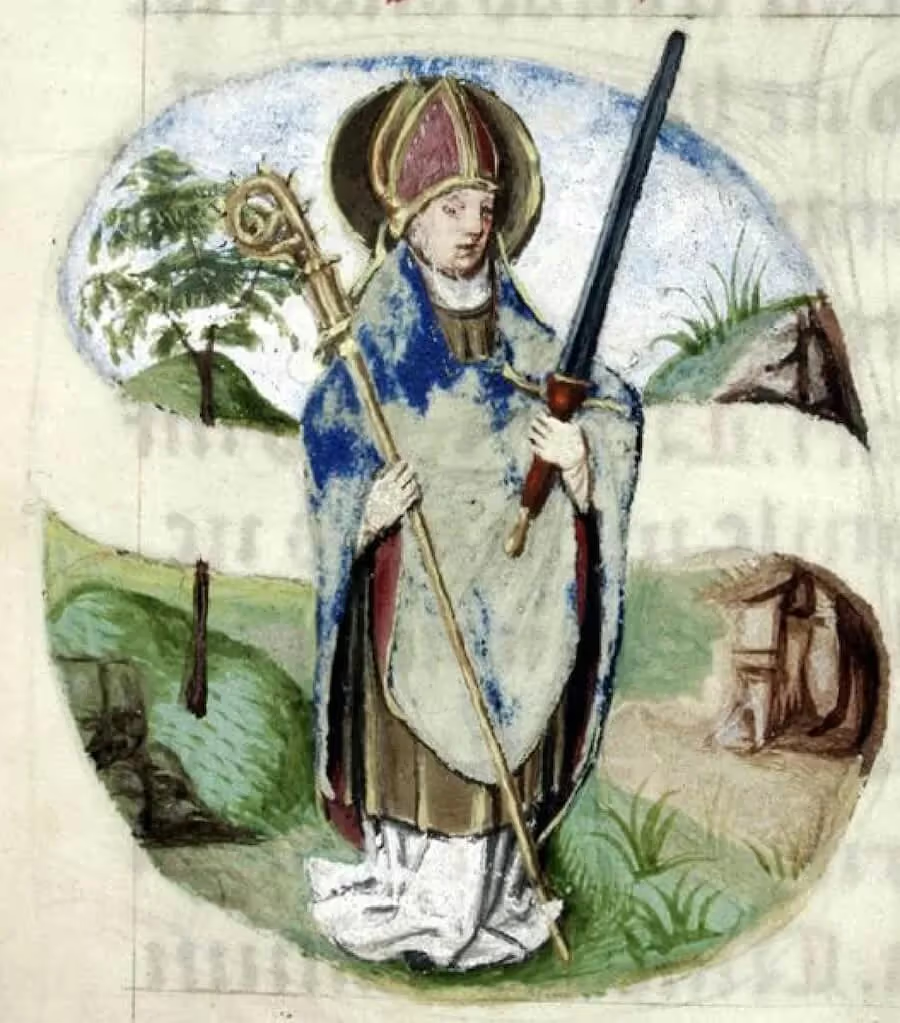
1 venerated soul with ties to this land - fathers and mothers of the faith who are remembered here still.
Famous Orthodox churches and monasteries in Germany
The sacred architecture of Orthodox Germany - cathedrals, parishes, and the mountain monasteries that keep the lamps burning.
- Salvatorkirche, Munich - A Gothic brick church originally built as the cemetery church of Munich's Frauenkirche; given to the Greek Orthodox community in 1829, it long served as the seat of the Greek Orthodox Metropolitan of Germany.
- Cathedral of the Resurrection of Christ, Berlin (Hohenzollerndamm) - Built 1936–1938 in the Russian-Byzantine style, today the cathedral church of the Moscow Patriarchate's Diocese of Berlin and Germany.
- Cathedral of the Holy New Martyrs and Confessors of Russia, Munich - The ROCOR cathedral in Munich, consecrated in 2016; notable as the first ROCOR church ever visited by a Patriarch of Moscow (Alexei II, 2007) after the restoration of communion.
- Greek Orthodox Metropolitan Cathedral (Metropolis Church), Bonn - Begun in 1974 under architect Klaus Hönig and consecrated in 1977, it serves as the episcopal seat of the Greek Orthodox Metropolis of Germany and Central Europe.
- Monastery of the Dormition of the Theotokos, Himmelsthür (Hildesheim) - A Serbian Orthodox monastery of the Diocese of Düsseldorf and all of Germany, built on the site of a former Evangelical church and home to the episcopal administration of the Serbian Orthodox in Central Europe.
- St. Demetrios Romanian Orthodox Cathedral, Nuremberg - The spiritual center of the Romanian Orthodox Metropolis of Germany, Central and Northern Europe.
Orthodoxy
kept here.
The shape of the faith as it is lived and prayed across Germany today.
Eastern Orthodoxy in Germany is overwhelmingly a diaspora reality: nearly every parish traces its origin to a specific wave of migration, and liturgy is commonly served in the mother tongue of the founding community - Greek, Church Slavonic, Romanian, Serbian, Bulgarian, Georgian or Arabic - with a steadily growing use of German, particularly for homilies, catechism, and services shared across jurisdictions.
The canonical landscape is shaped by several autocephalous and autonomous churches operating in parallel. The Greek Orthodox Metropolis of Germany (Ecumenical Patriarchate) is historically the senior body and provides the president of the Orthodox Bishops' Conference of Germany; alongside it serve the Romanian Metropolis based in Nuremberg, the Serbian Eparchy of Düsseldorf and all of Germany, the Moscow Patriarchate's Diocese of Berlin and Germany, the ROCOR Diocese of Berlin and Germany, and smaller Bulgarian, Georgian, Antiochian and Ukrainian structures. All are in sacramental communion, and the OBKD since 2010 provides a single public voice.
Relations with the state are governed by Germany's characteristic system of public-law religious corporations (Körperschaft des öffentlichen Rechts). Several Orthodox jurisdictions have been granted this status by individual federal states, enabling Orthodox religious instruction in public schools in regions such as Bavaria, Hesse and North Rhine-Westphalia, as well as chaplaincy in hospitals, prisons and the Bundeswehr.
The community's character is increasingly multi-generational: the children and grandchildren of Greek and Yugoslav Gastarbeiter now form a substantial German-born layer, while Romanian and Ukrainian migration continues to refresh the parishes with new arrivals. Convert communities, though numerically small, are active and help drive the development of German-language liturgical texts and music.
Asked
of this land.
Frequently asked questions about Orthodoxy in Germany
Is Orthodox Christianity a major religion in Germany?
Yes. Though Germany is historically Catholic and Lutheran, Eastern Orthodoxy is widely regarded as the country's third-largest Christian confession, with roughly 1.5 million faithful coordinated through the Orthodox Bishops' Conference in Germany (OBKD), and as many as 2 million by broader estimates.
Which Orthodox jurisdictions operate in Germany?
The main canonical bodies are the Greek Orthodox Metropolis of Germany (Ecumenical Patriarchate), the Romanian Orthodox Metropolis of Germany, Central and Northern Europe, the Serbian Orthodox Eparchy of Düsseldorf and all of Germany, the Russian Orthodox Diocese of Berlin and Germany (Moscow Patriarchate), the parallel ROCOR diocese, and smaller Bulgarian, Georgian, Antiochian and Ukrainian structures.
When did Orthodoxy first take root in Germany?
A Russian chapel existed in Berlin from 1718 following Russo-Prussian diplomatic relations, and in 1829 the Salvatorkirche in Munich was given to the Greek Orthodox community, becoming the seat of the Metropolitan of Germany. Large-scale growth, however, came with 20th-century migrations.
What languages are used in the liturgy?
Each jurisdiction primarily uses its traditional liturgical language - Greek, Church Slavonic, Romanian, Serbian, etc. - but German is increasingly used for sermons, catechism, and inter-jurisdictional celebrations, and some parishes celebrate the Divine Liturgy fully or partly in German.
Are Orthodox churches recognised by the German state?
Several Orthodox jurisdictions have been granted the status of corporation under public law (Körperschaft des öffentlichen Rechts) in individual federal states, which allows them to teach Orthodox religious education in public schools and provide official chaplaincy.
Does Germany include Oriental Orthodox Christians in these figures?
No. Eastern Orthodox (Chalcedonian) Christians - Greek, Russian, Romanian, Serbian, Bulgarian, Georgian and Antiochian - are distinct from Oriental Orthodox communities such as the Coptic, Armenian Apostolic, Ethiopian, Eritrean and Syriac Orthodox, who also have a significant presence in Germany but are not part of the same communion.
More from the tradition.
Meet the saints
The lives behind the icons, calendars, and books we print.
ExploreRead the Journal
Essays on feasts, fasting, and the rhythm of the Church year.
ExploreThe 2027 Calendar
A saint, a reading, and the day's fasting guideline for every day of 2027.
ExploreMobile & web apps
Carry the daily rhythm on iPhone and iPad or continue in the web app.
Explore