India.
Eastern Orthodox Christianity in India is a small but historic minority, represented today by Russian and Greek parishes and by missions of the Ecumenical Patriarchate, distinct from the much larger Oriental Orthodox Saint Thomas communities.
Orthodoxy in
India.
A living tradition - its history, its faithful, its sacred places.
Eastern Orthodox Christianity in India
India is a vast, religiously plural country in which Christianity is an ancient but minority faith. Within Indian Christianity, the Eastern Orthodox (Chalcedonian) presence is very small and clearly distinct from the much larger and older body of Saint Thomas Christians in Kerala, whose main Orthodox branch - the Malankara Orthodox Syrian Church - belongs to the Oriental Orthodox communion and is not in sacramental communion with the Ecumenical Patriarchate.
Early contacts and the Russian mission
Sustained Eastern Orthodox engagement with India began in the 20th century through Russian émigré clergy. Archimandrite Andronik (Yelpidinsky) arrived as a monk-missionary in 1931 and lived for nearly two decades among the Malankara Orthodox, hoping to mediate their reunion with the Eastern Orthodox Church. Greek merchants in Bengal had already formed a community in Calcutta by the late 17th century; a stone church opened in 1782 and the present Transfiguration of Our Saviour Church was built in the 1920s.
Jurisdictional situation today
Two canonical Eastern Orthodox jurisdictions have pastoral responsibility for India:
Ecumenical Patriarchate of Constantinople - through the Orthodox Metropolitanate of Singapore and South Asia, established in 2008 when the Holy Synod of Constantinople detached South Asia from the Metropolis of Hong Kong. It oversees Singapore, India, Pakistan, Bangladesh, Nepal, Sri Lanka and neighbouring states, and has mission parishes in India served mainly by indigenous clergy, particularly in West Bengal.
Russian Orthodox Church (Moscow Patriarchate) - its Patriarchal Exarchate of South-East Asia, founded in December 2018 with its centre in Singapore, cares for Russian-speaking Orthodox in the wider region. The first Russian Orthodox parish in Delhi, dedicated to the Apostle Thomas, was registered in 2006 during a visit by the future Patriarch Kirill; services have also been held for Russian communities in Mumbai and Goa.
Current life and character
Eastern Orthodox faithful in India consist chiefly of Russian, Greek, Serbian, Romanian, Ukrainian and other expatriates, together with a small but growing number of Indian converts served by missions of the Metropolitanate of Singapore and South Asia. Liturgies are celebrated in Church Slavonic, Greek and English, as well as in Bengali and other local languages in mission parishes. Relations with the Malankara Orthodox Syrian Church are cordial - Patriarch Kirill of Moscow and Catholicos Baselios Marthoma Paulose II met in 2015 - but the two communions remain ecclesially separate because of the Christological differences dating to the Council of Chalcedon (AD 451).
In a country of over a billion people, Eastern Orthodoxy in India is numerically tiny, yet it is a living ecclesial reality with ordered parish life, missionary activity, and historical witness stretching back to the Greek merchant communities of the colonial period and the Russian monastic mission of the 1930s.
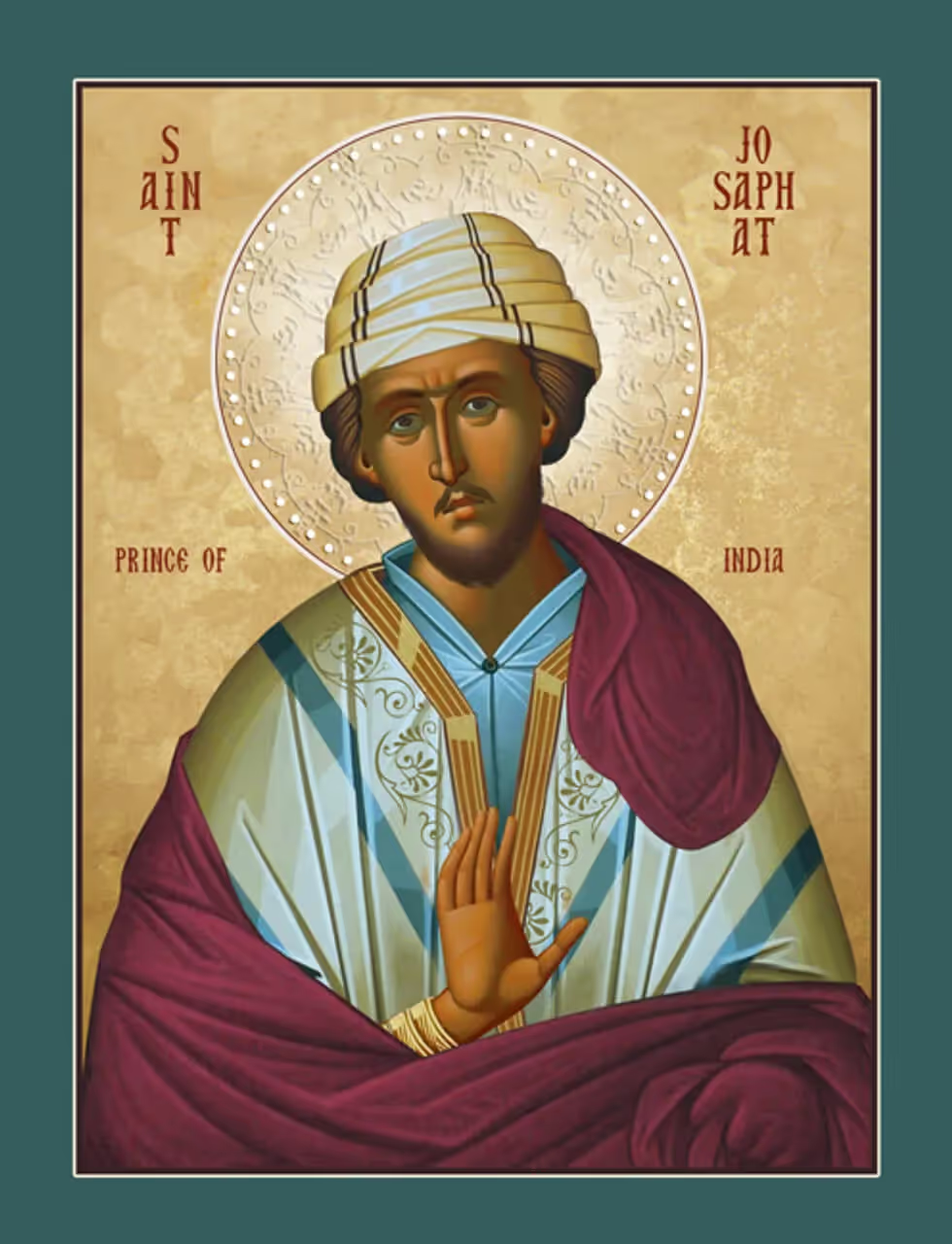
Saints of
India.
1 venerated soul with ties to this land - fathers and mothers of the faith who are remembered here still.
Notable Eastern Orthodox churches in India
The sacred architecture of Orthodox India - cathedrals, parishes, and the mountain monasteries that keep the lamps burning.
- Greek Orthodox Church of the Transfiguration of Our Saviour, Kolkata - The foundation stone was laid on 3 November 1924 and the church opened to the public on 19 November 1925, serving the historic Greek community of Bengal under the Ecumenical Patriarchate.
- Russian Orthodox Parish of the Holy Apostle Thomas, New Delhi - First registered in 2006 during a visit to India by the future Patriarch Kirill, and formally established as a parish of the Moscow Patriarchate in 2012; initially served within the Russian Embassy premises.
- Earlier Greek Orthodox Church of Calcutta (1782) - A stone church built by the Greek merchant community in 1782, predecessor of the present Transfiguration church; it stood until the community relocated in the 1920s.
- Mission parishes of the Metropolitanate of Singapore and South Asia in West Bengal - A network of mission communities (Nadapur, Parul, Boramar, Damodarpur, Kakdeep and others) served by indigenous Indian clergy under the Ecumenical Patriarchate.
- Russian Orthodox chapel communities in Goa and Mumbai - Periodic liturgical services offered to Russian-speaking faithful, with a long-standing initiative for a permanent parish in Goa centred on the Morjim area.
Orthodoxy
kept here.
The shape of the faith as it is lived and prayed across India today.
Eastern Orthodoxy in India is a minority presence organised today under two canonical umbrellas: the Ecumenical Patriarchate, through the Metropolitanate of Singapore and South Asia (founded 2008), and the Russian Orthodox Church, through the Patriarchal Exarchate of South-East Asia (founded 2018). Both jurisdictions operate from Singapore, with local clergy and communities inside India.
Parish life is concentrated in a few centres: the historic Greek Orthodox Church of the Transfiguration of Our Saviour in Kolkata, the Russian parish of the Apostle Thomas in New Delhi (registered 2006, officially established 2012), periodic Russian services for expatriates in Mumbai and Goa, and mission communities of the Ecumenical Patriarchate in West Bengal villages. Divine services are held in Greek, Church Slavonic, English and - in mission parishes - Bengali and other Indian languages.
The faithful are predominantly diaspora: Russian, Greek, Ukrainian, Serbian, Romanian and Bulgarian expatriates and diplomats, alongside a growing number of Indian converts served by mission priests. Eastern Orthodoxy is legally recognised but holds no special status; the Indian state is constitutionally secular, and Orthodox communities function as ordinary religious minorities.
It is essential to distinguish Eastern Orthodoxy from the much larger Oriental Orthodox presence in India - chiefly the Malankara Orthodox Syrian Church, which traces itself to the apostolate of Saint Thomas and numbers in the millions. The two communions share many liturgical and spiritual features but have been ecclesially separate since the Council of Chalcedon in 451; relations are fraternal but not yet in full communion.
Asked
of this land.
Frequently asked questions about Orthodoxy in India
Is the Malankara (Indian) Orthodox Church the same as Eastern Orthodox?
No. The Malankara Orthodox Syrian Church is an autocephalous Oriental Orthodox church that did not accept the Council of Chalcedon (451). Eastern Orthodox Christians recognise it as theologically close and liturgically kindred, but the two communions are not in sacramental communion.
Which Eastern Orthodox jurisdictions are present in India?
Two canonical jurisdictions operate in India: the Metropolitanate of Singapore and South Asia (Ecumenical Patriarchate of Constantinople), founded in 2008, and the Patriarchal Exarchate of South-East Asia (Russian Orthodox Church), founded in 2018. Both are headquartered in Singapore and serve India through local parishes and missions.
Where can one attend an Eastern Orthodox Divine Liturgy in India?
Regular liturgies are celebrated at the Greek Orthodox Church of the Transfiguration of Our Saviour in Kolkata, at the Russian parish of the Apostle Thomas in New Delhi, and at mission parishes of the Metropolitanate of Singapore in rural West Bengal. Periodic services are also held for Russian communities in Mumbai and Goa.
Were there Russian Orthodox missionaries in India historically?
Yes. Archimandrite Andronik (Yelpidinsky) lived in India from 1931 to the late 1940s, residing among the Malankara Orthodox and serving scattered Russian émigrés. His mission is considered the foundation of sustained Russian Orthodox presence in the subcontinent.
How old is the Greek Orthodox community in India?
Greek merchants settled in Bengal from the 17th century; the first Greek Orthodox church of Calcutta opened in 1782, and the present Transfiguration of Our Saviour Church was consecrated in 1925, celebrating its centenary in 2025.
In what languages are services celebrated?
Services are offered in Greek and English at the Kolkata parish, in Church Slavonic and English at the Russian parish in New Delhi, and in Bengali, English and Greek in the mission communities of West Bengal.
More from the tradition.
Meet the saints
The lives behind the icons, calendars, and books we print.
ExploreRead the Journal
Essays on feasts, fasting, and the rhythm of the Church year.
ExploreThe 2027 Calendar
A saint for every day of the year - now open for pre-order.
ExploreMobile & web apps
Carry the daily rhythm on iPhone and iPad or continue in the web app.
Explore