Italy.
Once part of the Byzantine Christian world and home to the first Orthodox church built in Western Europe, Italy today hosts around 900,000–1,000,000 Eastern Orthodox faithful served by Greek, Romanian, Russian, Serbian and other canonical jurisdictions.
Orthodoxy in
Italy.
A living tradition - its history, its faithful, its sacred places.
Eastern Orthodox Christianity has an ancient but discontinuous history in Italy. During the first millennium much of the peninsula - especially Venice, Ravenna, Calabria, Apulia, Sicily and the exarchates of Byzantine rule - belonged to the Greek-speaking liturgical world of the undivided Church. After the Great Schism of 1054 and the gradual Latinisation of southern Italy, the organised Orthodox presence largely disappeared, surviving mainly through Greek communities in seaports and through pockets of the Italo-Byzantine monastic tradition.
A Western Orthodox revival
The modern rebirth of Orthodoxy in Italy begins with the Greek diaspora of the late Middle Ages. After the fall of Constantinople in 1453, Greek merchants, scholars and soldiers settled in the Venetian Republic, forming a confraternity that in the sixteenth century built one of the earliest Orthodox churches in Western Europe: San Giorgio dei Greci, completed in 1573 in the Castello district of Venice. This community, long tied to the Ecumenical Patriarchate, became the historical anchor of Orthodox life on Italian soil.
Jurisdictional landscape today
Today Italy is a true mosaic of canonical Orthodox jurisdictions, each serving its own ethnic tradition while bearing common witness. The principal canonical bodies are:
The Orthodox Archdiocese of Italy and Exarchate of Southern Europe, under the Ecumenical Patriarchate of Constantinople, established in 1991, with its cathedral at San Giorgio dei Greci in Venice.
The Romanian Orthodox Diocese of Italy, a diocese of the Romanian Orthodox Metropolis of Western and Southern Europe, by far the largest Orthodox body in the country.
The Patriarchal Parishes of the Russian Orthodox Church in Italy, representing the Moscow Patriarchate.
The Serbian Orthodox Eparchy of Austria, Switzerland, Italy and Malta.
Parishes of the Bulgarian, Georgian and other autocephalous Churches serving their respective diasporas.
Since 2009 these canonical hierarchs have coordinated their pastoral work through an Assembly of Orthodox Bishops in Italy, following the pan-Orthodox model endorsed by the Mother Churches for regions of the diaspora.
From historic minority to second religion
Late twentieth- and early twenty-first-century migration has transformed Orthodoxy from a tiny legacy community into one of Italy's largest religious bodies. Romanians, Ukrainians, Moldovans, Serbs, Russians, Greeks, Bulgarians and Georgians together account for the overwhelming majority of Orthodox faithful. Parishes multiply rapidly: many worship in historic Latin churches loaned by Catholic dioceses, while others have built new temples in Byzantine style. The Romanian Orthodox Diocese of Italy alone numbers several hundred parishes grouped in more than twenty deaneries.
Relations with the Italian state and the Roman Church
The Italian Republic recognises Orthodox jurisdictions through bilateral agreements (intese) granting legal personality and certain civil rights. Relations with the Roman Catholic Church are generally cordial: Catholic parishes frequently share buildings with Orthodox congregations, and pilgrim sites such as the relics of Saint Nicholas in Bari remain a major point of spiritual contact between Eastern Christians and the Latin West. Within the bounds of confessional differences, Orthodoxy in Italy is increasingly a settled, pastoral and liturgical presence rather than a purely immigrant phenomenon.
Saints of
Italy.
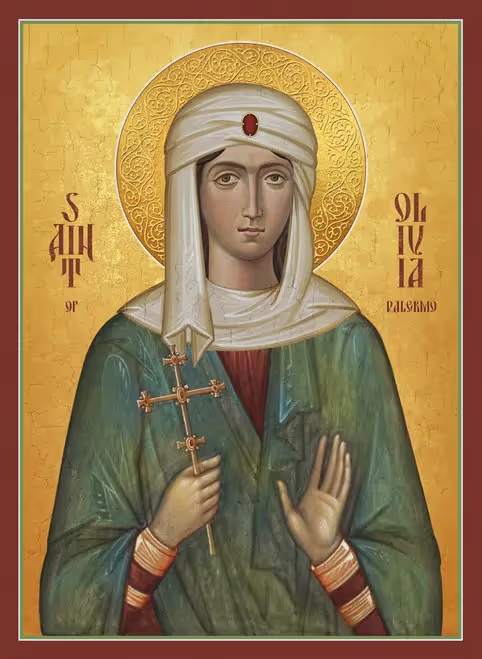
1 venerated soul with ties to this land - fathers and mothers of the faith who are remembered here still.
Famous Orthodox churches and places of pilgrimage in Italy
The sacred architecture of Orthodox Italy - cathedrals, parishes, and the mountain monasteries that keep the lamps burning.
San Giorgio dei Greci - Venice
Built between 1539 and 1573 by the Greek community of Venice following the fall of Constantinople, San Giorgio dei Greci is one of the earliest Orthodox churches in Western Europe. Since 1991 it has served as the metropolitan cathedral of the Greek Orthodox Archdiocese of Italy and Exarchate of Southern Europe under the Ecumenical Patriarchate.
Russian Orthodox Church of Saint Nicholas - Bari
Built starting in 1913 to welcome Russian pilgrims venerating the relics of Saint Nicholas, this complex with its distinctive Russian architecture was formally transferred to the Russian Orthodox Church (Moscow Patriarchate) in 2009 and remains a major centre of Russian Orthodox worship and pilgrimage in southern Italy.
Russian Orthodox Church of Saint Catherine the Great Martyr - Rome
Consecrated in 2009 on the grounds of the Russian Embassy at Villa Abamelek, this church with its gilded onion domes is the principal Russian Orthodox temple in Rome and serves the Patriarchal Parishes of the Russian Orthodox Church in Italy.
Basilica of Saint Nicholas - Bari (pilgrimage site)
Although a Latin Catholic basilica, the Pontifical Basilica of Saint Nicholas houses the relics of the great Wonderworker, translated from Myra in 1087, and is one of the most important Orthodox pilgrimage destinations in the West. The crypt altar is regularly granted to Orthodox bishops and clergy for the celebration of the Divine Liturgy, and the translation of the relics on 9/22 May is a major feast in the Russian Orthodox calendar.
Romanian Orthodox parishes across Italy
The Romanian Orthodox Diocese of Italy, established canonically in 2007–2008 under Bishop Siluan, oversees several hundred parishes throughout the peninsula - the largest network of Orthodox communities in the country - many of them hosted in historic Catholic churches placed at the disposal of Romanian faithful by local Catholic dioceses.
Orthodoxy
kept here.
The shape of the faith as it is lived and prayed across Italy today.
Eastern Orthodoxy in Italy today is overwhelmingly a diaspora Orthodoxy, shaped by the pastoral needs of Romanian, Ukrainian, Moldovan, Russian, Serbian, Greek, Bulgarian and Georgian faithful who have settled in the country since the 1990s. Because there is no autocephalous Italian Orthodox Church, the faithful are organised under their respective Mother Churches; the Romanian Patriarchate, the Ecumenical Patriarchate and the Moscow Patriarchate account for the largest share of parishes.
Liturgical life reflects this plurality. Services are most often celebrated in Romanian, Church Slavonic, Greek or Serbian, with Italian increasingly used for readings, homilies and parts of the Divine Liturgy, particularly in mixed congregations and among second-generation faithful. The Greek Archdiocese's cathedral in Venice preserves a continuous Byzantine liturgical tradition reaching back to the sixteenth century, while newer Romanian and Russian parishes often emphasise the full Slavic-Byzantine liturgical cycle including All-Night Vigils and festal pilgrimages.
The relationship between Orthodoxy and the Italian state is regulated through formal agreements (intese) that grant Orthodox jurisdictions legal recognition. Dialogue with the Roman Catholic Church is extensive and largely cooperative: Catholic dioceses frequently grant the use of unused or shared church buildings to Orthodox communities, and the Basilica of Saint Nicholas in Bari has become a major ecumenical pilgrimage site, welcoming Orthodox clergy and faithful to venerate the relics of the saint.
Monastic life, though limited compared to traditionally Orthodox countries, is growing: small Romanian, Russian, Serbian and Greek communities maintain sketes, hermitages and monasteries scattered across the peninsula, giving a contemplative dimension to what is otherwise a deeply parochial Orthodoxy in transition from immigrant community to rooted local church.
Asked
of this land.
Frequently asked questions about Orthodoxy in Italy
Is there an autocephalous Orthodox Church of Italy?
No. Italy has no autocephalous Orthodox Church. The canonical Orthodox faithful are organised under the jurisdiction of various Mother Churches - principally the Ecumenical Patriarchate, the Romanian Patriarchate, the Moscow Patriarchate and the Serbian Patriarchate.
How many Orthodox Christians live in Italy?
Estimates vary, but serious studies generally place the number of Eastern Orthodox Christians in Italy on the order of 900,000 to over one million, mostly immigrants and their Italian-born children from Romania, Ukraine, Moldova, Russia, Serbia, Greece and Georgia. This makes Orthodoxy one of the largest religious bodies in the country after Roman Catholicism.
Which is the largest Orthodox jurisdiction in Italy?
The Romanian Orthodox Diocese of Italy, part of the Romanian Patriarchate's Metropolis of Western and Southern Europe, is by far the largest, with several hundred parishes throughout the country serving the very large Romanian community.
What is the oldest Orthodox church in Italy?
The church of San Giorgio dei Greci in Venice, built between 1539 and 1573 for the Greek community of the Venetian Republic, is the historical cradle of modern Orthodoxy in Italy and today serves as the cathedral of the Greek Orthodox Archdiocese of Italy.
What language are Orthodox services celebrated in?
Most commonly in Romanian, Church Slavonic, Greek or Serbian - the liturgical language of each community's Mother Church. Italian is increasingly used for readings, preaching and some responses, especially in parishes with faithful of mixed origin.
Is Eastern Orthodoxy the same as the "Italian Orthodox Church" one sometimes hears about?
No. Several small groups in Italy use the name "Orthodox Church of Italy" or similar titles but are not in communion with the canonical Eastern Orthodox Churches. Only the jurisdictions listed under the Ecumenical, Romanian, Russian, Serbian, Bulgarian, Georgian and other autocephalous Patriarchates are recognised as canonically Eastern Orthodox.
More from the tradition.
Meet the saints
The lives behind the icons, calendars, and books we print.
ExploreRead the Journal
Essays on feasts, fasting, and the rhythm of the Church year.
ExploreThe 2027 Calendar
A saint for every day of the year - now open for pre-order.
ExploreMobile & web apps
Carry the daily rhythm on iPhone and iPad or continue in the web app.
Explore