Cyprus.
Cyprus is home to one of the oldest autocephalous Eastern Orthodox Churches, founded according to tradition by the Apostles Paul and Barnabas and granted independence at the Council of Ephesus in 431.
Orthodoxy in
Cyprus.
A living tradition - its history, its faithful, its sacred places.
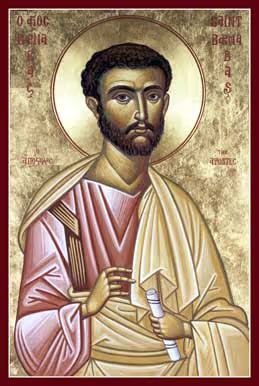
The Church of Cyprus is an ancient autocephalous Eastern Orthodox Church and one of the defining institutions of Cypriot identity. According to apostolic tradition, Christianity arrived on the island in AD 45 with the preaching of Saints Paul, Barnabas and Mark the Evangelist, and Apostle Barnabas is venerated as the first bishop of Cyprus.
Apostolic foundation and autocephaly
The Church of Cyprus is counted among the oldest Eastern Orthodox autocephalous churches. It claims to have always been independent, although it may have been subject to the Church of Antioch before its autocephaly was formally recognized at the Council of Ephesus in 431. A pivotal moment came in 478, when the grave of Saint Barnabas was discovered with a copy of the Gospel of Matthew laid upon his relics - evidence cited by the Cypriot fathers to defend the apostolic, self-governing character of their church.
Medieval and Ottoman periods
Under the Latin Kingdom of Cyprus established in 1191, the Catholic rulers gradually reduced the number of Orthodox bishoprics from fourteen to four, relocating Orthodox prelates away from their traditional seats. The Archbishop was moved from Nicosia to Solia, and other sees were likewise displaced. The Ottoman conquest of 1571 paradoxically restored a measure of ecclesial liberty: the archbishop became ethnarch, representing the Greek Orthodox population before the Sublime Porte - a role that shaped the modern fusion of religion and national identity on the island.
Modern era
When the Republic of Cyprus became independent in 1960, its constitution confirmed the position of the Church of Cyprus as an autocephalous and independent Greek Orthodox Church on the basis of its ancient titles, and Archbishop Makarios III was elected the republic's first president. A major internal crisis erupted in 1973 when three metropolitans attempted to depose Makarios over his political role, but they were themselves deposed by a major synod of bishops drawn from the ancient patriarchates.
The Church today
The Church is governed by a Holy Synod and organized into an archdiocese and several metropolises, including Paphos, Kition, Kyrenia, Limassol, Morphou, Constantia-Famagusta, Tamassos, Trimythous and others. The sees of Kyrenia, Constantia-Famagusta and Morphou lie in territories occupied since 1974, a wound that continues to mark Cypriot ecclesial life, with many historic churches and monasteries in the north desecrated or inaccessible.
The reigning primate is His Beatitude Archbishop George III (Georgios), elected on 24 December 2022 and enthroned on 8 January 2023 at the Cathedral of Apostle Barnabas in Nicosia as the 76th head of the Church. Orthodoxy remains woven into every dimension of Cypriot public life - from village panegyria and Holy Week processions to national holidays and education - and the monasteries of the Troodos and Karpas preserve some of the finest Byzantine and post-Byzantine iconography in the Orthodox world.
Saints of
Cyprus.
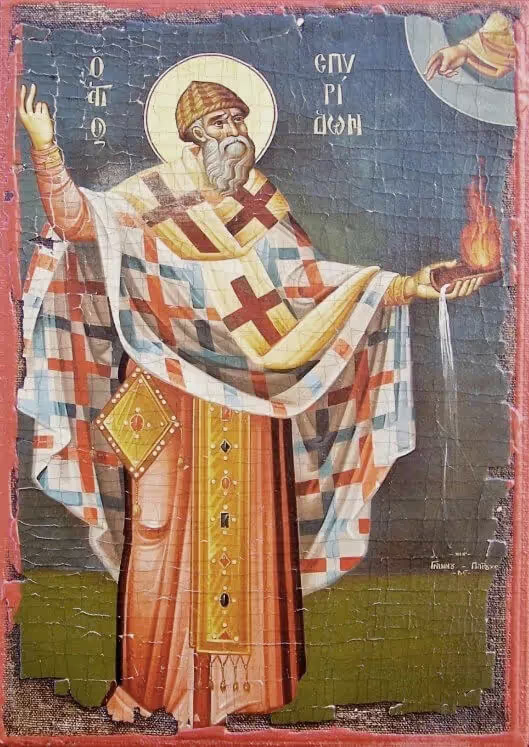
2 venerated souls with ties to this land - fathers and mothers of the faith who are remembered here still.
Famous Orthodox churches and monasteries in Cyprus
The sacred architecture of Orthodox Cyprus - cathedrals, parishes, and the mountain monasteries that keep the lamps burning.
- Kykkos Monastery (Panagia tou Kykkou), Troodos Mountains - Founded in the late 11th century under Byzantine Emperor Alexios I Komnenos, it is the richest and most venerated monastery in Cyprus, home to one of the three icons of the Theotokos tradition attributes to the hand of the Apostle Luke.
- Stavrovouni Monastery, Larnaca District - Perched on a rocky peak and founded according to tradition c. AD 327–329 by Saint Helena, mother of Saint Constantine the Great, it preserves a relic of the True Cross and remains one of the oldest active monasteries in the Orthodox world.
- Church of Saint Lazarus (Agios Lazaros), Larnaca - Built in the late 9th to early 10th century by Emperor Leo VI over the tomb of Saint Lazarus the Friend of Christ, who, according to Orthodox tradition, fled to Cyprus after his resurrection and was ordained first Bishop of Kition by Paul and Barnabas.
- Machairas Monastery, Nicosia District - A major 12th-century foundation on the slopes of Kionia in the Machairas mountains, treasuring the miraculous icon of Panagia Machairiotissa and long associated with Cypriot monastic and hesychast tradition.
- Apostolos Andreas Monastery, Karpas Peninsula - Situated near the north-easternmost tip of the island, long called the "Lourdes of Cyprus" for its pilgrimages and miracles; though located in the occupied north, it has been partially restored and opened again for Divine Liturgy.
- Cathedral of Apostle Barnabas, Nicosia - The cathedral church of the Archbishopric, where the Archbishops of Cyprus are enthroned and which serves as the administrative centre of the autocephalous Church.
Orthodoxy
kept here.
The shape of the faith as it is lived and prayed across Cyprus today.
Cyprus is one of the most overwhelmingly Orthodox countries in the world. According to the 2011 census of the government-controlled area, about 89.1% of the population identifies as Orthodox Christian, the great majority belonging to the autocephalous Greek Orthodox Church of Cyprus. The liturgical language is Koine Greek, following the Byzantine rite shared with the Ecumenical Patriarchate and the Church of Greece.
The Church of Cyprus is independent (autocephalous) and enjoys a constitutionally privileged relationship with the state. The Archbishop of Nea Justiniana and All Cyprus holds traditional honours dating from Byzantine times, including the imperial privileges granted by Emperor Zeno after the discovery of Saint Barnabas's relics: the right to sign in cinnabar (red ink), to carry an imperial sceptre in place of a pastoral staff, and to wear a purple mantle during liturgical functions.
Parish life is closely bound to local patrons and miraculous icons. Pilgrimage to Kykkos Monastery in the Troodos mountains, the tomb of Saint Lazarus in Larnaca, and - increasingly since its partial reopening for worship - the Monastery of Apostolos Andreas on the Karpas Peninsula remain central devotional practices. Monasticism continues to thrive, with foundations such as Machairas, Stavrovouni and Chrysoroyiatissa still inhabited by active brotherhoods.
Beyond the island, Cypriot Orthodoxy is represented abroad through its diaspora faithful who typically belong to the Ecumenical Patriarchate's jurisdictions in Great Britain, Australia and elsewhere, while the Church of Cyprus itself remains in full canonical communion with the other autocephalous Orthodox Churches.
Asked
of this land.
Frequently asked questions about Orthodoxy in Cyprus
Is the Church of Cyprus autocephalous?
Yes. The Church of Cyprus is one of the oldest autocephalous (self-governing) Orthodox Churches. Its independence was formally recognized at the Council of Ephesus in 431, overriding the claims of the Patriarch of Antioch.
Who founded Orthodox Christianity in Cyprus?
According to tradition, the Apostles Paul, Barnabas and Mark the Evangelist preached in Cyprus in AD 45, with Saint Barnabas considered the first bishop and apostle of the island.
Who is the current head of the Church of Cyprus?
His Beatitude Archbishop George III (Georgios), elected on 24 December 2022 and enthroned on 8 January 2023 at the Cathedral of Apostle Barnabas in Nicosia as the 76th Archbishop of Cyprus.
What language is used in the Divine Liturgy?
Services are celebrated in Koine (ecclesiastical) Greek, following the Byzantine rite common to the Greek-speaking Orthodox world.
What happened to Orthodox churches in northern Cyprus after 1974?
The Metropolises of Kyrenia, Morphou and Constantia-Famagusta lie in territory occupied since 1974. Many historic churches and monasteries were damaged, looted or repurposed. The Monastery of Apostolos Andreas on the Karpas Peninsula has been partially restored and is again accessible for worship.
How is the Church related to the Cypriot state?
The Church of Cyprus holds a constitutionally recognized role in the Republic of Cyprus. Archbishop Makarios III served as the republic's first president from 1960, and the Church remains an influential voice in Cypriot public and cultural life.
More from the tradition.
Meet the saints
The lives behind the icons, calendars, and books we print.
ExploreRead the Journal
Essays on feasts, fasting, and the rhythm of the Church year.
ExploreThe 2027 Calendar
A saint, a reading, and the day's fasting guideline for every day of 2027.
ExploreMobile & web apps
Carry the daily rhythm on iPhone and iPad or continue in the web app.
Explore