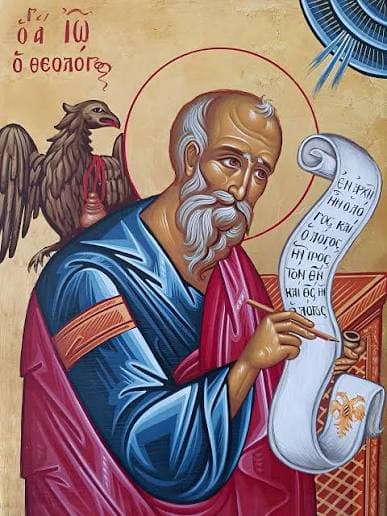
Saint Apostle and Evangelist John the Theologian.
Also known as Saint John the Apostle, John the Beloved, John the Divine, John the Evangelist, John of Patmos, John the Elder
The beloved disciple of Christ and author of the Fourth Gospel, three Epistles, and the Apocalypse. He died peacefully in Ephesus in extreme old age, the only Apostle not to be martyred.
O beloved Apostle of Christ our God, / come quickly to deliver your helpless people. / He on whose breast you leaned, will accept you as intercessor. / Entreat Him, O Theologian, to disperse the clouds of darkness, / granting us peace and great mercy!
The Beloved
Disciple and Theologian of the Church
John was the youngest of the Twelve Apostles and closest to Jesus, famously leaning on His breast at the Last Supper. Entrusted by Christ to care for the Virgin Mary at the Crucifixion, John spent his later years establishing Christian communities throughout Asia Minor and authoring works of profound theological depth. His writings emphasize love as the essence of the Gospel and have shaped Christian theology for nearly two millennia.
Early years
John the Apostle was born into a family of Jewish fishermen on the Sea of Galilee. He was the son of Zebedee and the younger brother of James the Great. According to church tradition, their mother was Salome. Jesus Christ our Savior was the uncle of Saint John the Theologian, since He was the half-brother of John's mother Salome. John and his brother James were helping their father Zebedee with the fishing when the Savior called them to follow Him and become fishers of men. They immediately left everything to follow His heavenly teaching.
John the Apostle is traditionally believed to be one of two disciples (the other being Andrew) recounted in John 1:35–39, who upon hearing the Baptist point out Jesus as the "Lamb of God", followed Jesus and spent the day with him, thus becoming the first two disciples called by Jesus. On this basis some traditions believe that John was first a disciple of John the Baptist, even though he is not named in this episode.
In the Church
He saw Christ after His Resurrection and was commissioned with the other disciples to preach the Gospel throughout the world when the Lord breathed on them as an earnest of the gift of the Holy Spirit. He was present also at the Lord's Ascension into heaven and received the Holy Spirit under the appearance of tongues of fire with the other disciples on the day of Pentecost.
When the time came to part from one another to preach in all the regions of the world, the Apostles drew lots to tell where each should go. It fell to John to preach the Gospel in Asia Minor which was full of idolatry and entirely given over to paganism. They made their way to Ephesus, a place where the people had great devotion to the goddess Diana and would celebrate festivals in her honor. At one of these, John climbed the hill where stood the great statue of the goddess in order to address the crowd. The pagans were enraged to see him there and tried to stone him, but by the grace of God all the stones missed their mark and struck the statue, which was reduced to rubble.
They took the Apostle John for trial at Rome. Saint John was sentenced to death for his confession of faith in the Lord Jesus Christ, but the Lord preserved His chosen one. The apostle drank a cup of deadly poison, but he remained alive. Later, he emerged unharmed from a cauldron of boiling oil into which he had been thrown on orders from the torturer. Domitian was so exasperated by this, that he exiled John to the desert island of Patmos.
Later years
After Domitian's death, the Apostle John left his exile in Patmos to return to Ephesus. He was translated to the Lord, while preaching the word of God at Ephesus, in deep old age during the days of Emperor Trajan (98-117 A.D.).
When Saint John was more than one hundred years old, he told seven of his disciples to take spades and follow him to a certain place outside the city of Ephesus, and then he told everyone to sit down while he went off to pray by himself for a while. When he returned, he told his disciples to dig a grave as long as he was tall, in the form of a cross. After the Apostle dismissed them, they buried him and wept bitterly. Later, they returned and opened the grave, but the Saint's body was not there.
Every year, on May 8, a red dust appears on his grave, which heals the sick, through the prayers of the Holy Apostle John. People call this dust "manna from the earth." Saint Augustine knew about this dust, and Saint Gregory of Tours also wrote about it.
Legacy and veneration
The Apostle John was especially loved by the Savior for his sacrificial love and his virginal purity. After his calling, the Apostle John did not part from the Lord, and he was one of the three apostles who were particularly close to Him. Saint John the Theologian was present when the Lord restored the daughter of Jairus to life, and he was a witness to the Transfiguration of the Lord on Mount Tabor.
The Basilica of Saint John the Theologian was constructed by Justinian the Great in the 6th century, at a site where John the Apostle was said to have been buried. Symeon Metaphrastes in the tenth century writes of the festival on May 8th being of such great magnitude that it seemed there were more people in attendance to take part in the miracle and receive a portion of its distribution than there were stars in the sky.
He called for all Christians to love the Lord and one another, and by this to fulfill the commands of Christ. The apostle's emphasis on love as the foundation of Christian life, expressed particularly in his epistles and Gospel, remains central to Orthodox theology and piety to this day. His intercessions are sought especially for those seeking theological wisdom and deeper understanding of God's nature.
How the saint's
memory is kept.
- When is the feast day of Saint John the Theologian?
- The primary feast day is May 8, celebrating the miraculous dust from his tomb. His repose is commemorated on September 26.
- Who was Saint John the Theologian?
- Saint John was the youngest of the Twelve Apostles and the most beloved disciple of Jesus Christ. He is traditionally regarded as the author of the Fourth Gospel, three Epistles, and the Book of Revelation.
- Why is he called the Theologian?
- John is called the Theologian by the Eastern Orthodox Church because he wrote about the deepest mysteries of God's nature and the divinity of Christ, particularly in his Gospel's opening about the Logos.
- Where did Saint John spend his later years?
- After his release from exile on Patmos, John spent his later years in Ephesus, Asia Minor, where he established Christian communities, wrote his Gospel, and eventually died a natural death at an advanced age.
- What is the miraculous dust from Saint John's tomb?
- Each year on May 8, a fine red dust flows from Saint John's tomb in Ephesus. Called 'manna from the earth,' it has been known for centuries to heal the sick through the apostle's intercession.
- How did Saint John die?
- Saint John died peacefully of natural causes in Ephesus at an advanced age under Emperor Trajan. He is the only Apostle who was not martyred, having survived Roman persecution including being thrown into boiling oil.
- What are Saint John's most important writings?
- Saint John authored the Gospel of John (written c. 95 AD), three Epistles (1, 2, and 3 John), and the Book of Revelation, all of which are part of the New Testament and considered foundational to Christian theology.
Who shall declare your greatness, / O virgin disciple, / for you pour forth wonders and are a source of healings, / and pray for our souls as theologian and friend of Christ.
O holy Apostle and Evangelist John, the Beloved Disciple of Christ, whom Jesus loved and chose to recline upon His bosom at the mystical supper, hear our prayers and supplications. Having witnessed the mysteries of the Incarnate Word and received revelation of the deepest truths of our faith, intercede with thy Lord and God on behalf of us sinners. Guide our hearts toward that love which thou didst proclaim throughout thy life, that love which fulfills the law and unites us to Christ. Entreat Him to grant us strength in temptation, comfort in tribulation, and perseverance unto salvation. Remember those who suffer from illness of body or mind, and pour forth upon them the healing grace that flows from thy tomb. O wise Theologian, teach us to see God as thou didst see Him, and grant us a share in that love which is the essence of the Gospel. By thy holy intercessions, deliver us from all adversity and lead us into the joy of thy Master's kingdom, where thou dost eternally behold the Face of Him whom thy heart loved. Amen.
Carry the tradition with you.
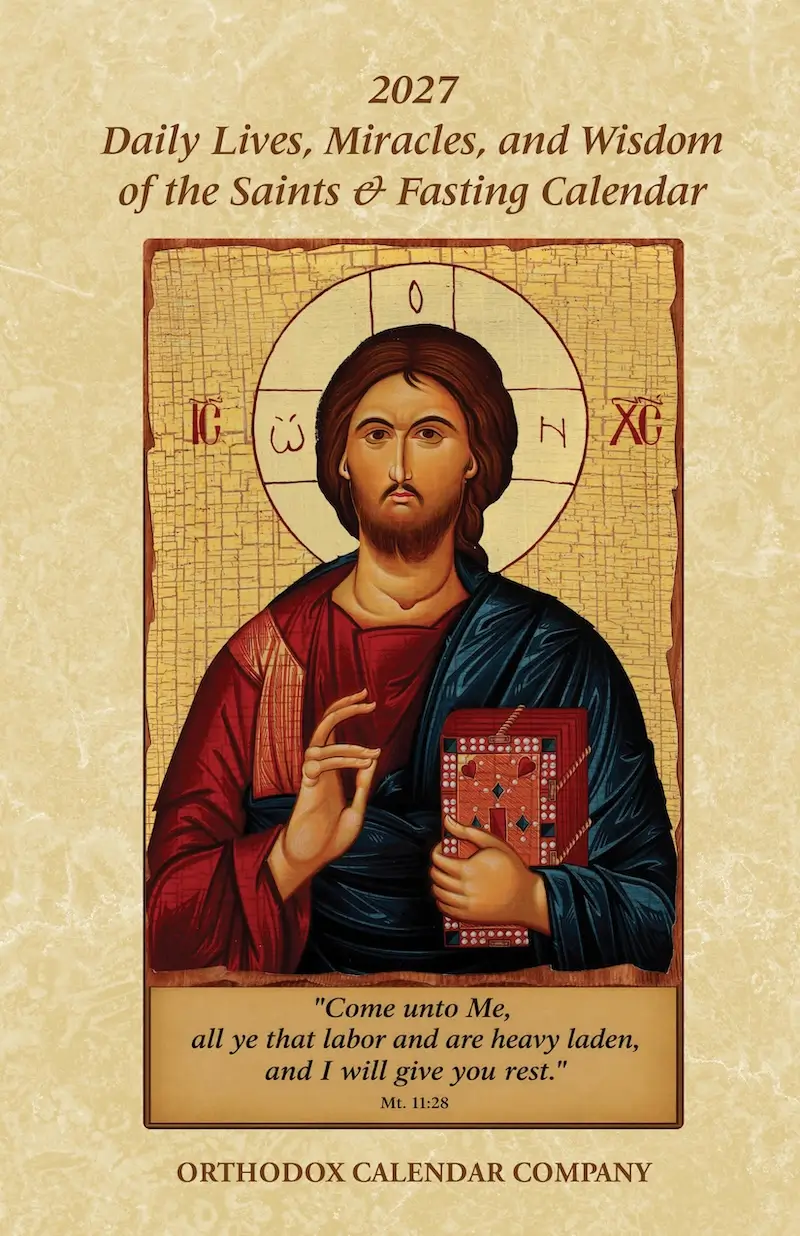
Hand-finished icons, books, and calendars to carry the Orthodox day into your home.

Read a life like this
every morning.
Meet the daily saints through Orthodox Daily Companion on iPhone and iPad, or through the Lives of the Saints web app in any modern browser.
Orthodox Daily Companion
The native Apple app, with a Home Screen widget, prayer reminders, and a private on-device journal.
Download on the App StoreLives of the Saints Web App
The browser experience for desktop, tablet, or phone, with a seven-day trial of the complete devotional library.
Open the web appGet a life like this one on every new tab - free, no account, from the same catalogue.
References and further reading
- en.wikipedia.orghttps://en.wikipedia.org/wiki/John_the_Apostle
- orthodoxwiki.orghttps://orthodoxwiki.org/Apostle_John
- oca.orghttps://www.oca.org/saints/lives/2025/05/08/101327-apostle-and-evangelist-john-the-theologian
- oca.orghttps://www.oca.org/saints/lives/2025/09/26/102731-repose-of-the-holy-apostle-and-evangelist-john-the-theologian
- goarch.orghttps://www.goarch.org/-/feast-of-the-holy-and-glorious-apostle-and-evangelist-john-the-theologian
- britannica.comhttps://www.britannica.com/biography/Saint-John-the-Apostle
- lychnos.orghttps://lychnos.org/saints-and-feasts/may08-saint-john-the-theologian/
- saintandrewgoc.orghttps://saintandrewgoc.org/blog/2020/5/12/may-8-saint-john-the-theologian
- athoniteusa.comhttps://www.athoniteusa.com/products/saint-john-theologian
- en.wikipedia.orghttps://en.wikipedia.org/wiki/Basilica_of_St._John
- diu.eduhttps://www.diu.edu/diu-today/program-spotlights/how-do-we-know-the-apostle-john-ministered-in-ephesus/
- russianicon.comhttps://russianicon.com/the-eastern-orthodox-icon-of-john-the-theologian/
- stbasil.comhttps://www.stbasil.com/news/2020/9/25/saint-john-the-theologian-apostle-evangelist-and-revelator
- russianicons.wordpress.comhttps://russianicons.wordpress.com/tag/john-the-theologian/
- christianheritagefellowship.comhttps://christianheritagefellowship.com/remembering-the-life-and-ministry-of-st-john/
- catholicfaith.churchhttps://www.catholicfaith.church/2025/12/saint-john-apostle-and-evangelist.html
- newadvent.orghttps://www.newadvent.org/cathen/08492a.htm
- mycatholic.lifehttps://mycatholic.life/saints/saints-of-the-liturgical-year/27-december-saint-john-the-apostle-and-evangelist-feast/
- marayam.comhttps://marayam.com/saint-johns-association-with-ephesus
- episcopalchurch.orghttps://www.episcopalchurch.org/lectionary/saint-john/
More from the tradition.
Read the Journal
Essays on feasts, fasting, and the rhythm of the Church year.
ExploreOrthodox countries
How the faith is lived and kept across the Christian world.
ExploreThe 2027 Calendar
A saint, a reading, and the day's fasting guideline for every day of 2027.
ExploreMobile & web apps
Carry the daily rhythm on iPhone and iPad or continue in the web app.
Explore