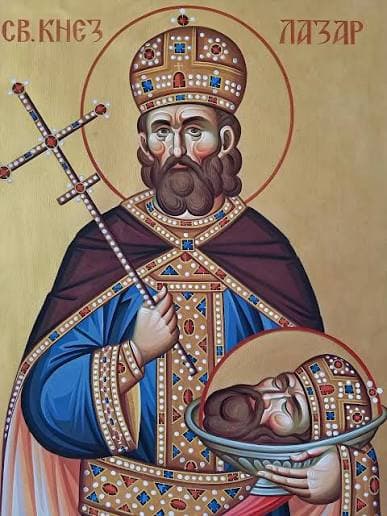
Saint Great-Martyr Lazarus
of Serbia.
Also known as Prince Lazar of Serbia, Holy King Lazar, Lazar Hrebeljanović, Tsar Lazar, Lazar of Kosovo, Saint Lazar the Great Martyr, Knez Lazar, Lazarus
Serbian prince and national hero who ruled Moravian Serbia from 1371 to 1389, choosing eternal faith over earthly compromise at the Battle of Kosovo, and venerated as a great martyr for his dedication to Christ and his people.
Tone 1
Longing for the beauty of God's glory,
you were found pleasing to Him while yet in the flesh
and by good deeds multiplied the talents entrusted to you.
Having suffered greatly, even to the shedding of your blood,
you received the crown of martyrdom from Christ.
By your prayers, O Lazar, entreat Him to save us who sing to you.
Your flock glorifies you as a valiant champion of true piety
and a glorious martyr, O most wise Lazar.
Since you have boldness before Christ our God,
entreat Him to grant peace to those who praise you,
that we may cry: "Rejoice, O praise-worthy Lazar!"
A Prince
Who Chose Heaven Over Earth
Saint Lazar Hrebeljanović was a medieval Serbian prince and ruler of Moravian Serbia who is venerated in the Eastern Orthodox Church as a martyr saint and national hero. Born around 1329 to an aristocratic family, he rose to prominence as the strongest lord in fragmented Serbia and ruled as de facto king from 1371 until his death. He is remembered for his choice to die as a martyr at the Battle of Kosovo in 1389 rather than submit to Ottoman suzerainty, choosing - according to Orthodox tradition - the eternal heavenly kingdom over earthly compromise. His incorrupt relics and the early cult surrounding his martyrdom made him the first layperson canonized as a saint in the Serbian Church.
Early years
Lazar was born in Prilepac, which is near Novo Brdo, in 1329, the son of the imperial chancellor Pribac Hrebeljanović. He was educated at Emperor Dušan's court in Prizren. Young Lazar gained the confidence of the Serbian emperor and was appointed to positions of responsibility during the reign of Stefan Dušan, the most powerful Serbian ruler of the medieval period.
He was later granted the high title knez ("prince" in Serbian) by Dušan's successor St. Emperor Stefan Uroš V. Despite his imperial title, Uroš was a weak and ineffectual leader, allowing local nobles to gain power and influence at the expense of the central authority. Lazar remained a loyal vassal to Stefan Uros V. During his lifetime, he had achieved considerable prestige as the major lord on the territory of the former Serbian Empire. The Church saw him as the only ruler worthy and capable of succeeding the Nemanjićs and restoring their state.
Lazar married Milica (Venerable Euphrosine of Serbia) around 1353. Milica was a relative of Emperor Dušan. The marriage strengthened Lazar's legitimacy by connecting him to the Nemanjić dynasty. They had seven children together, including his successor Stefan Lazarević.
In the Church
In the year 1371 he was chosen King of all Serbia and he toiled much at strengthening the condition of the country. He pacified neighboring princes, who had wronged or plundered Serbian settlements. He was concerned also for the Christian enlightenment of the nation, he built churches, supported the monasteries and charitable establishments. Lazar became not only a political unifier but a great patron of Orthodox monasticism and ecclesiastical life.
A major achievement of Lazar's reign was reconciling the Serbian Church with Constantinople. He called, together with his son-in-law Đurađ Stracimirović, a synod that elected a new patriarch, Saint Ephraem. Lazar sent a delegation to Constantinople with the monk Isaiah to implore the patriarch to heal the Serbian-Constantinople Schism of 1352. In 1375, full communion between Peć and Constantinople was re-established in the Holy Archangels Monastery on the grave of Emperor Dušan. St. Lazar restored the monasteries of Hilandar on Mount Athos and Gornjak. He built Ravanica and Lazarica in Kruševac and was a benefactor of the Russian monastery of St. Pantaleon on Mt. Athos, as well as many other churches and monasteries.
Lazar is celebrated as a saint and martyr in ten cultic writings composed in Serbia between 1389 and 1420; nine of them could be dated closer to the former year than to the latter. These writings were the principal means of spreading the cult of Saint Lazar, and most of them were used in liturgy on his feast day.
Later years
In his final years, since the encounter at Pločnik in 1386, it was clear to Lazar that a decisive battle with the Ottomans was imminent. After he made peace with Sigismund, to avoid troubles on his northern borders, the prince secured military support from Vuk Branković and King Tvrtko. Prince Lazar knew that his chances against the Turkish aggressor were small and on the eve of the Battle of Kosovo he gathered his upper aristocracy and asked if they should fight for the Holy cross and Golden Freedom or surrender to their adversaries and live as slaves of the Muslims. They had to chose between the Heavenly Kingdom and earthly one. In the true spirit of Christianity they preferred to place their hope in Christ and Eternal Life.
The Battle of Kosovo, the most famous battle in Serbia's medieval history, was fought on 15 June 1389. In the fierce fighting and mutual heavy losses, both Prince Lazar and Sultan Murad lost their lives. Lazar is killed during battle, Sultan Murad was assassinated after the battle by Serbian nobleman later identified as Miloš Obilić(or Kobilić), pretended to have deserted to the Ottoman forces. Lazar, all in wounds, was taken captive and led to Beyazit. The latter ordered him to be beheaded.
After the Battle of Kosovo, Prince Lazar was interred in the Church of the Ascension in Priština, the capital of Vuk Branković's domain. After a year or two, in 1390 or 1391, Lazar's relics were transferred to the Ravanica Monastery, which the prince had built and intended as his burial place. The translation was organized by the Serbian Church and Lazar's family. The ceremonial interment of the relics in Ravanica was attended by the highest clergy of the Serbian Church, including Patriarch Danilo III. It is most likely at this time and place that Lazar was canonized, though no account of his canonization was written.
Legacy and veneration
The authors of the cultic writings interpreted the death of Lazar and the thousands of his warriors on the Kosovo Field as a martyrdom for the Christian faith and for Serbia. Sultan Murad and his army are described as bloodthirsty, godless, heathen beasts. Prince Lazar, by his martyrdom, remains eternally among the Serbs as the good shepherd. His cult was adjoined to the other great cults of medieval Serbia, those of the first canonized Nemanjićs - Saint Simeon (whose secular name was Nemanja) and his son Saint Sava.
In this period they started to use printing to spread the veneration of the Holy Prince: they made a woodcut representing Lazar as a cephalophore, holding his severed head in his hand. Arsenije IV Šakabenta, Metropolitan of Karlovci, employed in 1741 the engravers Hristofor Žefarović and Toma Mesmer to create a poster titled "Saint Sava with Serbian Saints of the House of Nemanja", where Lazar was also depicted. Its purpose was not only religious, as it should also remind people of the independent Serbian state before the Ottoman conquest, and of Prince Lazar's fight against the Ottomans.
After nearly three centuries the relics of Saint Prince Lazar on 9th September 1989 were placed back in its endowment, Ravanica Monastery, where they now stand. It rests there today incorrupt and extends comfort and healing to all those who turn to him with prayer. Saint Lazar remains a supreme example of Orthodox Christian faithfulness and the principle of "everything for Christ," inspiring countless Serbian believers across the centuries and representing the continuity of Orthodox faith amid trials.
How the saint's
memory is kept.
- When did Saint Lazar die and what is his feast day?
- Saint Lazar fell at the Battle of Kosovo on June 15, 1389, and was beheaded on the orders of Sultan Bayazet. The Eastern Orthodox Church commemorates him on June 15 (old calendar June 28, known as Vidovdan or St. Vitus Day). This date has become a major feast day and national holiday for Serbian Orthodox Christians and Serbian people generally.
- What is the Kosovo Choice?
- According to Serbian Orthodox tradition, on the night before the Battle of Kosovo, an angel of God appeared to Prince Lazar and offered him a choice: he could win an earthly kingdom by defeating the Ottomans through military victory, or he could accept a heavenly kingdom by sacrificing himself and his army in martyrdom. Lazar chose the eternal heavenly kingdom, and with this decision he led his forces into battle knowing they would be defeated, but accepting martyrdom for Christ and the Orthodox faith.
- Where are the relics of Saint Lazar today?
- The relics of Saint Lazar were returned to the Ravanica Monastery near Ćuprija, Serbia in 1989, on the 600th anniversary of his martyrdom. They are preserved there incorrupt and venerated by pilgrims. The monastery, which Lazar himself founded, remains a major pilgrimage site and center of his veneration in the Orthodox Church.
- Why is Saint Lazar called the Great Martyr?
- Saint Lazar is called a great martyr because he was killed by the Ottoman Turks for the Christian faith at the Battle of Kosovo in 1389. According to Orthodox tradition, after his capture he was beheaded by Sultan Bayazet's forces. His death is understood as a martyrdom on behalf of Christ and Orthodox Christianity, and his body was found incorrupt, a sign of his sanctity and martyrdom recognized by the Serbian Church.
- What did Saint Lazar accomplish during his reign?
- Saint Lazar ruled Moravian Serbia from 1371 to 1389 and unified the fragmented Serbian lands into the most powerful Christian state in the Balkans at that time. He was the first layperson canonized as a saint in the Serbian Orthodox Church. He built and restored many churches and monasteries including Ravanica and Lazarica, and he reconciled the Serbian Church with Constantinople, restoring full communion that had been broken since 1352.
- What is Saint Lazar's significance to Serbian Orthodox Christians?
- Saint Lazar is one of the most important saints in Serbian Orthodox Christianity and Serbian national identity. He is venerated as the supreme example of choosing eternal faith over earthly compromise, and his feast day, Vidovdan (June 28), is both a major religious observance and a national holiday in Serbia. Serbian Orthodox churches worldwide bear his name, and his memory has inspired Serbian identity and resistance for six centuries.
- Is Saint Lazar recognized as a saint by the Eastern Orthodox Church?
- Yes, Saint Lazar was canonized as a saint by the Serbian Orthodox Church shortly after his death in 1389, though no formal written account of his canonization survives. He is venerated throughout the Eastern Orthodox communion, particularly by Serbian Orthodox communities. He is called a 'great martyr' and is included in the liturgical calendar of the Serbian Orthodox Church, with his feast celebrated on June 15 (Gregorian calendar).
Tone 2
In truth you were revealed to your flock as a rule of faith,
an image of humility and a teacher of abstinence;
your humility exalted you;
your poverty enriched you.
Therefore, as one who has boldness before Christ our God,
O holy Lazar, entreat Him on behalf of us all,
that our souls may be saved.
O holy great martyr and glorious prince Lazar, thou chosen vessel of Christ and pillar of the Orthodox faith, look upon us in our affliction and hear our fervent prayers. Thou didst choose the heavenly kingdom over earthly glory and didst seal thy faith with thy precious blood. Intercede for us before the throne of our Lord Jesus Christ, that we too may learn to prefer the eternal treasures of Heaven to the fleeting riches of this world. Strengthen us in times of trial, guide us in times of confusion, and grant us the grace to remain steadfast in our Orthodox faith unto the end, that together with thee we may glorify the Holy Trinity for ever and ever. Amen.
Carry the tradition with you.
Hand-finished icons, books, and calendars to carry the Orthodox day into your home.
Read a life like this
every morning.
Meet the daily saints through Orthodox Daily Companion on iPhone and iPad, or through the Lives of the Saints web app in any modern browser.
Orthodox Daily Companion
The native Apple app, with a Home Screen widget, prayer reminders, and a private on-device journal.
Download on the App StoreLives of the Saints Web App
The browser experience for desktop, tablet, or phone, with a seven-day trial of the complete devotional library.
Open the web appGet a life like this one on every new tab - free, no account, from the same catalogue.
References and further reading
- en.wikipedia.orghttps://en.wikipedia.org/wiki/Lazar_of_Serbia
- orthodoxwiki.orghttps://orthodoxwiki.org/Lazar_of_Serbia
- oca.orghttps://www.oca.org/saints/lives/2016/06/15/101734-right-believing-prince-lazarus-the-great-martyr-of-serbia
- oca.orghttps://www.oca.org/saints/troparia/2007/06/15/101734-right-believing-prince-lazarus-the-great-martyr-of-serbia
- arhiva.spc.rshttp://arhiva.spc.rs/eng/saint_lazar_great_martyr_kosovo_1.html
- royalfamily.orghttps://royalfamily.org/about-serbia/prince-lazar-hrebeljanovic/
- sesdiva.euhttps://sesdiva.eu/en/virtual-rooms/popular-saints/item/65-prince-lazar-hrebeljanovic-en
- en.ravanica.rshttps://en.ravanica.rs/about-monastery/relics-holy-prince-lazar/
- serbia.comhttps://serbia.com/ravanica-monastery-the-resting-place-of-prince-lazar/
- en.ravanica.rshttps://en.ravanica.rs/
- en.wikipedia.orghttps://en.wikipedia.org/wiki/Ravanica
- en.ravanica.rshttps://en.ravanica.rs/about-monastery/history/
- orthochristian.comhttps://orthochristian.com/132195.html
- obitel-minsk.orghttps://obitel-minsk.org/en/kosovos-hero-tsar-lazar-choosing-faith-over-throne
- religionunplugged.comhttps://religionunplugged.com/news/2024/6/26/st-vitus-day-why-the-saints-feast-is-so-important-to-orthodox-christians
- global-politics.euhttp://global-politics.eu/kosovos-great-martyr/
- sainthermanmonastery.comhttps://www.sainthermanmonastery.com/product-p/tsl.htm
- en-academic.comhttps://en-academic.com/dic.nsf/enwiki/193679
- grokipedia.comhttps://grokipedia.com/page/Lazar_of_Serbia
- military-history.fandom.comhttps://military-history.fandom.com/wiki/Lazar_of_Serbia
More from the tradition.
Read the Journal
Essays on feasts, fasting, and the rhythm of the Church year.
ExploreOrthodox countries
How the faith is lived and kept across the Christian world.
ExploreThe 2027 Calendar
A saint, a reading, and the day's fasting guideline for every day of 2027.
ExploreMobile & web apps
Carry the daily rhythm on iPhone and iPad or continue in the web app.
Explore