Egypt.
Egypt is the historic seat of the Greek Orthodox Patriarchate of Alexandria and All Africa, one of the ancient patriarchates of the Pentarchy, though today Eastern Orthodox faithful form a small minority in the country.
Orthodoxy in
Egypt.
A living tradition — its history, its faithful, its sacred places.
Eastern Orthodox Christianity in Egypt
Egypt is the historic heartland of one of the most venerable sees in Christendom: the Greek Orthodox Patriarchate of Alexandria and All Africa. According to ancient tradition, the Church of Alexandria was founded by Saint Mark the Evangelist, who preached in the city in the mid-first century and is honored as its first bishop and martyr.
For centuries Alexandria ranked alongside Rome, Antioch, Constantinople, and Jerusalem as one of the five ancient patriarchates of the early Church — the Pentarchy. Following the Council of Chalcedon in 451, a lasting division emerged in Egypt between those who accepted the council's definition of the two natures of Christ and those who did not. The Eastern Orthodox (Chalcedonian) line of patriarchs continued through the Greek-speaking “Melchite” community, while the majority of native Egyptian Christians formed what is today the separate Coptic Orthodox Church, which is not in communion with the Eastern Orthodox world.
From Byzantine Egypt to the Ottoman and Modern Periods
After the Arab conquest of Egypt in the seventh century, the Greek Orthodox community shrank dramatically and lived for centuries as a small, tolerated minority. A significant revival came in the nineteenth century, when Egyptian prosperity under Muhammad Ali and his successors drew tens of thousands of Greeks, Syrians, and other Orthodox Christians to Alexandria, Cairo, and cities along the Suez Canal, rapidly enlarging the Greek Orthodox Church in Egypt.
Under the long reign of Patriarch Photios (1900–1925), the Patriarchate consolidated its independence, expanded its hierarchy, and began a deliberate missionary outreach to sub-Saharan Africa. In the first half of the twentieth century, the Patriarchate formally extended its canonical territory to the entire African continent, and today its official title is the Greek Orthodox Patriarchate of Alexandria and All Africa.
Jurisdiction and Present Situation
The Patriarchate is an autocephalous Eastern Orthodox Church in communion with the Ecumenical Patriarchate of Constantinople and the other canonical Orthodox Churches. Its primate bears the ancient titles Pope and Patriarch of Alexandria and All Africa; the current incumbent is His Beatitude Theodoros (Theodore) II, elected in 2004.
Within Egypt itself, the Eastern Orthodox faithful are concentrated in Alexandria, Cairo, Port Said, Ismailia, and Suez, where historic parishes continue to serve a much-reduced community. The emigration of most of the Greek population in the 1950s and 1960s, following the Nasser-era nationalizations, sharply diminished the flock; membership in Egypt was estimated at about 110,000 in 1980 and has continued to decline. Alongside the Patriarchate of Alexandria, the Autonomous Church of Sinai — centered on the ancient Monastery of Saint Catherine at the foot of Mount Sinai — also forms part of the Eastern Orthodox presence on Egyptian soil.
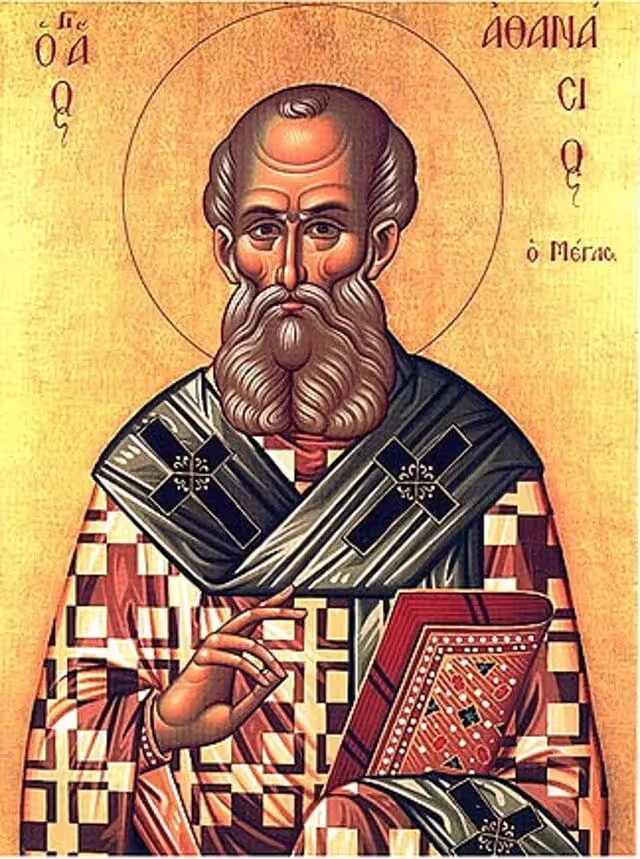
Despite its small numbers, the Patriarchate of Alexandria retains immense historical and theological significance as the see of Saints Athanasius the Great, Cyril of Alexandria, and countless desert fathers whose witness shaped the faith of the whole Orthodox world.
Saints of
Egypt.
2 venerated souls with ties to this land — fathers and mothers of the faith who are remembered here still.
.avif&w=3840&q=75)
Famous Orthodox churches and monasteries in Egypt
The sacred architecture of Orthodox Egypt — cathedrals, parishes, and the mountain monasteries that keep the lamps burning.
- Cathedral of the Annunciation (Evangelismos), Alexandria — The patriarchal cathedral and seat of the Pope and Patriarch of Alexandria. The foundation stone of this three-aisled basilica was laid in 1847, and it remains the principal church of the Patriarchate.
- Patriarchal Monastery of Saint Savvas the Sanctified, Alexandria — The principal monastic institution of the Church of Alexandria, housing the patriarchal offices. It traces its origins to the fourth century and stands on a site of earlier pre-Christian religious significance.
- Patriarchal Cathedral of Saint Nicholas, Cairo — The cathedral of the Archdiocese of Memphis (Cairo), serving the Orthodox faithful of the Egyptian capital. Located in the historic grounds of the Arab-speaking Greek Orthodox community of Cairo, with origins in the seventeenth century.
- Church of Saint George, Cairo (Mar Girgis) — A historic Greek Orthodox church in Old Cairo; adjacent to it is the Museum of the Greek Orthodox Patriarchate of Alexandria, which houses icons and ecclesiastical treasures, and the church itself incorporates an ancient Nilometer.
- Saint Catherine's Monastery, Mount Sinai — A Greek Orthodox monastery built in the sixth century under the Emperor Justinian at the traditional site of the Burning Bush. Dedicated to the Transfiguration (and popularly to Saint Catherine the Great Martyr), it is the center of the autonomous Church of Sinai and a UNESCO World Heritage Site.
Orthodoxy
kept here.
The shape of the faith as it is lived and prayed across Egypt today.
Eastern Orthodoxy in Egypt is embodied almost entirely by the Greek Orthodox Patriarchate of Alexandria and All Africa, an autocephalous church of apostolic foundation. Services are traditionally celebrated in Koine Greek, though Arabic is increasingly used in parishes serving Arabic-speaking faithful, and certain parishes of the Patriarchate elsewhere in Africa worship in local languages. The liturgical tradition follows the Byzantine rite shared by all Eastern Orthodox Churches.
The community in Egypt is numerically small but institutionally important: the Patriarchate maintains its seat at the Cathedral of the Annunciation (Evangelismos) in Alexandria, with administrative offices at the Patriarchal Monastery of Saint Savvas the Sanctified in the same city. A second major center is Cairo, where the Patriarchal Cathedral of Saint Nicholas serves the faithful of the capital.
Relations with the Egyptian state are regulated under the broader framework governing Christian minorities. The Patriarchate coexists peacefully with the much larger Coptic Orthodox Church but the two are not in communion, since the Copts belong to the Oriental Orthodox family that did not accept the Council of Chalcedon. The Patriarchate of Alexandria is also the spiritual mother of a growing African Orthodox diaspora, with an expanding network of dioceses across sub-Saharan Africa.
In addition, the Autonomous Orthodox Church of Sinai, headed by the Archbishop of Sinai, Pharan and Raithu who is also abbot of Saint Catherine's Monastery, represents a distinctive self-governing Eastern Orthodox presence on Egyptian territory, historically linked to the Patriarchate of Jerusalem.
Asked
of this land.
Frequently asked questions about Orthodoxy in Egypt
Who leads the Eastern Orthodox Church in Egypt?
The Eastern Orthodox Church in Egypt is led by the Pope and Patriarch of Alexandria and All Africa, currently His Beatitude Theodoros II, whose seat is in Alexandria. He presides over an autocephalous church in communion with the Ecumenical Patriarchate of Constantinople and the other canonical Orthodox Churches.
Are the Coptic Orthodox and the Greek Orthodox of Alexandria the same church?
No. They share a common origin in the ancient Church of Alexandria founded by Saint Mark, but they divided after the Council of Chalcedon in 451. The Coptic Orthodox Church belongs to the Oriental Orthodox family, while the Greek Orthodox Patriarchate of Alexandria is part of the Eastern Orthodox (Chalcedonian) communion. The two are not in sacramental communion.
What language is used in Eastern Orthodox services in Egypt?
Services are traditionally celebrated in Greek, reflecting the Patriarchate's Byzantine heritage, with Arabic used increasingly in parishes that serve Arabic-speaking faithful.
How many Eastern Orthodox Christians live in Egypt?
Precise current figures are not publicly reported. Membership was estimated at about 110,000 in 1980 and has continued to decline since, following the large-scale emigration of the Greek community in the mid-twentieth century.
Is Saint Catherine's Monastery Eastern Orthodox?
Yes. Saint Catherine's Monastery on Mount Sinai is an Eastern Orthodox monastery and the spiritual and administrative center of the autonomous Church of Sinai. It has been continuously inhabited since the sixth century and is one of the oldest functioning Christian monasteries in the world.
What is the relationship between the Patriarchate of Alexandria and the rest of Africa?
The Patriarchate's canonical territory is the entire African continent. From its base in Egypt it oversees dozens of metropolises and dioceses across sub-Saharan Africa, where Eastern Orthodox mission work has grown substantially since the twentieth century.