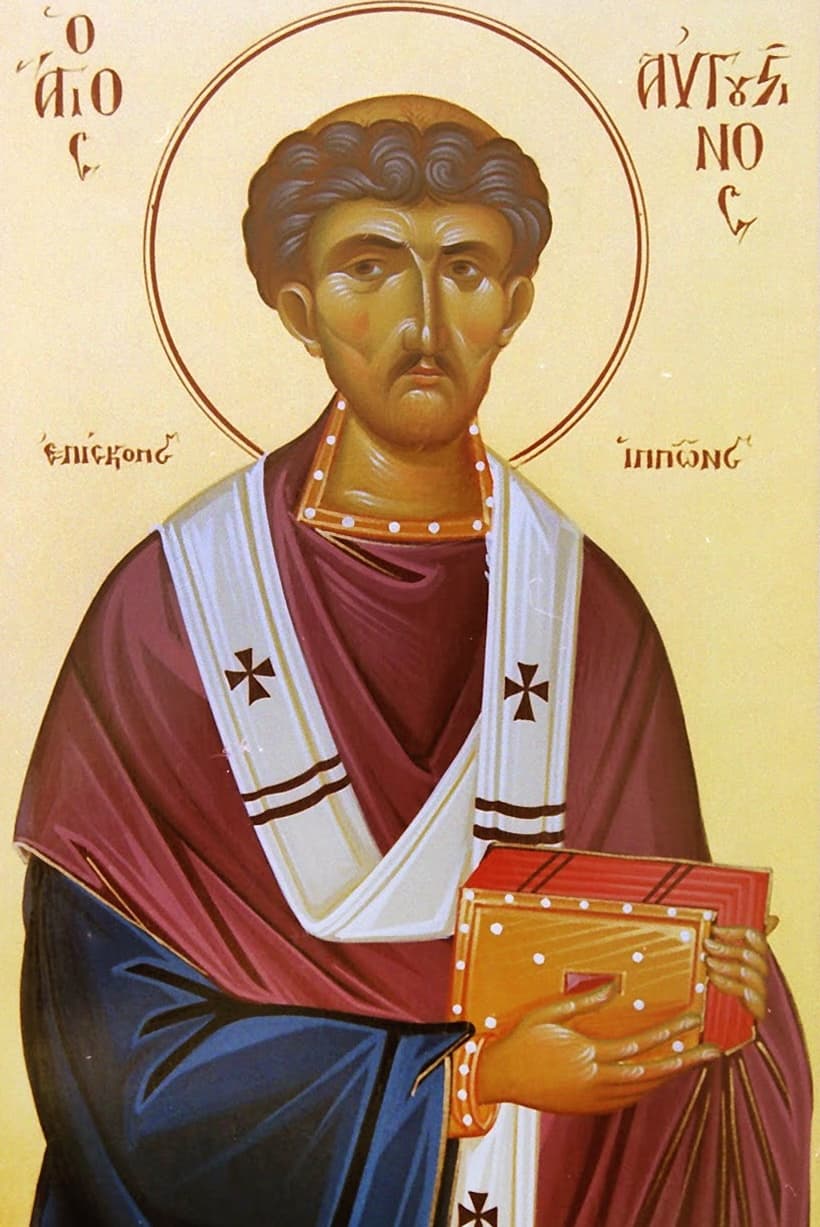
Saint Blessed Augustine, Bishop
of Hippo.
Also known as Saint Augustine of Hippo, Augustine of Hippo, Aurelius Augustine, Augustine the Blessed, Augustine the Doctor of Grace
Fourth–fifth-century North African bishop and theologian whose prolific writings shaped Christian thought; venerated in the Eastern Orthodox Church on June 15 as a defender of the Faith against heresies.
Tone 3
You received the light of Christ in your heart, / and being in this light, and illumining the faithful with light, / you burned the enemies with your wise writings; / O blessed Father Augustine, always intercede with Christ for all of us.
The Blessed
Augustine: Defender of the Faith and Doctor of Grace
Augustine of Hippo was a pivotal North African bishop whose conversion from sin and heresy transformed him into a tireless defender of Orthodox Christian teaching. His vast literary legacy - over one thousand works - defended the Faith against Donatism, Manichaeism, and Pelagianism, earning him veneration as a great Church Father and teacher. Though his theology is approached with pastoral rather than dogmatic emphasis in the Orthodox tradition, his confessional and devotional writings have long inspired the faithful.
Early years
Augustine was born in 354 in the municipium of Thagaste in the Roman province of Numidia. His mother, Monica or Monnica, was a devout Christian; his father Patricius was a pagan who converted to Christianity on his deathbed. He had a brother named Navigius and a sister whose name is lost but is conventionally remembered as Perpetua.
In his youth, Augustine pursued worldly ambitions. Upon Patrick's death in 370 CE, Augustine became a professor of rhetoric in Carthage. Joining some other intellectuals, he became interested in the Christian sect of the Manichaeans. At about the age of 15, Augustine began a relationship with a young woman in Carthage. Though his mother wanted him to marry a person of his class, the woman remained his lover. He was warned by his mother to avoid sex outside marriage. However, Augustine persisted in the relationship for over fifteen years. The woman gave birth to Augustine's son Adeodatus, which means "Gift from God".
When Augustine moved to Milan as a professor of rhetoric, his life took a decisive turn. Numerous significant experiences in Milan led up to the dramatic moment, beginning with the influence of the great Ambrose of Milan. Originally attending Ambrose's sermons to observe the preacher's celebrated oratorical skills, Augustine was unexpectedly influenced by the message itself. He discovered that Catholic Christianity could be reasonably defended, particularly against the Manichees, and that many of the troubling Old Testament passages could be interpreted allegorically.
In the Church
He returned to north Africa and created a monastic foundation at Tagaste for himself and a group of friends. In 391 he was ordained a priest in Hippo Regius (now Annaba, in Algeria). In the year 391 Valerian, Bishop of Hippo, ordained Saint Augustine a priest, and in 395, appointed him vicar bishop of the see of Hippo. After the death of Bishop Valerian, Saint Augustine took his place.
During his 35 years as bishop, Saint Augustine wrote many works devoted to combating the Donatist, Manichaean and Pelagian heresies. He became a famous preacher (more than 350 preserved sermons are believed to be authentic), and was noted for combatting the Manichaean heresy. His theological method combined rigorous dialectic with pastoral sensitivity, earning him renown across North Africa and the broader Church. "It is better," he said, "for them to condemn our grammar, than for people not to understand." Saint Augustine died on August 28, 430.
Later years
He wrote his autobiographical Confessions in 397–398. His work The City of God was written to console his fellow Christians shortly after the Visigoths had sacked Rome in 410. These masterworks established Augustine as a theologian of enduring influence across East and West.
By 430, the Vandals were laying siege to the city of Hippo. Augustine orchestrated the city's final defenses from his deathbed. As he weakened, his faithful scribes wrote out the Psalms in large letters for him to read. When he could no longer hold the pages, they pasted them to the walls. He died on 28 August 430. Shortly after his death, the Vandals lifted the siege of Hippo, but they returned soon after and burned the city. They destroyed all but Augustine's cathedral and library, which they left untouched.
Legacy and veneration
The Fifth Ecumenical Council, held in Constantinople in A.D. 553, listed Augustine among other Fathers of the Church, though there is no unqualified endorsement of his theology mentioned. In the acts of the Sixth Ecumenical Council (not yet translated into English), he is called the "most excellent and blessed Augustine" and is referred to as "the most wise teacher."
The famous and revered Bishop of Hippo, a pivotal figure in the history of North African Christianity, is commemorated in the Orthodox Church on June 15. He appears to have been added to the calendar in Russia during the "Western Captivity" when the influence of Latin scholasticism was at a high point. The celebrated theologian of the eighteenth century, Nikodemos the Hagiorite, included the name of Saint Augustine in the Synaxaristes (the book of the saints). He states the following: "In memory of our father among the saints, Augustine, Bishop of Hippo." And he includes two verses as follows: "You were enflamed by the love of God, you demonstrated to be all splendid, blessed Augustine."
In Orthodox tradition, Augustine is approached with theological reserve regarding certain aspects of his thought - particularly his teachings on predestination and grace - yet honored for his monumental defense of orthodox teaching against heresies and his confessional and devotional contributions to the spiritual treasury of the Church.
How the saint's
memory is kept.
- When is the feast day of Blessed Augustine in the Orthodox Church?
- June 15 (New Calendar). The Western Church commemorates him on August 28, the date of his death.
- Where was Augustine born and what was his family background?
- Augustine was born in Thagaste (modern Souk Ahras, Algeria) in Numidia in 354. His mother, Monica, was a devout Christian, and his father, Patricius, was a pagan who converted to Christianity before his death. Augustine's family was Berber but heavily Romanized.
- What major heresies did Augustine combat during his episcopate?
- During his 35 years as bishop of Hippo, Augustine defended orthodox Christianity against Donatism, Manichaeism, and Pelagianism - three major heresies threatening the North African Church.
- What are Augustine's most famous works?
- Augustine's best-known works are the Confessions (his spiritual autobiography), the City of God (written after Rome's fall), works against the Pelagians, and the Enchiridion (Handbook of Christian Knowledge). His writings numbered approximately 1,030 compositions.
- How is Blessed Augustine regarded in Orthodox theology?
- Augustine is venerated in Orthodoxy as a great Church Father and defender of the Faith. The Fifth and Sixth Ecumenical Councils mentioned him favorably. However, Orthodox theology approaches certain aspects of his thought - particularly on predestination and grace - with reserve, preferring his confessional and devotional contributions.
- Where are Augustine's relics today?
- Augustine's relics are housed in the Basilica of San Pietro in Ciel d'Oro in Pavia, Italy, in a marble reliquary. In 1842, a portion of his right arm was returned to Annaba (ancient Hippo) in Algeria.
Tone 2
Let us praise the great Augustine, / a divine Hierarch of Christ's Church and a wise guide; / a renowned theologian of the city on high, / a lover of prayer, and a pillar of repentance; / "Intercede with the Lord, that He may have mercy on our souls."
From the Orthodox Synaxarion and service traditions:
O holy hierarch, father Augustine, even though the land of Hippo hath fallen silent, yet do we glorify thee as the uprooter of heresies, the confirmation of the Orthodox Faith, the great boast of monastics, the adornment of hierarchs, the lover of poverty, the elucidator of the Scriptures, and as our fervent intercessor. Pray thou that we be granted great mercy.
Carry the tradition with you.
Hand-finished icons, books, and calendars to carry the Orthodox day into your home.

Read a life like this
every morning.
Meet the daily saints through Orthodox Daily Companion on iPhone and iPad, or through the Lives of the Saints web app in any modern browser.
Orthodox Daily Companion
The native Apple app, with a Home Screen widget, prayer reminders, and a private on-device journal.
Download on the App StoreLives of the Saints Web App
The browser experience for desktop, tablet, or phone, with a seven-day trial of the complete devotional library.
Open the web appGet a life like this one on every new tab - free, no account, from the same catalogue.
References and further reading
- orthodoxwiki.orghttps://orthodoxwiki.org/Augustine_of_Hippo
- oca.orghttps://www.oca.org/saints/lives/2025/06/15/101736-blessed-augustine-bishop-of-hippo
- goarch.orghttps://www.goarch.org/-/photios-shrine-augustine-of-hippo
- myrrh-bearers.orghttps://myrrh-bearers.org/english/june/M06-15-Augustine.html
- faculty.georgetown.eduhttps://faculty.georgetown.edu/jod/augustine/bless_aug.htm
- en.wikipedia.orghttps://en.wikipedia.org/wiki/Augustine_of_Hippo
- oca.orghttps://www.oca.org/saints/troparia/0203/06/15/101736-blessed-augustine-bishop-of-hippo
- en.wikipedia.orghttps://en.wikipedia.org/wiki/San_Pietro_in_Ciel_d_Oro
- worldhistory.orghttps://www.worldhistory.org/Augustine_of_Hippo/
- goarch.orghttps://www.goarch.org/-/saint-augustine-greek-orthodox-tradition
- oca.orghttps://www.oca.org/questions/teaching/st.-augustine-original-sin1
- now.fordham.eduhttps://now.fordham.edu/event/augustine-and-the-orthodox-the-west-in-the-east/
- johnsanidopoulos.comhttps://www.johnsanidopoulos.com/2017/06/synaxarion-of-saint-augustine-of-hippo.html
- historyatlas.comhttps://www.historyatlas.com/people/augustine-of-hippo/
- catholicireland.nethttps://www.catholicireland.net/saintoftheday/st-augustine-of-hippo-354-430-bishop-and-doctor-of-the-church/
- agustinosrecoletos.orghttps://agustinosrecoletos.org/2022/07/a-biografia-de-agustin-de-hipona/?lang=en
- findthesaint.comhttps://findthesaint.com/saints/saint-augustine-of-hippo/
- justus.anglican.orghttp://justus.anglican.org/resources/bio/50.html
- tabletalkmagazine.comhttps://tabletalkmagazine.com/article/2024/02/augustine-of-hippo-a-life/
- staugustinecleveland.orghttps://www.staugustinecleveland.org/st-augustine-of-hippo-biography
More from the tradition.
Read the Journal
Essays on feasts, fasting, and the rhythm of the Church year.
ExploreOrthodox countries
How the faith is lived and kept across the Christian world.
ExploreThe 2027 Calendar
A saint, a reading, and the day's fasting guideline for every day of 2027.
ExploreMobile & web apps
Carry the daily rhythm on iPhone and iPad or continue in the web app.
Explore